Evaluatory Data Analysis: Lec 1-11
 Call Kai
 Learn
Learn Practice Test
 Spaced Repetition
 Match
Match Flashcards
 Knowt Play
1/25

There's no tags or description
Looks like no tags are added yet.
Name | Mastery | Learn | Test | Matching | Spaced | Call with Kai | Chat |
|---|
No analytics yet
Send a link to your students to track their progress
26 Terms
Population or universe
Refers to the group of all items we are studying and have to draw conclusions or inferences from
it is a technical term and does not just refer to people but the group of people or objects for which the results of statistical enquiry apply
Sample
refers to the collection of some but not all units of a population
it is a subset of population containing the same characteristics
It is selected to represent the population in a research study.
The goal is to use the results obtained from the sample to help answer questions about the population.
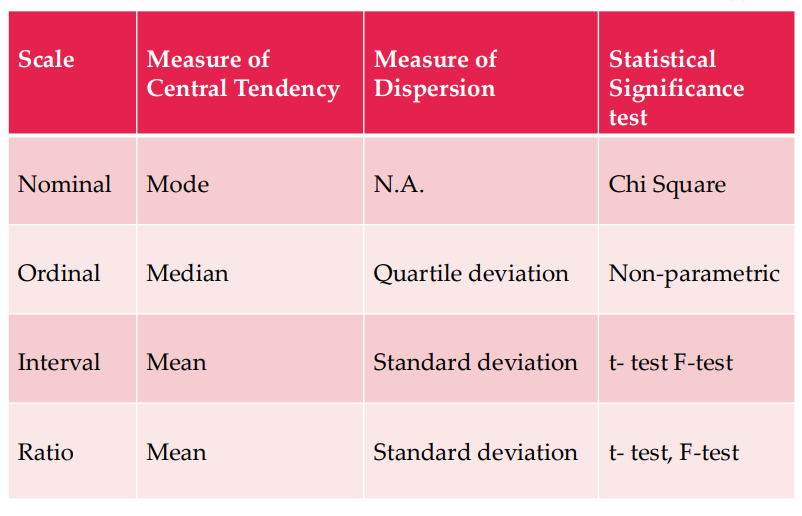
Nominal Scale
A nominal scale allows to classify the observations on a characteristic into different categories
We cannot quantify or even rank order these categories
The characteristic measured on nominal scale generates categorical data
Example: Data on gender, race, colour, city, etc.
Ordinal Scale
also classifies the observations on a characteristic into different classes but these classes are ordered on some continuum.
This scale allows us to rank the items according to the classes but the differences between the adjacent ranks may not be equal.
Example: Socio-economic status of families – Upper Class, Middle Class and Lower Class
Interval scale
Some scales in behavioural sciences are measurements of physical variables such as temperatures, time or pressure.
Interval variables allow us not only to rank order the items that are measured but also to quantify and capture the sizes of differences between them.
There is no true zero (or no absolute zero)
The Fahrenheit scale is an example of interval scale.
No inherent starting point and ratios are meaningless
Ratio Scale
features an identifiable absolute zero point
It is an interval scale where a value of zero indicates none of the variable.
Ratio measurements identify the direction and magnitude of differences and allow ratio comparisons of measurements.
Most statistical data analysis procedures do not distinguish between the interval and ratio properties of the measurement scales.
In ratio scale, both diff and ratios are meaningful
There is constant (equal) size interval between any adjacent units on the measurement scale
True Zero Point.
Example: weight, height or distance
STATISTICAL ANALYSIS FOR TYPES OF MEASUREMENT SCALES
Data
• The measurements obtained in a research study are called the data.
• The goal of statistics is to help researchers organize and interpret the data.
COLLECTION OF DATA
• Primary data is data collected primarily for the purpose of the given Enquiry. They are original in character and are raw materials of the enquiry.
• Secondary data are data already collected by someone for some purpose and are available for the present study.
Examples: the data collected during census operations are primary data to the department of census and the same data, if utilized by a researcher for some study, are secondary data for him
PRIMARY DATA
✓Direct personal observation
✓Indirect oral investigation
✓Data through mailed questionnaires / Online data collection
✓Information through agencies
✓Investigation through enumerators
DIRECT PERSONAL OBSERVATION
Meaning: The investigator collects the data personally by asking or cross-examining the informant in a tactful and courteous manner.
When adopted: This method is adopted when intensive or in-depth study is essential and greater accuracy is needed.
Advantage – Accuracy: gives reliable and accurate information as response will be encouraging because of personal touch. – Uniformity: Uniformity and homogeneity of data can be maintained.
Disadvantages: is expensive and time consuming, chances of personal prejudices/bias creeping into the investigation are more.
INDIRECT ORAL INVESTIGATION
Indirect Oral Investigation
When used: This method is used when the informant is reluctant to supply information.
Method: The investigator approaches witnesses or third parties who are in touch with the informant.
Uses: This method is generally adopted by Government agencies for their enquiry committees or commissions and in cases of thefts, murders, riots etc.
Advantages: This method is simple and convenient, and adequate information can be obtained if information is collected from different parties.
Disadvantages: Absence of direct contact can mar the reliability of the information. Also, witnesses may colour the information to suit their interests.
3. A. DATA THROUGH MAILED QUESTIONNAIRES
Data Through Mailed Questionnaires
Method: Data is collected through a questionnaire consisting of a list of questions pertaining to the enquiry, which is posted to the respondents.
Use: This method is followed by research workers, private individuals, non-official agencies and Government agencies.
Advantages: The mailed questionnaire method is the most economical and there is a saving of time and labour. It is suitable when the area of the survey is large.
Accuracy: Since information is obtained directly from respondents, error in the investigation is small.
Disadvantages: Since there is no direct contact between investigator and respondent, one cannot be sure about the accuracy and reliability of the data. Some people may not reply, leading to non-response or delayed response.
3. B. DATA THROUGH ONLINE METHODS
Data Through Online Methods
Method: Data is collected through a form consisting of a list of questions pertaining to the enquiry through an online method using internet.
Procedure: This form is posted to the respondents, who are expected to answer the questions or write the answers in the blank spaces.
Response: A covering message is also sent along with the questionnaire requesting full co-operation and prompt reply from the respondents.
Methods used: The methods used are Google Form, Microsoft Form, Computer-assisted telephone interviewing (CATI) etc.
4. INFORMATION THROUGH AGENCIES
Information Through Agencies
Method: The investigator appoints agents or correspondents to collect data. These agents collect the information and transfer it to the investigator.
Use: This method is usually followed by news agencies where information is needed in different fields like politics, sports, natural and man-made calamities etc.
When adopted: This method is adopted where information is required from a wide area on a regular basis.
Advantages: This method gives extensive information in a speedy and economical way.
Disadvantages: It may be biased and the requisite degree of accuracy and uniformity cannot be maintained.
5. DATA THROUGH SCHEDULES OR INVESTIGATIONS THROUGH ENUMERATORS
Data Through Schedules / Investigations Through Enumerators
Use: This method is generally employed by the Government for population census etc.
Method: Several enumerators are selected and trained. They are then armed with standardised questionnaires and sent to informants to get first-hand information.
When adopted: This method is adopted when one requires reliable and accurate information from all types of people (literate and illiterate).
Advantage: It provides first-hand information from informants.
Disadvantages: This data collection exercise may be costly and time consuming and depends on the efficiency of the enumerators.
SECONDARY DATA
Secondary data are those bits of information which have been already collected by some other agency for its own use.
Secondary data are like finished products as they are already processed Primary data lose their original form when they are statistically processed and become secondary data for the user.
However, the investigator must be very cautious while using secondary data as: i) It might have been influenced by personal prejudices of the original investigator ii) The method of collection may not be proper iii) The degree of accuracy may not be sufficient for the present inquiry.
Secondary data is available through ✓ Published sources ✓ Unpublished sources
PUBLISHED SOURCES
Various governmental, international and local agencies publish statistical data. The chief among them are
Reports of international agencies like International Monetary Fund (I.M.F.)
United Nations Organisation (UNO)
UNPUBLISHED SOURCES
There are various sources of unpublished data. They are the records maintained by various government offices, research material of researchers for universities or research institutes
The most important requirement for a successful data collection exercise is a questionnaire
• Classification Section: includes the details of the respondents such as name, age, sex, education, marital status, occupation. Also details like date of interview and name of the interviewer are included in this section.
• Subject matter section: includes questions related to the subject matter of the inquiry. The answers given here can be analysed according to the information in the classification section
REQUISITES OF A GOOD QUESTIONNAIRE
The questionnaire must be brief
Questions should not be ambiguous
Questions must be easily understood
must be arranged in a logical sequence
should have a precise answers
must not contain words of vague meaning
Questions of a sensitive or personal nature should be avoided.
Questions should not require the respondent to make any calculations.
To check reliability of answers
PILOT SURVEY
Before using the method of collecting data through questionnaire, it is always advisable to conduct ‘PILOT SURVEY’ for testing the questionnaire.
is, in fact, a replica or rehearsal of the main survey.
brings into light weaknesses of the questionnaire and also of the survey technique, if any
From the experience gained in this way, improvement can be made if necessary.
SCHEDULES
Schedules
Meaning: Schedules are proforma containing the set of questions which are filled in by the enumerators who are specially appointed for the purpose.
Method: The enumerators go to respondents, put to them the questions from the schedule and record the replies in the space meant for the same in the proforma.
Selection of enumerators: The method requires careful selection of enumerators and they should be trained to perform their job well.
Qualities: The enumerators should be honest, sincere, hardworking and should have patience and perseverance.
Advantages & limitation: This method is very useful in extensive enquiries and can lead to fairly reliable results. It is, however, very expensive. Population census all over the world is conducted through this method.
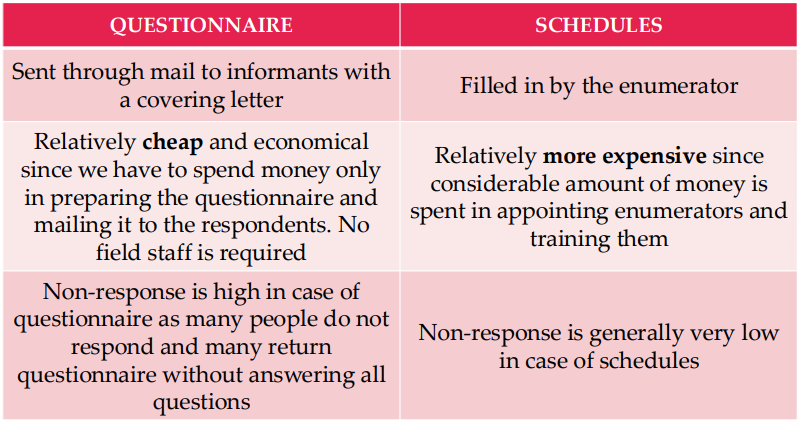
DIFFERENCE BETWEEN QUESTIONNAIRE AND SCHEDULES
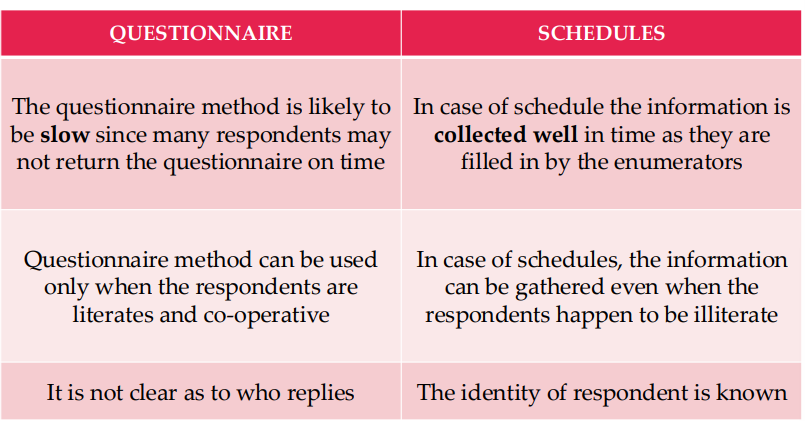
DIFFERENCE BETWEEN QUESTIONNAIRE AND SCHEDULES
SAMPLING METHODS
Probability sampling methods: every item in the universe has a known chance, or probability, of being chosen for the sample.
items will be chosen strictly at random.
selection of sample items is independent of the person making the study
Non-probability sampling methods: do not provide every item in the universe with a known chance of being included in the sample. The selection process is, at least, partially subjective.