EFB 101 Exam #2 Key Terms
 Call Kai
 Learn
Learn Practice Test
 Spaced Repetition
 Match
Match Flashcards
 Knowt Play
1/74

There's no tags or description
Looks like no tags are added yet.
Name | Mastery | Learn | Test | Matching | Spaced | Call with Kai | Chat |
|---|
No analytics yet
Send a link to your students to track their progress
75 Terms
Taxon
Formal grouping at any level
Phylogeny
The evolutionary relationship between organisms
Binomial Nomenclature
A two-part naming system
What is correct binomial nomenclature?
Genus species
Monophyletic group
A group with a common ancestor and ALL of it’s decendents
Polyphyletic group
All the groups’ species and NOT the common ancestor
Paraphyletic group
One ancestral species, and SOME of their descendents
Nodes
A common ancestor; where lineages diverse
Sister Taxa
Share an immediate common ancestor not shared by any other group; each others closest relative
Basal taxon
A lineage that diverges from all other groups early; most related to original species
Polytomy
More than 2 branches from a single node
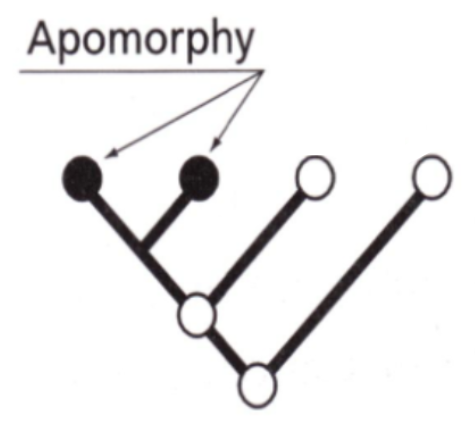
Apomorphy
Derived character state different than that of the ancestor

Plesiomorphy
Character state present in a distant common ancestor
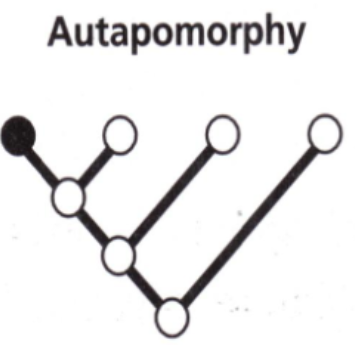
Autapomorphy
Derived character unique to a particular taxon

Synapomorphy
Derived character in 2 or more taxa as a result of a common ancestor
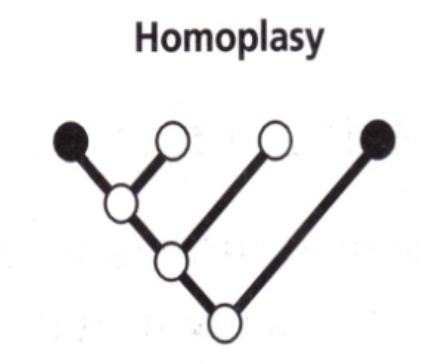
Homoplasy
Derived character shared by 2 or more organisms, but did not arise from common ancestry
Ingroup
Group actively trying to be organized
Outgroup
Related to ingroup, but branch off earlier
Parsimony
The explanation which requires the fewest evolutionary changes is the best
Molecular clock
Method to estimate time required for evolutionary changes, based on constant genome evolution

Homologous structures
Similar structures because of common ancestry
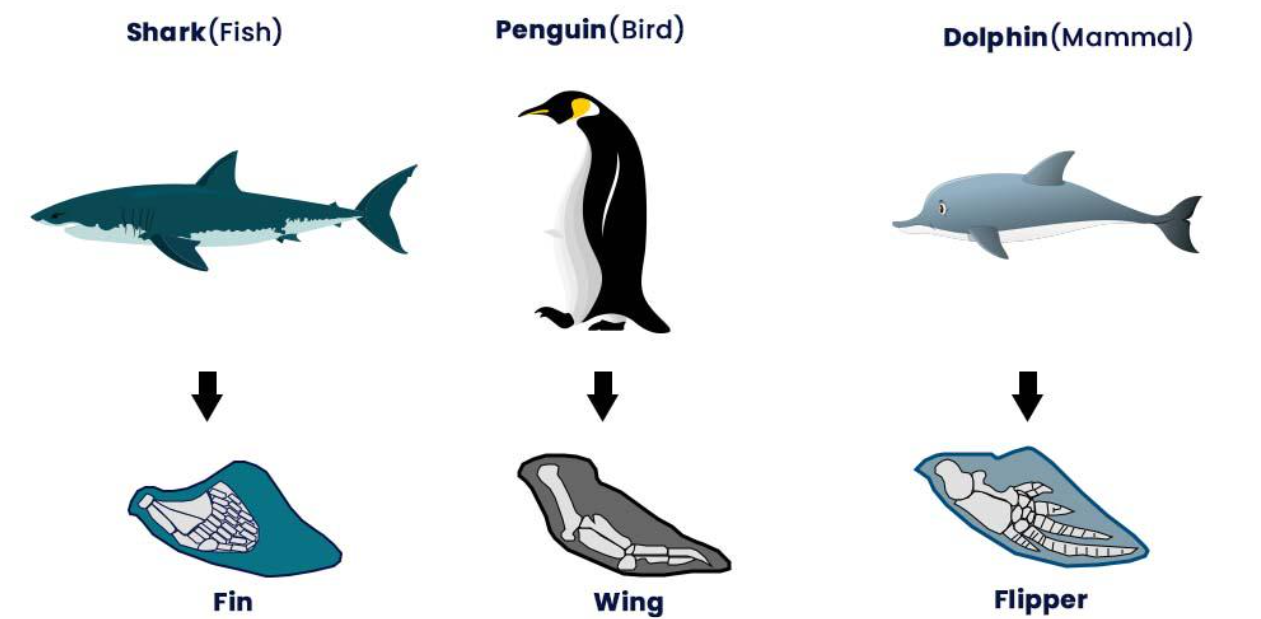
Analogous structures
Similar structures that evolved independently
Shared ancestral characters
Ancestral character shared by multiple taxa (evolved a long time ago)
Shared derived character
Derived characters present in multiple taxa because of a common ancestor
Phylogenetic bracketing
The prediction of traits of an extinct organism by looking at the traits of the closest living relatives

Synapomorphy
A trait that appeared in a more recent common ancestor, and is unique to members of a particular clade
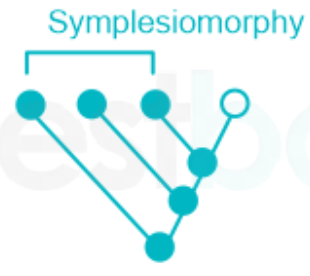
Symplesiomorphy
A shared ancestral character shared across multiple groups
Two major domains of prokaryotes?
Bacteria and archea
What defines a prokaryote
No nucleus, no membrane bound organelles, cell wall (peptidoglycan)
Cilia
Hair-like membrane protrusions that aid with movement
Flagella
Whip-like protrusion that aids in movement. Motor, hook, and filament.
Tumbling
Clockwise rotation of flagella. Used for orientation
Running
Counterclockwise tumbling of flagella. Used for movement.
Taxis
Directed movement to/from stimulus
Vesicles
Membranous sac in prokaryotes that helps with transport, storage, and organization.
Bacteriostatic
Inhibits growth
Bactericidal
Kills bacteria
Exotoxins
Toxin released outside of cells
Endotoxins
Toxins produced insides cells
Transformation
Uptake foreign DNA from surroundings
Transduction
Phages carry prokaryotes genes from host and attach them to bacterial cells
Conjugation
DNA transferred through 2 cells temporarily joined
Cyanobacteria
Gram negative bacteria that provided the atmosphere with oxygen early on in earth’s history
Extremophiles
Living in extreme conditions
Thermophiles
Living in very hot conditions
Halophiles
Living in very salty conditions
Methanogens
Produce ATP
Rod shaped
Bascillus
Shperical
Cocci
Spiral
Spirilli
Gram Positive Bacteria
Thick later of peptidoglycan, simple cell walls (PURPLE)
Gram Negative Bacteria
Less peptidoglycan, more complex (PINK)
Obligate aerobes
Must use oxygen for respiration
Obligate anaerobes
Poisoned by oxygen
Facultative anaerobes
Can use, or not use, oxygen
Photoautotroph
Light as energy source, CO2 as carbon source
Chemotroph
Inorganic chemical as energy source, CO2 as carbon source
Photoheterotroph
Light as energy source, organic compounds as carbon source
Chemoheterotroph
Organic compounds as light and energy source
Endosymbiosis
Eukaryotic cells evolved organelles when smaller prokaryotic cells were engulfed
Cyanobacteria
Photosynthetic bacteria
Plankton
Protists, bacteria, archaea
Pseudopods
Cell extension that uses the cytoskeleton to squeeze cytoplasm forward
Homeobox (hox) genes
Regulatory genes that control developmental/locomotion structures
Diploblasty
Two tissue types
Ectoderm
Outside tissues
Endoderm
Inside tissues
Radial symmetry
No front, back, left, right
Bilateral symmetry
Can be divided into two mirror halves
Protostomes
Mouth forms first
Mesoderm
Middle layer of cells between ectoderm and endoderm. Forms muscle
Coelom
Body cavity that may be filled with air or fluid. Lined with the mesoderm
What primarily defines lophotrochozoa?
Growing continuously
What primarily defines ecdysozoa?
Molting/ ecdysis