Structure of Nucleic Acids
 Call Kai
 Learn
Learn Practice Test
 Spaced Repetition
 Match
Match Flashcards
 Knowt Play
1/12

There's no tags or description
Looks like no tags are added yet.
Name | Mastery | Learn | Test | Matching | Spaced | Call with Kai | Chat |
|---|
No analytics yet
Send a link to your students to track their progress
13 Terms
What are the main nucleic acids and what are they made up of?
DNA: Deoxyribonucleic acid
RNA: Ribonucleic acid
These are polymers made up of nucleotides (monomers)
What do the monomers of DNA consist of?
Nucleotides composed of a deoxyribose sugar, a phosphate group, and a nitrogenous base (adenine, thymine, cytosine, guanine)
What is the chemical structure and role of the phosphate group?
1 central phosphorus atom bonded to 4 oxygen atoms
Connects the 5' -carbon of one sugar to the 3' - carbon of the next sugar
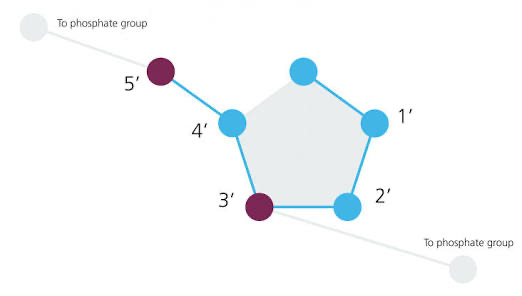
How does the deoxyriboses’ chemical structure allow DNA to form?
A 5 sided, 5-carbon ring
Carbons numbered 1 to 5 going clockwise from the 1'-carbon connected to the nitrogenous base
Deoxygenated because it lacks 1 oxygen atom at the 2'-carbon position compared to ribose sugar
What is the 5 prime end of the deoxyribose sugar?
The end of a DNA strand where the 5'-carbon of the deoxyribose sugar is free
The carbon only binds to the phosphate group without connecting to another sugar
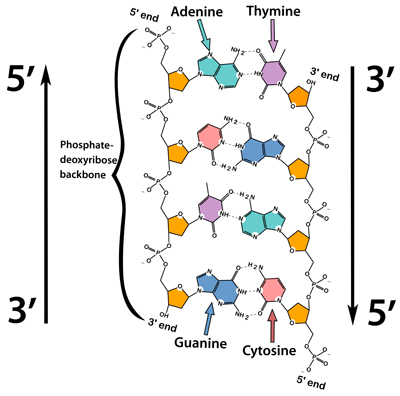
What is the 3 prime end of the deoxyribose sugar?
The end of the deoxyribose sugar that has a free hydroxyl group (-OH) at the 3'-carbon position
Essential for DNA synthesis and pairing with the phosphate group of the next nucleotide
Called the growing/tail end
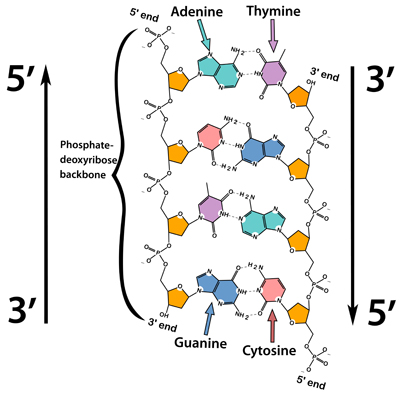
What are some key differences between DNA and RNA?
Nitrogenous bases: RNA has Uracil, DNA has Thymine
Pentose sugar: Sugar of RNA is oxygenated (ribose), DNA is deoxygenated (deoxyribose)
Structure: RNA generally single strand, DNA double helix
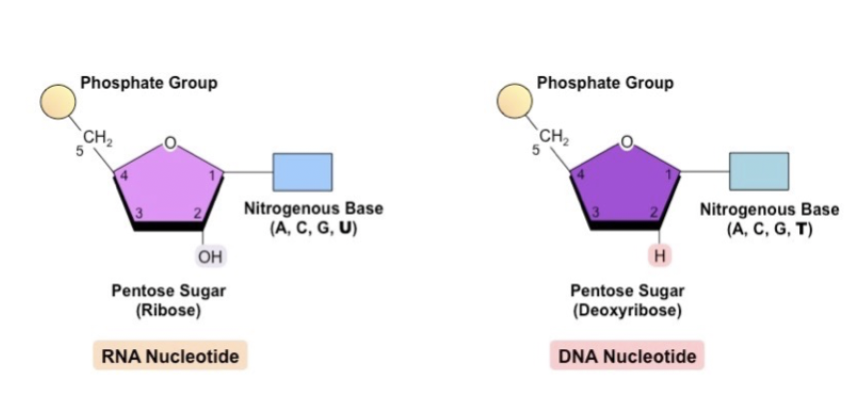
What is the chemical structure and location of the nitrogenous bases?
Attached to the 1'-carbon of the deoxyribose sugar
Each contains: Nitrogen, carbon, hydrogen and oxygen
Come in two types: Purines and Pyrimidines
Connected to each other via weak hydrogen bondds
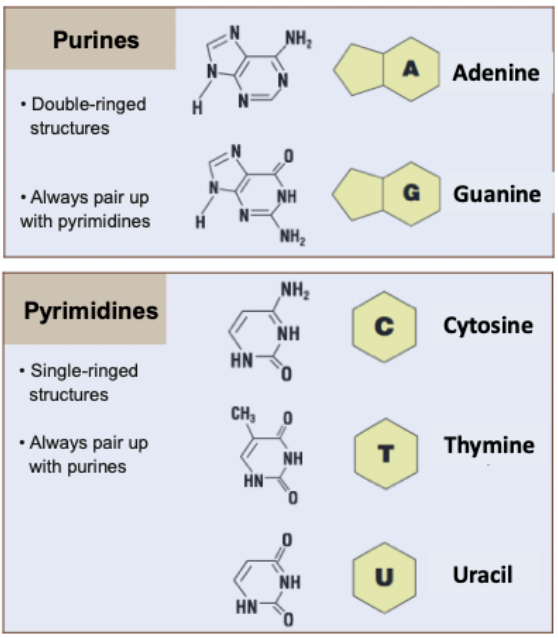
What are purines and which bases are classified as these?
Purines: Adenine and Guanine
Double-ringed
Tip: Purines are pure, angles have halo rings that are pure
What are pyramidines and which bases are classified as these?
Pyrimidines: Cytosine, Thymine, Uracil
Single ringed
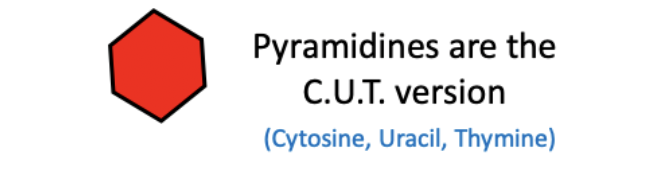
TIP: Pyramids are sharp and CUT (acronym for 3 base names)
How is the bond that connects the nitrogenous bases different to the bond that connects the sugar-phosphate backbone?
Sugar Phosphate: Covalent peptide bond
Peptide bond between the phosphate group of one nucleotide and the ribose sugar of the next nucleotide
Nitrogenous base: Hydrogen bond
Bases held together by weak hydrogen bonds
What are the complementary base pairs?
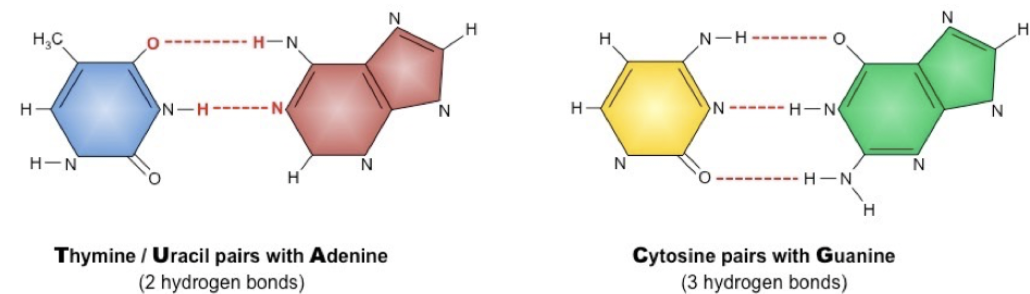
Adenine pairs with Thymine (Uracil in RNA) via 2 hydrogen bonds
Guanine pairs with Cytosine via 3 hydrogen bonds
Purines always pair with pyramidines
How and why is there complementary base pairing?
Complemetary base pairing: The specific pairing of nitrogenous bases due to their complementary hydrogen-bonding sites
Therefore only specific bases can form stable hydrogen bonds:
Adenine (A) pairs with Thymine (T) in DNA or Uracil (U) in RNA.
Cytosine (C) pairs with Guanine (G).
This ensures accurate storage and transfer of genetic information