MOVEMENT INTO AND OUT OF THE CELL FASHCARDS
 Call Kai
 Learn
Learn Practice Test
 Spaced Repetition
 Match
Match Flashcards
 Knowt Play
1/5

Earn XP
Description and Tags
BIOLOGY
Name | Mastery | Learn | Test | Matching | Spaced | Call with Kai | Chat |
|---|
No analytics yet
Send a link to your students to track their progress
6 Terms
Diffusion
The movement of molecules from a region of its higher concentration to a region of its lower concentration molecules move down a concentration gradient, as a result of their random movement
.
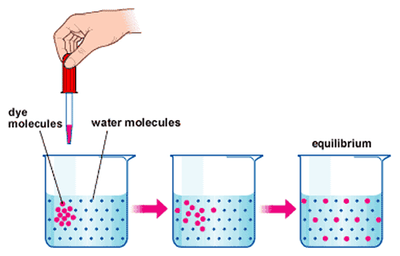
At Equilibrium, the concentrations of molecules are equal.
Energy for diffusion comes from the kinetic energy of the random movement of molecules and ions.
The diffusion of gases and solutes is important as without it, molecules that are needed for life, (Such as glucose and oxygen for respiration) would not be able to get to the places they are required.
Some substances move into and out of cells by diffusion through the cell membrane.
Factors that influence diffusion (Passive Transport)
Concentration gradient
Temperature
Surface area to volume ratio
Distance
Osmosis
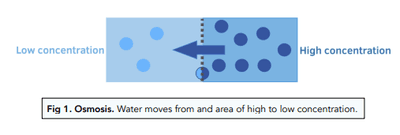
Conc. of Solute (In-Cell) | Conc. of Solute (Outside-Cell) | Condition of the Cell |
|---|---|---|
Low | High | Cell Shrinks (Flaccid/Hypertonic) |
Same | Same | No Change (Isotonic) |
High | Low | Turgid/Hypotonic |
In Animals
Increasing solute concentration inside a cell can cause it to burst (cell lysis) because it has too much water and no cell wall.
In Plants
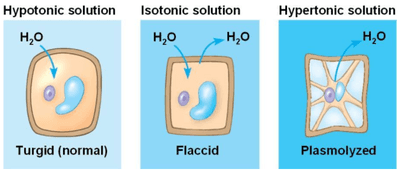
Increasing solute concentration inside the cell causes the cell to become turgid, and the vacuole fills up. The cell wall can withstand the higher turgor pressure.
Decreasing solute concentration inside the cell causes the cell to become flaccid, losing water, and the vacuole to get smaller. The cell body shrinks, pulling away from the cell wall.
Plants are supported by the water pressure inside the cells pressing outwards on the cell wall.
Plasmolysis: the process in which a plant cell loses water due to osmosis, causing the cell membrane to shrink away from the cell wall.
.
.
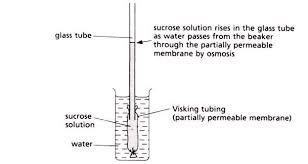
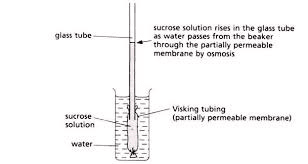
Dialysis Tubing Experiment
Dialysis Tubing (or Visking tubing) is a non-living, partially permeable membrane made from cellulose.
Pores are small enough to prevent the passage of large molecules (such as sucrose) but allow smaller molecules (such as glucose and water) to pass through by diffusion and osmosis.
Interactive
Dialysis Tubing Experiment
(or Visking tubing) is a non-living, partially permeable membrane made from cellulose.
Pores are small enough to prevent the passage of large molecules (such as sucrose) but allow smaller molecules (such as glucose and water) to pass through by diffusion and osmosis
Active transport
The movement of particles through a cell membrane from a lower concentration region to a higher concentration region (i.e., against a concentration gradient) using energy from respiration (ATP)
Carrier Proteins or Protein Carriers are also used during active transport.
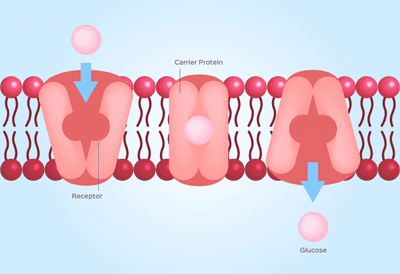
It is embedded in the cell membrane, where it picks up specific molecules and moves them through the membrane against their concentration gradient.
Active transport is needed when an organism wants to optimise the nutrients it can take up - ion uptake by root hair cells.
Some particles are too large to cross a membrane by diffusion or active transport. A few very specialised cells have developed a method for taking up these particles; the particles are engulfed by the cell surface membrane flowing around them which is called Endocytosis. Endocytosis (called phagocytosis) is used by white blood cells to engulf pathogens.
Difference between Diffusion, Osmosis, and Active Transport
Feature | Diffusion | Osmosis | Active Transport |
|---|---|---|---|
Type of movemen | Passive (no energy required) | Passive (no energy needed) | Active (requires energy-ATP) |
Direction | High → Low concentration | High → Low water potential | Low → High (against gradient) |
Substance moved | Gases or solutes (e.g., oxygen, CO2CO2) | Water only | glucose, ions, etc. |
Membrane needed? | Not always | A partially permeable membrane is required | Requires membrane and carrier |
Differences between Diffusion, Osmosis, and Active Transport
Feature | Diffusion | Osmosis | Active Transport |
|---|---|---|---|
Type of movement | Passive (no energy required) | Passive (no energy needed) | Active (requires energy-ATP) |
Direction | High → Low concentration | High → Low water potential | Low → High (against gradient) |
Substance moved | Gases or solutes (e.g., oxygen, CO2CO2) | Water only | glucose, ions, etc. |
Membrane needed? | Not always | A partially permeable membrane is required | Requires membrane and carrier |