Anat and Physio 2: Integumentary System
 Call Kai
 Learn
Learn Practice Test
 Spaced Repetition
 Match
Match Flashcards
 Knowt Play
1/3

There's no tags or description
Looks like no tags are added yet.
Name | Mastery | Learn | Test | Matching | Spaced | Call with Kai | Chat |
|---|
No analytics yet
Send a link to your students to track their progress
4 Terms
Skin layers
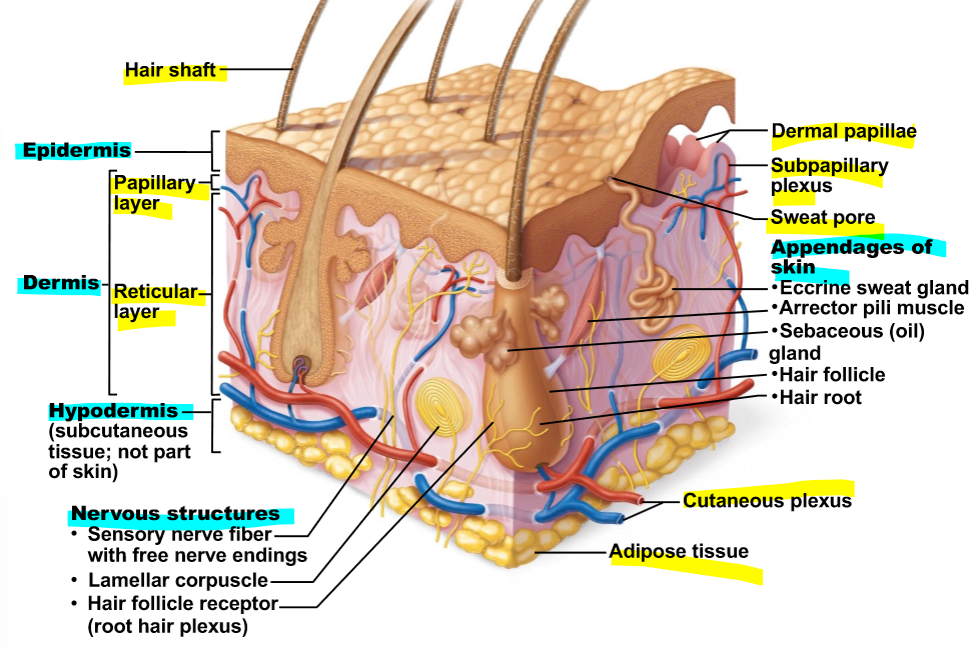
Epidermis
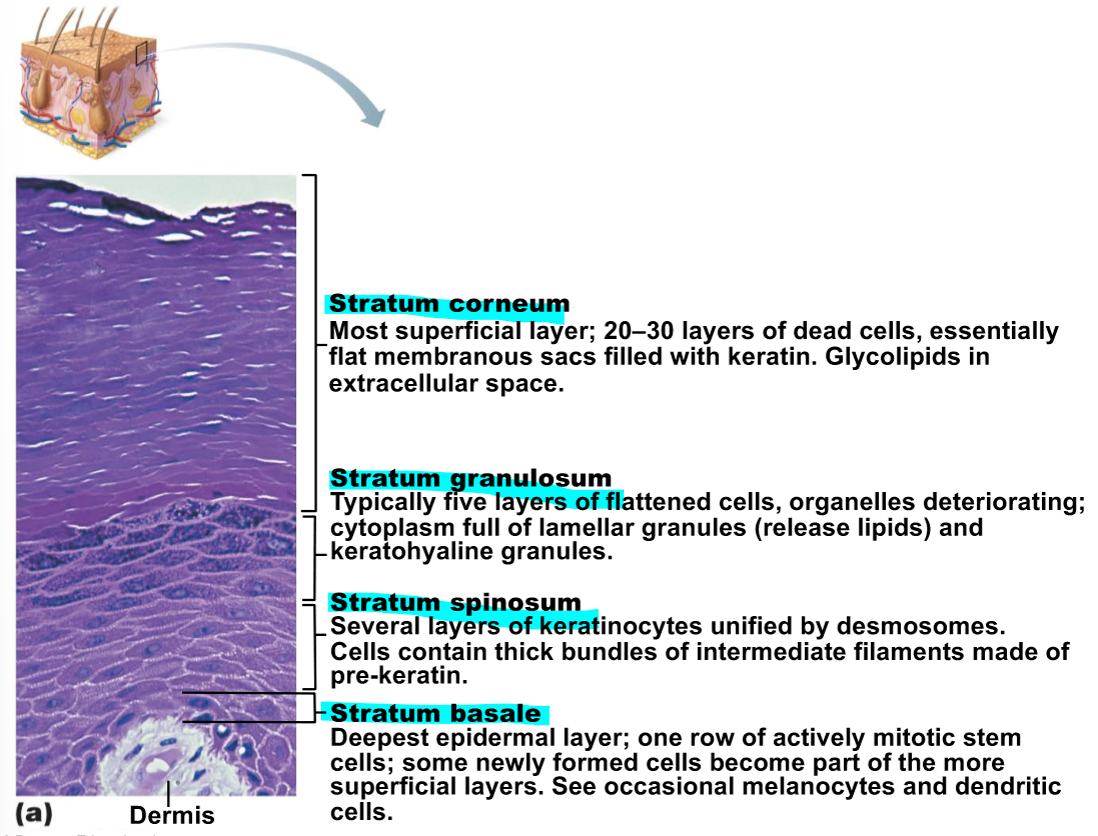
a) Keratinized stratified squamous epithelium
• Four cell types present in the epidermis
– Keratinocytes
– Melanocytes
– Dendritic (Langerhans) cells
– Tactile (Merkel) cells
b) Epidermis consists of four or five distinct layers
– Stratum basale: deepest
single row of stem cells
also called stratum germinativum (cell undergo rapid division)
– Stratum spinosum: prickly
Cells contain web-like system of intermediate prekeratin filaments attached to desmosomes
Abundant melanosomes and dendritic cells
– Stratum granulosum: granular
Thin, 3 to 6 cell layers in which the cells flatten
Keratinization begins (cells accumulate granules)
Cells above this layer begin to die
– Stratum lucidum (only in thick skin)
– Stratum Corneum: rough
20–30 rows of dead, flat, keratinized membranous sacs
Three-quarters of epidermal thickness
Functions
Waterproofs
Protect from abrasion and penetration
Barrier against biological, chemical, and physical assaults
Dermis
a) Strong, flexible connective tissue, but the primary tissue found is dense irregular connective tissue (reticular)
b) Cells
Fibroblasts, macrophages, and occasionally mast cells and white blood cells
c) Two layers:
Papillary: Makes up about 10-20% of the dermis
Areolar connective tissue full of blood vessels and nerves
Reticular: Makes up about 80-100 of the dermis
Dense irregular connective tissue
Lots of collagen fibers for strength
Lots of elastic fibers for stretch
Hypodermis
Subcutaneous tissue not part of skin
Q: A patient taking a drug that inhibits cell division (such as certain chemotherapy drugs) would expect which layer of the epidermis to be affected first?: stratum basale
Q: The principal tissue found in the dermal layer is: dense irregular connective tissue (dermis- reticular part)
Epidermis cont.
Q: Touch sensors of the epidermis: tactile cells
Q: The principal role of melanin is to: shield the nucleus from damage by ultraviolet radiation
Q: The most important role of the eccrine sweat gland is: body temperature regulation
Q: One critical function of sebum, in addition to roles in skin softening, is that it protects against: harmful bacteria
Skin pigments
a) Melanin: Gives you brown color
Made by melanocytes
Transported to keratinocytes and forms pigment shields
Melanin sits on top of keratinocytes and protects DNA from damage by UV
b) Carotene: Carrots! Pigment is yellow/orange (palms or soles of feet)
c) Hemoglobin: Protein in red blood cells that carries O2
Responsible for pinkish hue of skin
Appendages of the Skin
a) hair
• Dead keratinized cells of hard keratin
More durable than soft keratin of skin
• Not in palms, soles, lips, nipples, portions of external genitalia
• Functions include:
Warn of insects on skin
Physical trauma
Heat loss
Sunlight
• Hair pigments
Melanins (yellow, rust, brown, black)
Gray/white hair: decreased melanin production, increased air bubbles in shaft
b) nails
Scalelike modifications of epidermis
Protective cover for distal, dorsal surface of fingers and toes
Contain hard keratin
c) sweat glands
Eccrine (merocrine): Found everywhere especially in the palms, soles of feet, and forehead
Function: to cool the body (thermoregulation)
Mainly composed of water and salts (electrolytes)
Apocrine: Found in axillary (armpit) and anogenital (anus)
Tend to be stinky
Ducts connect to hair follicles
Specialized ones:
Ex: ceruminous glands= secrete cerumin (ear wax)
Ex: mammary glands= secrete milk
d) sebaceous oil glands
Widely distributed
Most develop from hair follicles and secrete into hair follicles
Become active at puberty
secrete sebum
Oily secretion that softens hair and skin; is also bactericidal
Skin Cancer
a) Most skin tumors are benign (not cancerous) and do not metastasize (spread)
b) Risk factors
Overexposure to UV radiation
Frequent irritation of skin
c) Some skin lotions contain enzymes that can repair damaged DNA
d) Three major types of skin cancer
Basal cell carcinoma
Squamous cell carcinoma
Melanoma
e) abcd rule
asymmetry
border irregularity
color
diameter
Burns
a) Tissue damage caused by heat, electricity, radiation, certain chemicals
Denatures proteins and kills cells
b) Partial-thickness burns
– First degree: Only affects the epidermis
Localized area that has redness, swelling, and pain
– Second degree: Involves epidermis and upper dermis
Ex: blister
c) Full-thickness burns
– Third degree: Full thickness of the skin
Not painful at first bc you kill your pain receptors
Burn areas appear gray, white, or blackish
Q: loss of one’s skin such as with severe burn leads to increased risk of
a. bacterial infection
b. inadequate body temperature maintenance
c. dehydration
d. all of the above