MICROBIO GRAM-NEGATIVE
 Call Kai
 Learn
Learn Practice Test
 Spaced Repetition
 Match
Match Flashcards
 Knowt Play
1/107

There's no tags or description
Looks like no tags are added yet.
Name | Mastery | Learn | Test | Matching | Spaced | Call with Kai | Chat |
|---|
No analytics yet
Send a link to your students to track their progress
108 Terms
GRAM NEGATIVE DIAGRAM
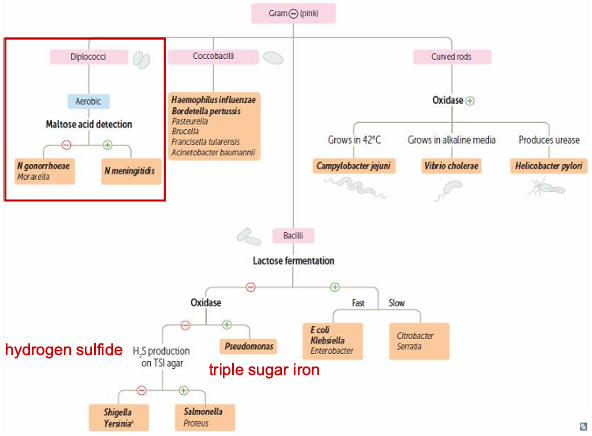
Gram - dipplococci. Metabolize ___ and produce ___. Contain lipooligosaccharides (LOS) with strong endotoxin activity.
N gonorrhoeae
glucose
IgA proteases
Acid production: Maltose and Glucose
N. meningococci
No polysaccharide capsule
Gonococci
Polysaccharide capsule
Meningococci
No maltose acid detection
Gonococci
Maltose acid detection
Meningococci
Gonococci has no vaccine due to antigenic variation of ___
pilus proteins
Meningococci has a vaccine ( ___ vaccine available for at-risk individuals)
type B
Gonococci are ___ transmitted
s3xually or perin4tally
Meningococci is transmitted via ___
respiratory and oral secretions
Causes gonorrhea, septic arthritis, neonatal conjunctivitis ( ___ after birth), pelvic inflammatory disease (PID), and ___
Gonococci
2-5 days
Fitz-Hugh-Curtis syndrome
Causes meningococcemia with petechial hemorrhages and gangrene of toes, meningitis, ___ (adrenal insufficiency, fever, DIC, shock)
Meningococci
Waterhouse-Friderichsen syndrome
Gonococci is diagnosed with?
NAT (nucleic acid test)
Meningococci is diagnosed via?
culture-based tests or PCR (polymerase chain reaction)
prevention of gonococci
Condoms ↓ sexual transmission
erythromycin eye ointment prevents neonatal blindness
prevention of meningococci
Rifampicin, ciprofloxacin, or ceftriaxone prophylaxis in close contacts
treatment of gonococci
ceftriaxone (+ azithromycin or doxycycline, for possible chlamydial coinfection)
treatment of meningococci
ceftriaxone or penicillin G
Small Gram-negative (coccobacillary) rod. ___ transmission.
HAEMOPHILUS INFLUENZAE
Aerosol
most common cause of ___ (otitis media, conjunctivitis, bronchitis), as well as invasive infections, since the vaccine for ___ was introduced (Given between ___ of age)
HAEMOPHILUS INFLUENZAE
mucosal infections
capsular type b
2 and 18 months
Produces IgA protease. Culture on ___, which contains factors V (NAD) and X (hemin) for ___, can also be grown with ___, which provides factor V via ___.
HAEMOPHILUS INFLUENZAE
chocolate agar
growth
S aureus
RBC hemolysis
HaEMOPhilus causes
Epiglottitis (endoscopic appearance, can be "cherry red" in children; "thumb sign" on lateral neck X-ray B)
Meningitis
Otitis media
Pneumonia
The vaccine, type b capsular, contains ___ conjugated to ___ or other protein.
HAEMOPHILUS INFLUENZAE
polysaccharide (polyribosylribitol phosphate)
diphtheria toxoid
In H. influenzae, it does not cause the flu (the ___ does)
influenza virus
Treatment of H. influenzae
amoxicillin +/- clavulanate for mucosal infections
ceftriaxone for meningitis
rifampin prophylaxis for close contacts
BORDETELLA PERTUSSIS Virulence factors
pertussis toxin (disables Gi)
adenylate cyclase toxin (increases cAMP)
tracheal cytotoxin
Three clinical stages of B. pertussis
Catarrhal
Paroxysmal
Convalescent
in B. pertussis, Catarrhal causes? specifically?
low-grade fevers: Coryza
in B. pertussis, Paroxysmal causes?
intense cough followed by inspiratory "whoop" ("whooping cough"), posttussive vomiting
in B. pertussis, Convalescent causes?
gradual recovery from a chronic cough
B. pertussis is prevented by
Tdap (tetanus, diphtheria, acellular pertussis): infants & children younger than 7
Dtap: (diphtheria, tetanus, acellular pertussis): adolescents and adults (include during pregnancy)
___ may be mistaken for a viral infection due to ___ resulting from immune response
B. pertussis
lymphocytic infiltrate
Treatment of B. pertussis
macrolides; if allergic, use TMP-SMX
Gram-negative aerobic coccobacillus. Transmitted via ingestion of ___.
BRUCELLA
contaminated animal products (eg, unpasteurized milk)
BRUCELLA survives in ___ in the ___. Can form ___.
macrophages
reticuloendothelial system
non-caseating granulomas
Typically presents with undulant fever, night sweats, and arthralgia.
BRUCELLA
Treatment of BRUCELLA
doxycycline + rifampin or streptomycin
Gram-negative, strictly aerobic, oxidase-negative coccobacillus
ACINETOBACTER BAUMANNII
Commensal opportunist but increasingly associated with resistant hospital-acquired infections, especially in the ICU.
ACINETOBACTER BAUMANNII
Can cause ventilator-associated pneumonia and septicemia in immunocompromised patients.
ACINETOBACTER BAUMANNII
Gram-negative, ___ (with polar flagella), oxidase-positive, grows at ___
CAMPYLOBACTER JEJUNI
comma- or S-shaped
42°C
A major cause of bloody diarrhea, especially in children.
CAMPYLOBACTER JEJUNI
Fecal-oral transmission through person-to-person contact or via ingestion of undercooked contaminated poultry or meat, or unpasteurized milk.
CAMPYLOBACTER JEJUNI
CAMPYLOBACTER JEJUNI occurs with contact in?
infected animals (dogs, cats, pigs)
CAMPYLOBACTER JEJUNI is a common antecedent to
Guillain-Barré syndrome and reactive arthritis
Gram-negative curved rods
VIBRIO CHOLERAE
Curved, flagellated (motile), Gram-negative rod that is triple+: catalase +, oxidase +, and urease +
HELICOBACTER PYLORI test for diagnosis
urea breath test or fecal antigen test
Urease produces ___, creating an ___ environment, which helps H pylori survive in ___.
ammonia
alkaline
acidic mucosa
H pylori colonizes mainly the ___; causes ___ (especially duodenal).
antrum of the stomach
gastritis and peptic ulcers
Risk factor for peptic ulcer disease, gastric adenocarcinoma, and MALT lymphoma.
H pylori
The most common initial treatment of H pylori
triple therapy: - Amoxicillin (metronidazole if penicillin allergy) + Clarithromycin + Proton pump inhibitor; Antibiotics Cure Pylori.
macrolide resistance: Bismuth-based quadruple therapy
Gram-negative, indole-positive rod.
ESCHERICHIA COLI
E coli virulence factors
Fimbriae
K capsule
LPS endotoxin
E coli virulence factors: Fimbriae causes?
cystitis and pyelonephritis (P pili)
E coli virulence factors: K capsule causes?
pneumonia, neonatal meningitis
E coli virulence factors LPS endotoxin
septic shock
Strains in ESCHERICHIA COLI
Enteroinvasive E. coli (EIEC)
Enterotoxigenic E. coli (ETEC)
Enteropathogenic E. coli (EPEC)
Enterohemorrhagic E. coli (EHEC)
Microbe invades the intestinal mucosa and causes necrosis and inflammation
Enteroinvasive E. coli
Produces heat-labile and heat-stable enterotoxins. No inflammation or invasion.
Enterotoxigenic E. coli
No toxin produced. Adheres to apical surface, flattens villi, and prevents absorption.
Enteropathogenic E. coli
___ is the most common serotype in the US. Often transmitted via undercooked meat, raw leafy vegetables
Enterohemorrhagic E. coli
O157:H7
___ causes hemolytic-uremic syndrome: triad of anemia, thrombocytopenia, and acute kidney injury due to microthrombi forming on damaged endothelium → mechanical hemolysis (with schistocytes on peripheral blood smear), platelet consumption, and ↓ renal blood flow.
Enterohemorrhagic E. coli
Shiga-like toxin
Invasive; dysentery. Clinical manifestations similar to Shigella.
Enteroinvasive E. coli EIEC
Traveler’s diarrhea (watery)
Enterotoxigenic E. coli ETEC
E.coli that causes Diarrhea, usually in children
Enteropathogenic E. coli EPEC
Dysentery (toxin alone causes necrosis and inflammation).
Enterohemorrhagic E. coli EHEC
Does not ferment ___ (vs other E coli). Hemorrhagic, Hamburgers, Hemolytic-uremic syndrome.
Enterohemorrhagic E. coli EHEC
sorbitol
Gram-negative rod in ___ that causes ___ in alcoholics and diabetics when aspirated.
KLEBSIELLA
intestinal flora
lobar pneumonia
In ___, very ___ are caused by abundant polysaccharide capsules. ___ (blood/mucus).
KLEBSIELLA
mucoid colonies
Dark red "currant jelly” sputum
Also a cause of nosocomial UTIs. Associated with the evolution of ___
KLEBSIELLA
multidrug resistance (MDR)
ABCDE's of Klebsiella
● Aspiration pneumonia
● aBscess in lungs and liver
● "Currant jelly" sputum
● Diabetes
● EtOH abuse
aerobic, motile, catalase-positive, Gram-negative rod. Non-lactose fermenting. Oxidase positive.
Aeruginosa
Frequently found in water. Has a grape-like odor.
PSEUDOMONAS AERUGINOSA
associated with: Pneumonia, Sepsis, Ecthyma gangrenosum, UTIs, Diabetes, Osteomyelitis, Mucoid polysaccharide capsule, Otitis externa (swimmer's ear), Nosocomial infections (eg, catheters, equipment), Addicts (drug abusers), Skin infections (eg, hot tub folliculitis, wound infection in burn victims).
PSEUDOMONAS
In ___, ___ may contribute to chronic pneumonia in cystic fibrosis patients due to biofilm formation.
PSEUDOMONAS AERUGINOSA
Mucoid polysaccharide capsule
PSEUDOMONAS AERUGINOSA produces PEEP
Phospholipase C (degrades cell membranes)
Endotoxin (fever, shock)
Exotoxin A (inactivates EF-2)
Pigments: pyoverdine and pyocyanin (blue-green pigment; also generates reactive oxygen species).
Corneal ulcers/keratitis in contact lens wearers/minor eye trauma.
PSEUDOMONAS AERUGINOSA
rapidly progressive, necrotic cutaneous lesion caused by Pseudomonas bacteremia. Typically seen in immunocompromised patients.
Ecthyma gangrenosum
Treatment for Pseudomonas aeruginosa
CAMPFIRE
● Carbapenems
● Aminoglycosides
● Monobactams
● Polymyxins (eg, polymyxin B, colistin)
● Fluoroquinolones (eg, ciprofloxacin, levofloxacin)
● thIRd- and fourth- generation cephalosporins (eg, ceftazidime, cefepime)
● Extended-spectrum penicillins (eg, piperacillin, ticarcillin)
causes typhoid fever; carrier with gallbladder colonization
Salmonella typhi
Causes gastroenteritis by non-typhoidal salmonella
Salmonella spp. (except S. typhi)
no hematogenous spread, very small inoculum required, manifests tenesmus in GI
Shigella
what is the order of decreasing severity in Shigella first caused by ___
S dysenteriae
4F’s: Finger, Flies, Flood, Feces
Spiral-shaped bacteria A with axial filaments.
SPIROCHETES
SPIROCHETES Includes?
Borrelia (big size), Leptospira, and Treponema
In SPIROCHETES, only ___ can be visualized using ___ (___ stain) in ___ due to size.
Borrelia
aniline dyes
Wright or Giemsa
light microscopy
In ___, Treponema is visualized by ___ or ___ microscopy.
SPIROCHETES
dark-field microscopy
direct fluorescent antibody (DFA)
LYME DISEASE is caused by ___, which is transmitted by the ___ (also a vector for ___).
Borrelia burgdorferi
Ixodes deer tick
Anaplasma spp. and protozoa Babesia
In Lyme disease, The natural reservoir is the ___; ___ are essential to the tick life cycle but do not harbor ___.
mouse
deer
Borrelia
Common in the northeastern United States.
LYME DISEASE
In LYME DISEASE, Stage ___: ___: ___ (typical "bulls-eye" configuration B is pathognomonic but not always present), ___ symptoms.
1
early localized
erythema migrans
flu-like
In LYME DISEASE, Stage ___: ___: secondary lesions, carditis, AV block, facial nerve (Bell) palsy, migratory myalgias/transient arthritis.
2
early disseminated
In LYME DISEASE, Stage ___: ___: encephalopathy, chronic arthritis.
3
late disseminated
A Key Lyme pie to the FACE:
Facial nerve palsy (typically bilateral)
Arthritis
Cardiac block
Erythema migrans
Treatment of lyme disease
doxycycline (1st line)
amoxicillin: if severe illness, CNS signs, or heart block
ceftriaxone
Spirochete with ___ found in water contaminated with animal urine.
LEPTOSPIRA INTERROGANS
hook-shaped ends
flu-like symptoms, myalgias (classically of calves), jaundice, photophobia with conjunctival suffusion (erythema without exudate). Prevalent among ___ and in the ___ (eg, ___).
Leptospirosis
surfers
tropics
Hawaii
severe form with jaundice and azotemia from liver and kidney dysfunction, fever, hemorrhage, and anemia in LEPTOSPIRA INTERROGANS
Weil disease (icterohemorrhagic leptospirosis)