Water - Unit 1 Biology SL
 Call Kai
 Learn
Learn Practice Test
 Spaced Repetition
 Match
Match Flashcards
 Knowt Play
1/17

There's no tags or description
Looks like no tags are added yet.
Name | Mastery | Learn | Test | Matching | Spaced | Call with Kai | Chat |
|---|
No analytics yet
Send a link to your students to track their progress
18 Terms
Water is the ____ of life
Solvent
Relevance of water/applications
Fluid in cytoplasm and organelles
Interstitial tissue fluid (between cells)
Transport of materials
Solvent of blood to carry nutrients and waste
Habitat (lakes, rivers, oceans)
Photosynthesis, transport and turgidity in plants
Polar Covalent - Why is water a polar covalent?
Unequal sharing of electrons between elements. Water is a polar covalent because oxygen has a higher electronegativity (tendency to pull on electrons), than the hydrogens, giving them charge of -ve, while hydrogen gets +ve
Water has ___ poles, and can form up to ____ bonds
Two poles, up to 4 bonds.
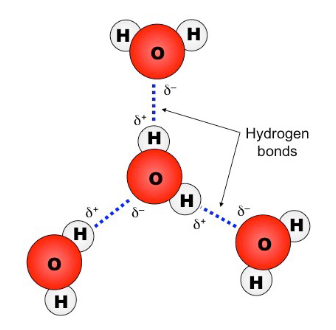
Cohesion
The tendency of water molecules to form hydrogen bonds through intermolecular forces. Very ephemeral (quick). It creates surface tension and allows water columns to be pulled upward under tension.
Adhesion
The attraction of water molecules to other polar or charged materials (e.g., glass, cellulose in cell walls). It contributes to capillary action.
Describe how water flows in the xylem
H-Bonds through cohesion create a continuous chain of water up, and these molecules also stick to the polar cellulose walls of the xylem vessels via adhesion.
How is dissolving ability dependent on polarity?
Polar substances are hydrophilic, and make use of interactions between opposite charges - (Ions, Polar Bonds, O-H)
Non polar substances are hydrophobic (a lot of -anes are hydrophobic), and result from cohesion from surrounding molecules (water molecules get really close together and squeeze non polar out). (C-H, Non polar bonds)
Solvation
The process where solvent (water) molecules surround and interact with solute particles and bring them into the solution.
Water is a medium of transport which carries nutrients like,
BLOOD: ions, proteins, glucose, hormones, gases
(O2/CO2)
PLANTS: minerals, amino acids, hormones
Water is a medium for metabolism which allows it to..
Provides the fluid medium and structural support that allows enzymes and reactants to bind.
Name some nutrients found in blood.
Glucose
Amino acids
Enzymes
Sodium
Potassium
Chlorine
Bicarbonate
(PFVSM - Plasma, Proteins, Fats (lipids), Vitamins, Sugars, Minerals like Sodium)
Buoyancy
Depends on density, upward force exerted by fluid to support object in water
Viscocity
Water’s resistance to an object moving through it
Thermal Conductivity
Water can hold and RETAIN heat - high thermal conductivity.
Specific Heat Capacity
Very high, needs a lot of heat before changing temperature. Explains why rivers feel cool in the summer and hot in the winter. Perspiration cools your body primarily through water's high heat of vaporization
Black-Throated Loon
Less Dense Bones → Buoyant
Not Hollow Structure → can dive underwater if needed
Loon’s legs are located far back to help them move (viscocity)
Barrier to water, water retains heat to prevent loon from losing it
H-Bonds Keep Temp stable in water
Ringed Seal
Dense Bones → Not buoyant
Overcome viscosity via streamlined body + paddle like feet
Blubber layer is insulator to prevent heat loss
H-Bonds keep temp stable