practice final exam 1 questions
 Call Kai
 Learn
Learn Practice Test
 Spaced Repetition
 Match
Match Flashcards
 Knowt Play
1/42

There's no tags or description
Looks like no tags are added yet.
Name | Mastery | Learn | Test | Matching | Spaced | Call with Kai | Chat |
|---|
No analytics yet
Send a link to your students to track their progress
43 Terms
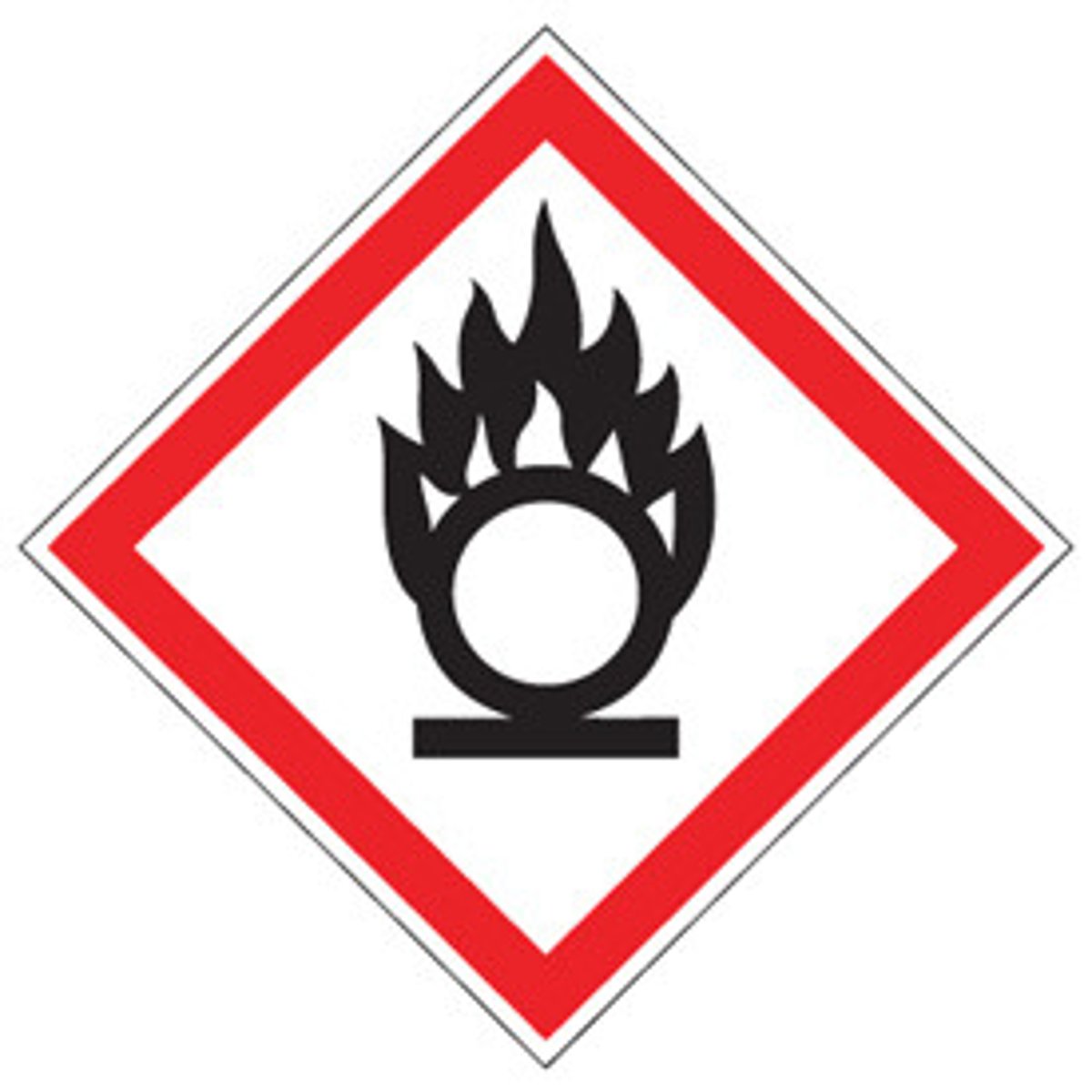
The chemical-labelled pictogram on the right corresponds to which of the following?
strong oxidizer
On the US National Fire Protection Diamond, what does the BLUE color correspond to?
health hazard
Concentrated hydrochloric acid (37% w/w) can severely burn you and must be handled with care. The density of
concentrated HCl is 1.2 g/mL and the molecular weight of HCl is 36.5 g/mol. What is the approximate molarity of
concentrated HCl?
12.1M
Which of the following gases is used to keep an NMR cooled to approximately 4 degrees Kelvin?
A. oxygen B. helium C. carbon dioxide D. hydrogen
helium
Which of the following combinations of peaks appears in the 1 H NMR spectrum of 2,3-dimethylbutane?
A. two singlets B. a doublet and a septet C. a singlet and two doublets D. a doublet and an octet
a doublet and a septet
How many signals appear in the proton-decoupled 13 C NMR spectrum of 1,3-dibromobenzene?
A. 1 B. 2 C. 3 D. 4
3
Which part of the electromagnetic spectrum is used in NMR spectroscopy?
A. radio waves B. IR C. x-ray D. microwave
radio waves
You are analyzing an unknown organic compound using infrared (IR) spectroscopy. The IR spectrum shows
a strong, broad absorption band around 3300-3500 wavenumbers, a medium, broad absorption band near 2900-
3000 wavenumbers, and a strong, sharp peak near 1720-1735 wavenumbers. Which one of the following
functional groups is most likely present in the compound?
A. alcohol B. carboxylic acid C. amine D. aldehyde
carboxylic acid
Which of the following processes takes place upon absorption of infrared radiation?
A. bond vibration B. electron excitation C. nuclear spin flip D. electron spin flip
bond vibration
What are the units of wavenumber in IR spectroscopy?
A. cm B. cm-1 C. J.mol -1 D. none, wavenumber is a dimensionless quantity
cm-1
When using NaHCO3 to neutralize residual acid in solution-solution extraction, why is it important to vent the
separatory funnel?
carbon dioxide is formed and creates pressure
Magnesium sulfate was used extensively during lab. What was its purpose?
A. It was used to form the Grignard reagent. B. It was a drying agent and removed residual water.
C. It neutralized NaHCO3 present in the reaction. D. It drove the reaction completion.
It was a drying agent and removed residual water.
3. What is the term that describes a mixture of two liquids which has a constant boiling point and composition
throughout distillation?
A. emmetrope B. azeotrope C. isotrope D. alletrope
B. azeotrope
14. Why is steel wool or glass prongs used in a fractional distillation column?
A. It increases the surface area and improves the separation between liquids
B. It heats up the reaction, thus driving it to completion
C. It allows for the solutions to react in the column thus driving the reaction to completion.
D. It reduces bumping and thus provides a more controlled distillation.
A. It increases the surface area and improves the separation between liquids
15. Which term describes heating of a chemical reaction for a specific amount of time, while continually cooling the vapor
produced back into liquid form, using a condenser?
A. distillation B. crystallization C. sublimation D. reflux
D. reflux
16. Which of the following would be an appropriate solvent for recrystallizing a crude sample of 1,3-dihydroxybenzene?
A. pentane B. methane C. sodium acetate D. ethanol
D. ethanol
17. Which compound is occasionally used with hot filtration during recrystallization?
A. sulfuric acid B. sodium bicarbonate C. silica gel D. charcoal
D. charcoal
18. You are determining the melting point of an unknown organic compound. The observed melting point range is 133-
136°C. When you mix the unknown compound with a known sample of pure acetanilide (melting point 113-115°C), the
melting point of the mixture is 95-105°C. What can you conclude about the identity of the unknown compound?
A. The unknown compound is acetanilide.
B. The unknown compound is a different compound than acetanilide.
C. The unknown compound is contaminated with acetanilide.
D. The unknown compound has a melting point lower than acetanilide.
B. The unknown compound is a different compound than acetanilide.
19. You synthesized benzoic acid in the lab and determined its melting point to be 118-122°C. The literature value for the
melting point of pure benzoic acid is 122°C. Which of the following is the most likely explanation for the observed
melting point range?
A. The benzoic acid sample is highly pure.
B. The benzoic acid sample contains impurities.
C. The thermometer used for measuring the melting point was inaccurate.
D. The benzoic acid sample was not completely dry.
B. The benzoic acid sample contains impurities.
20. You analyze a mixture of three compounds: A, B, C, and D. The retention times for these compounds are as follows:
Compound A - 2.0 minutes, Compound B - 3.0 minutes, Compound C - 4.0 minutes, Compound D - 6.1 minutes. Which
of the following statements is correct?
A. Compound A is the most volatile. B. Compound B is the solvent.
C. Compound C is the least polar. D. Compound D is the lowest molecular weight
A. Compound A is the most volatile.
21. Which of the following is a detector used in gas chromatography?
A. interferometer B. calorimeter C. flame ionization detector D. spirometer
C. flame ionization detector
22. You have a mixture of hexanol, hexanoic acid, and benzene and perform TLC analysis on a silica gel plate
(with an eluant mixture of 80:20 hexane:ethyl acetate). Which compound should have the lowest Rf value?
A. hexanol B. hexanoic acid C. benzene D. They all have the same Rf.
B. hexanoic acid
Which of the following is a non-destructive visualization technique used in TLC?
A. UV lamp B. I2 C. KMnO4 D. p-anisaldehyde
UV lamp
You are separating a mixture of two compounds, A and B. Compound A is more polar than compound B using normal
phase column chromatography (similar to column used in lab). Which of the following conditions would most likely lead
to better separation of these two compounds?
A. Using a less polar solvent as the mobile phase. B. Using a more polar solvent as the mobile phase.
C. Increasing the flow rate of the mobile phase. D. Decreasing the length of the column.
Using a less polar solvent as the mobile phase
In a column chromatography experiment, you are attempting to separate a mixture of three compounds: X, Y, and Z.
The stationary phase is silica gel, and the mobile phase is a pentane/diethyl ether mixture. Compound X is nonpolar,
compound Y is moderately polar, and compound Z is highly polar. Which elution order is most likely for these
compounds?
A. X will elute first, followed by Y, and then Z. B. Y will elute first, followed by X, and then Z.
C. Z will elute first, followed by Y, and then X. D. X and Y will co-elute first, followed by Z.
X will elute first, followed by Y, and then Z.
The specific rotation [a] of the R-enantiomer of compound X is +80. What is the specific rotation [a] of a 20:80
(ratio of % R isomer:%S isomer) mixture of the enantiomers of compound X?
A. - 48 B. +0.75 C. - 75 D. - 60
- 48
How many stereoisomers for tartaric acid are optically active (structure show on the right)?
A. 0 B. 2 C. 3 D. 4
2
Propylmagnesium bromide was generated and reacted with residual water in the flask. What product is formed?
A. propane B. propanol C. propene D. 1-bromopropane
propane
Which of the following solvents would be best for a Grignard reaction?
A. acetone B. methanol C. hexane D. diethyl ether
diethyl ether
Which of the following is a proper practice when keeping a good lab notebook?
A. Leaving several blank pages between entries for future notes.
B. Using a consistent format for recording data, observations, and results.
C. Relying on memory to fill in the details after the experiment is complete.
D. Tearing out pages that contain mistakes to keep the notebook tidy.
B. Using a consistent format for recording data, observations, and results.
Which of the following practices is NOT recommended for keeping a good lab notebook?
A. Recording the date and title of each experiment.
B. Writing in pen to ensure permanence of records.
C. Using white-out to correct mistakes for a neat appearance.
D. Including detailed observations and any deviations from the procedure
C. Using white-out to correct mistakes for a neat appearance.
Which of the following writing conventions is NOT appropriate scientific technical report?
A. Using leading zeros when reporting numbers less than 1 (e.g. 0.23 mg)
B. Avoiding use of informal, imprecise, ordinal words
C. Referring to figures correctly in text
D. Use of hedge words such as "proven"
D. Use of hedge words such as "proven"
Which of the following practices is recommended for proper scientific technical writing?
A. Using clear and concise language to convey information effectively.
B. Including relevant data and figures to support your conclusions.
C. Providing proper citations for all referenced work
D. All of the above
D. All of the above
TLC
*"thin layer chromatography" used to analyze a mixture by separating out its constituents by means of selective adsorption
*partitioning process based on differences in polarity
ppm
Parts per million, chemical shift units in NMR
ee
enantiomeric excess, measure of optical purity
Rf
retention factor, distance traveled by substance/distance traveled by solvent
gc
Gas Chromatography for volatile compound analysis.
nmr
nuclear magnetic resonance, structure elucidation technique
mCPBA
meta-Chloroperoxybenzoic acid. An oxidizing agent that will convert an alkene into an epoxide.
MSDS
material safety data sheet, chemical hazard documentation
Using the liquid-liquid extraction, describe how you would separate a mixture containing dodecane and dodecanoic acid?
1) Dissolve the mixture in an organic solvent (e.g., diethyl ether).
2) Add an aqueous base solution like NaOH or NaHCO3. The dodecanoic acid converts into its water-soluble carboxylate salt form, while neutral dodecane stays in the organic layer.
3) Separate the layers using a separatory funnel.
4) Acidify the aqueous layer with HCl to precipitate pure dodecanoic acid, then filter. Evaporate the organic solvent layer to collect pure dodecane
A student carries out a reaction to synthesize 1.0 gram of Compound C from 5.0 grams or Compound A and
18.0 mL of Compound B (density 2.00 g/mL). See reaction below. What is the theoretical yield of Compound
C? Calculate the percent yield of Compound C obtained? Show your calculations. Use proper significant
figures. (2 points).
1Compound A (MW: 100.0 g/mol)+ 5Compound B (MW: 90.0g/mol) -> 1Compound C (MW: 200.0 g/mol)
theoretical yield of compound C: 10g, percent yield of compound C: 10%