MSE 1.3
 Call Kai
 Learn
Learn Practice Test
 Spaced Repetition
 Match
Match Flashcards
 Knowt Play
1/5

Earn XP
Description and Tags
thermal properties
Name | Mastery | Learn | Test | Matching | Spaced | Call with Kai | Chat |
|---|
No analytics yet
Send a link to your students to track their progress
6 Terms
(maximum) service temperature
maximum useable temperature for a material. above this temperature, the material will “fail”. failing includes: melting, excessive deformation, burning, corrosion, loss of other properties (magnetic, eletric, etc.) or becoming brittle (if too cold). service temperatures are often much lower than Tm (0.5-0.8 or lower).
heat capacity
the heat energy required to raise the temperature of a material by 1 kelvin (celsius). this is a materials constant. units: j/(amount of material - mass, volume, moles)
thermal conductivity (Λ)
the speed of energy flowing/transferring, also known as the “speed” of heat flow. the rate at which hear flows through a material at a steady-state (e.g. across a temperature gradient that is constant with time. units: W/m*K
fourier’s law
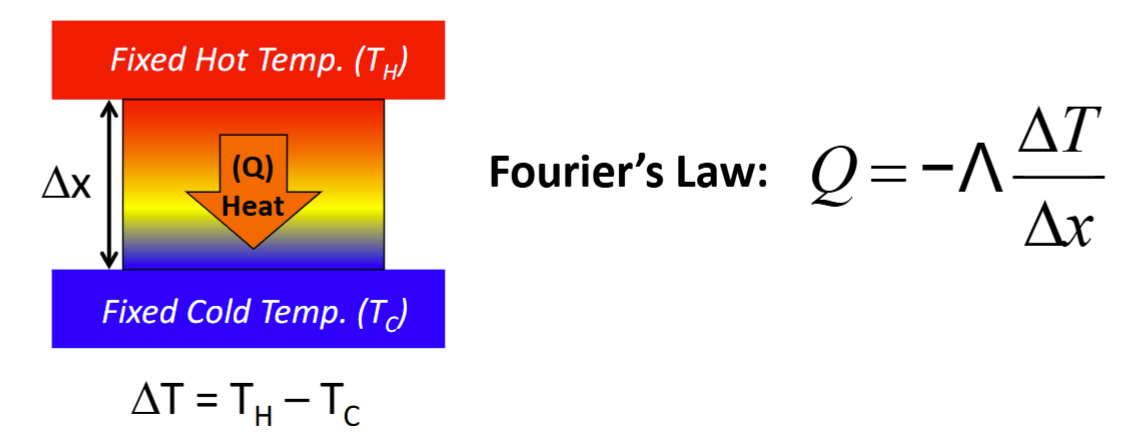
thermal diffusivity (Dth)
a material property used to describe transient heat flow. units: m²/s. Used to estimate “how quickly” a material will heat up (i.e. reach a temperature) when a heat source is applied (or alternatively “cool down” when a cooling source is applied.) Dth ~ Λ/Cp where Λ is the flow rate and Cp is the amount of heat energy.
thermal expansion coefficient
change in volume (or length) of a material with change in temperature. also known as coefficient of thermal expansion (CTE). cross property: thermal and mechanical.
