Fundamentals of Chemistry Part 1.0
 Call Kai
 Learn
Learn Practice Test
 Spaced Repetition
 Match
Match Flashcards
 Knowt Play
1/43

There's no tags or description
Looks like no tags are added yet.
Name | Mastery | Learn | Test | Matching | Spaced | Call with Kai | Chat |
|---|
No analytics yet
Send a link to your students to track their progress
44 Terms
What is the study of the composition, structure, and properties of matter and the changes it undergoes?
Chemistry
What are the three basic states of matter:
Solid
Liquid
Gas
Other states of matter:
Plasma
Bose-Einstein Condensate
It is a state of matter with an ionized gas
Plasma
It occurs at ultralow temperature (very near to absolute zero, close to the point that the atoms are not moving at all)
Bose-Einstein Condensate
What occupies space and possesses mass; may exist as solid, liquid, or gas?
Matter
Two classifications of matter:
Pure substance
Mixture
This is the matter who has an invariant chemical composition and distinct properties?
Pure substance
It is the fundamental substance; cannot be separated into simpler substances by chemical methods
Element
What is the substance composed of two or more elements in fixed proportions; can be separated into simpler substances and elements only by chemical methods?
Compound
What is a material made up of two or more different substances which are physically combined, but not chemically bonded?
Mixture
The mixture is completely uniform throughout. You cannot see the individual components with the naked eye.
Homogeneous
The mixture is non-uniform. You can easily see the different phases or substances that make it up.
Heterogeneous
Many laws in Chemistry are stated as variation statements. These statements may be:
Direct
Inverse
Joint Variations
What is simply the way of comparing certain attribute of an object with some given standard?
Measurement
The International Standards of mass equal to 1 kg refer to a cylinder of?
platinum-iridium
The second is defined as 9,192,631,770 times the period of vibration from?
Cesium atom
1 meter is defined as the distance of light travels in a vacuum in?
1/299,792,458 seconds
Measurement may be taken by:
Direct Method
Indirect Method
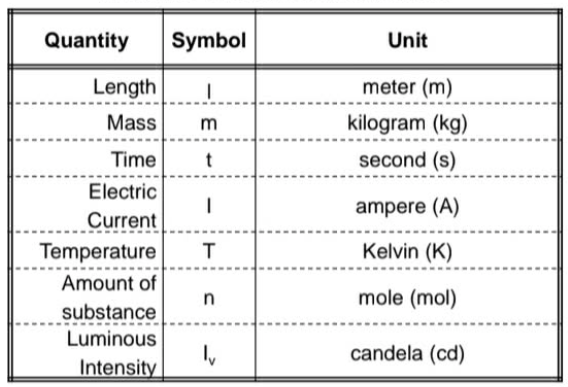
Seven SI Fundamental Quantities:
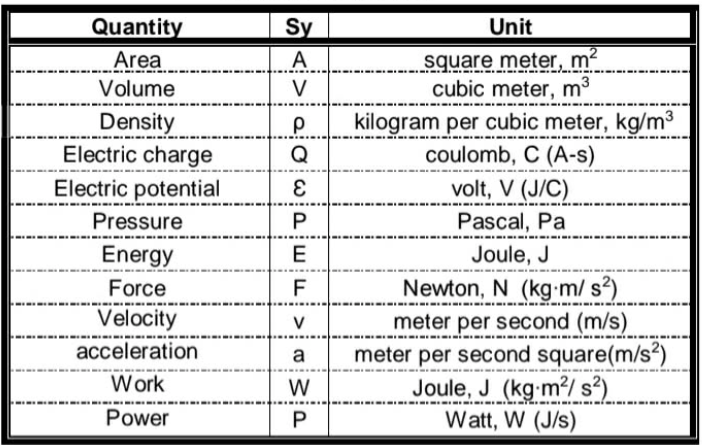
Some SI Derived Units:
It is a complete set of units both fundamental and derived for all kind of quantities
System of Units
FPS (foot-pound-second)
Old British or English System
MS (meter-kilogram-second)
CGS (centimeter-gram-second)
Metric System SI (Systeme International d’Unites)-
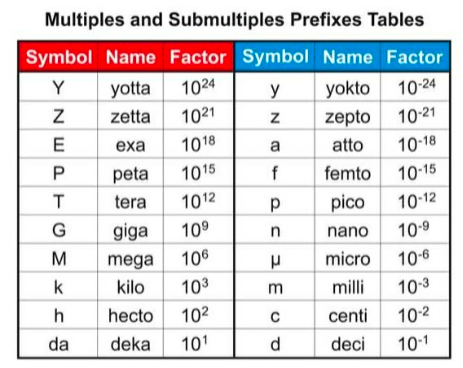
Multiples and Submultiples Prefixes Tables:
What are those digits in a number with known certainty plus the first digit that is uncertain?
Significant figures
They are numbers that have defined values and are obtained by definition. The number is not counted in determining the number of significant figures.
Example: 12 eggs in a dozen, 2 pieces in a pair
Exact numbers (constant number)
They are numbers that are obtained by measurement and must be expressed in the right significant figures. The number of significant figures must depend on the sensitivity of measuring devices used
Inexact numbers
All rules of significant figures:
Rule 1: All nonzero digits are significant
Rule 2: Middle zeroes (zeroes between two nonzero digits) are significant
Rule 3: All zeroes that are written to the right of the decimal number count as significant figures
Rule 4: Leading zeroes (zeroes to the right of the decimal number less than none and preceding a nonzero digit) are not significant
Rule 5: Trailing zeroes (zeroes at the end of a nonzero digit) is significant if a decimal point or a bar on top is indicated, for example, 300. kW has three significant figure.
What is a convenient way of expressing a very small or a very large number?
Scientific notation
The form of Scientific Notation:
M x 10^n
In these two, the number of decimal places to the decimal point’s right in the final sum and difference is determined by the lowest number of decimal places to the decimal point’s right in any of the original numbers.
Addition or subtraction
In these two, the result must contain the same number of significant figures as in the original number having the smallest number of significant figures
Multiplication or division
It is used to convert a unit to another unit, a numerator, and a denominator representing a relationship are used
Dimensional analysis or factor unit method
LENGTH CONVERSION FACTORS:
1 m = 3.281 ft = 1.094 yards (yd)
1 inch (in) = 2.54 cm
1 foot (ft) = 12 in
1 mile (mi) 1.61 km
AREA CONVERSION FACTORS:
1 square meter (m²) = 10.76 square feet (ft²)
1 ft² = 929 square centimeter (cm²)
1 hectare = 10,00 m² = 2.471 acres
1 acre = 43, 560 ft²
VOLUME CONVERSION FACTORS:
1 mL = 1 cubic centimeter (cc or cm³)
1 L = 1000 mL = 1.057 quarts (qt)
1 cubic meter (m³) = 1000 L
1 gal = 3.7854 L
TIME CONVERSION FACTORS:
1 earth year = 364.25 days
1 week = 7 days
1 day = 24 hours (hr)
1 hr = 60 minutes (min) = 3600 sec
MASS CONVERSION FACTORS:
1 kg = 1000 g = 2.2 pounds (lb)
1 g = 1000 mg
metric ton = 1000 kg
pound = 454 kg
It is the quantity of matter that it contains. It is a constant quantity.
Mass
It is the force that gravity exerts on the body
Weight
A moderately accurate measurement is done, it is sensitive to 0.01 gram
Triple Beam Balance