Gene Regulation: The trp Operon
 Call Kai
 Learn
Learn Practice Test
 Spaced Repetition
 Match
Match Flashcards
 Knowt Play
 Podcast
1/29

Earn XP
Description and Tags
Flashcards testing concepts of gene regulation in the trp operon model, including operon structure, transcription repression, attenuation, anti-attenuation, and differences between prokaryotic and eukaryotic gene expression.
Name | Mastery | Learn | Test | Matching | Spaced | Call with Kai | Chat |
|---|
No analytics yet
Send a link to your students to track their progress
30 Terms
What is the primary purpose of gene regulation via the trp operon model in cells?
To save energy within the cell and avoid overproduction of tryptophan, which is a very "expensive" protein/amino acid to make in terms of energy and resources.
Which organism serves as the foundation for understanding the trp operon model?
E-coli bacteria.
What is the promoter region of the trp operon?
The "front" of the DNA strand where coding begins and where RNA polymerase binds.
What is the function of the operator region in an operon?
It is a short region of DNA that interacts with repressor proteins to alter transcription of an operon by binding a repressor to stop transcription.
How is a repressor protein defined in the trp operon system?
A protein coded for by a regulatory gene that prevents gene expression by binding to its operator.
What is the leader region in the trp operon?
The segment of DNA or mRNA that immediately precedes the coding region, also known as the leader segment or leader sequence.
What is the role of structural genes in the trp operon?
They are segments of DNA that do not code for regulatory proteins, but instead code for proteins that play a role in the structure or function of a cell or organism.
What happens when an excess of tryptophan is present in the cell during transcription repression?
Tryptophan binds to the repressor, changing its shape and making it strongly attracted to the operator.
What is the direct result when the repressor protein binds to the operator?
It stops RNA polymerase from transcribing the structural genes, repressing transcription and preventing the synthesis of tryptophan to save energy.
How many structural genes are contained in the mRNA molecule transcribed from the trp operon?
Five structural genes.
What starting substrate is converted into tryptophan by the enzymes coded by the structural genes?
Chorismate.
How do the five proteins translated from the structural genes assemble to produce tryptophan?
The first two proteins join first to make an enzyme, the third protein joins, and finally the fourth and fifth join together and combine with the rest.
Why is the attenuator region described as weak?
It consists only of A-U pairs with two hydrogen bonds.
How many regions are located within the leader region of the trp mRNA?
4 regions.
Where is the stop codon positioned in the mRNA leader sequence?
Between region 1 and 2.
What specific codons are present in region 1 of the mRNA leader sequence?
Region 1 has two codons for tryptophan.
During high tryptophan conditions, what does the ribosome do upon reaching the stop codon in the leader region?
Once the ribosome reaches the stop codon, it stops translating.
Which regions of the mRNA combine base pairs to form the attenuator loop?
Regions 3 and 4.
How does the formation of the attenuator loop stop transcription?
Due to weak hydrogen bonds, the attenuator separates from the DNA strand, sending RNA polymerase flying off the DNA strand.
During low tryptophan conditions, where does the ribosome stall in the mRNA leader region?
The ribosome stops at region 1 with the tryptophan codon while waiting to receive tryptophan.
Which regions combine base pairs to form the anti-attenuator stem loop?
Regions 2 and 3.
Where is RNA polymerase located when the ribosome stalls at region 1 during anti-attenuation?
RNA polymerase is not yet at the attenuator region; instead, it is at region 4.
What is the overall outcome of forming the anti-attenuator stem loop?
RNA polymerase continues transcribing the mRNA.
In contrast to eukaryotes, what is the structure of prokaryotic chromosomes and histone association?
Prokaryotic chromosomes are circular and DNA is not usually wrapped around histones.
What features are missing from prokaryotic mRNA compared to eukaryotic mRNA?
Prokaryotic mRNA has no methyl cap and no poly-A tail.
Where do ribosomes bind on prokaryotic mRNA in place of a methyl cap?
Ribosomes bind to a 'ribosome binding site' rich in G and A.
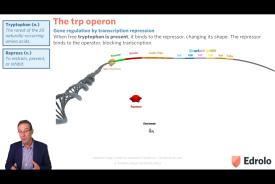
In the trp operon diagram shown, what happens when free tryptophan is present?
Free tryptophan binds to the repressor, changing its shape so the repressor binds to the operator, blocking transcription.

In this metabolic pathway diagram, which enzyme converts Chorismate into Anthranilate?
Anthranilate synthase.
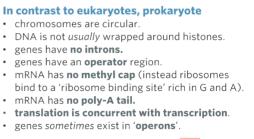
According to the contrast shown in this diagram, how does prokaryotic translation compare in timing to transcription?
Translation is concurrent with transcription.
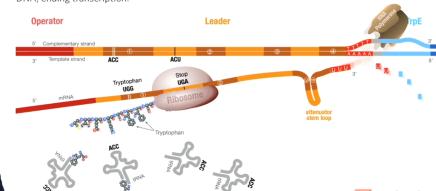
In the attenuation mechanism shown, what loop structure causes RNA polymerase to detach from the DNA?
Attenuator stem loop.