IB HL Physics (2023) - The Particulate Nature of Matter
 Call Kai
 Learn
Learn Practice Test
 Spaced Repetition
 Match
Match Flashcards
 Knowt Play
1/78

There's no tags or description
Looks like no tags are added yet.
Name | Mastery | Learn | Test | Matching | Spaced | Call with Kai | Chat |
|---|
No analytics yet
Send a link to your students to track their progress
79 Terms
Density
Mass per unit of volume (Kgm-3)
Temperature ☆
A measure of the average random kinetic energy of particles in a substance (°C Or K)
Heat
The thermal energy transferred from a body of higher temperature to a body of lower temperature
Absolute Zero ☆
The lowest temperature theoretically possible at which particles have zero kinetic energy (0K or -273°C)
Thermal Equilibrium
When two bodies in thermal contact have the same temperature and no net flow of heat energy
Internal Energy
The sum of the kinetic and potential energies in ln the molecules of a body (J)
Specific Heat Capacity
The amount of thermal energy required to raise 1kg of a substance by 1K (J Kg-1K-1)
Thermal Capacity
The amount of energy required to raise the temp of an object by 1K or 1°C (J K-1)
Specific Latent Heat of Fusion
The energy required to change 1kg of a solid into a liquid (JKg-1)
Specific Latent Heat Vaporisation
The energy required to change 1kg of a liquid into a gas (JKg-1)
Methods of Heat Transfer
Conduction - Through solids
Convection - Through fluids
Thermal Radiation - Transfer through the emission of photons
Black Bodies ☆
An object which can absorb and emit all wavelengths of EM radiation (reflects NO radiation)
Intensity
The amount of energy recieved per unit second, per cross sectional area (Wm-2)
Black bodies and Intensity
For black bodies (like stars) we can plot the intensity of each wavelength emitted on a graph and it always takes this shape
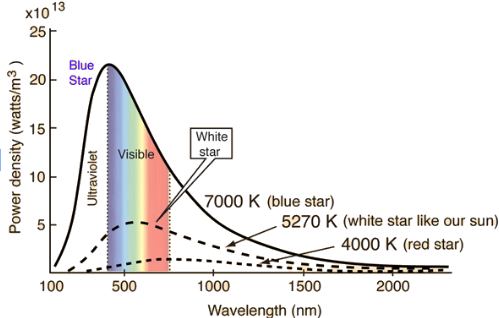
Wien’s Displacement Law ☆
The relationship between the peak wavelength and the absolute temperature of the surface of a black body
T at λmax = 2.898 x 10⁻³ mK (metres Kelvin NOT miliKelvin)
λmax is the wavelength at which maximum energy is radiated
Luminosity (L)
The Energy radiated by a star per second (W)
Stefan’s Law ☆
The total energy radiated per unit time by a black body is proportional to the fourth power of its absolute temperature and surface area
Apparent Brightness (b)
The amount of energy per second per unit area that arrives at a distance from the star (Wm-2)
Emissivity (e)
The ratio of power emitted from a body to the power emitted by a black body of the same size
e will always be between 0 and 1
a black body has an emissivity of 1
Albedo
The proportion of incident light that is reflected off a surface
Solar Constant ☆
The intensity of solar radiation across all wavelengths that is incident at the mean distance of earth from the sun
Greenhouse Gases
Gases which make up our atmosphere that trap heat and prevent it from escaping into space
Carbon Dioxide (CO2)
Methane (CH4)
Water Vapour (H2O)
Nitrous Oxide (N2O)
The Greenhouse Effect: Excitation ☆
Gas Molecules will absorb certain wavelengths of photons and temporarily gain more energy. This is known as excitation
Eventually they re-emit these photons in all directions
The Greenhouse Effect: Resonance ☆
The natural frequency of greenhouse gases is in the infrared region which means they are prone to absorbing the energy from infrared radiation
Then they later re emit the photons in all directions and sometimes back towards Earth
Energy Balance
the difference between the energy into the earth and the energy leaving the eart
Enhanced Greenhouse effect ☆
the additional radiative forcing resulting from increased concentrations of greenhouse gases induced by human activities
Pressure
The amount of force per unit area that acts perpendicular to the surface of an object (Pa)
Pressure in Solids and liquids
Solids - weight/ area of face
liquids - density*gravity*height
State of a Gas
The specific physical condition of a gas sample at a given time
Ideal Gas Assumptions ☆
D - duration of collisions are negligible
R - random motion by particles
I - Intermolecular forces not present between particles
V - volume of particles are negligible
E - elastic collisions between particles
Real Gases and Ideal Gases
Real gases approach ideal gas behaviour at:
Low pressure and High Temperature
Ideal Gas Laws
Boyle’s Law - Pressure-Volume
Charles’s Law - Temperature-Volume
Gay-Lussac’s Law - Pressure-Temperature
Gay-Lussac’s Law ☆
For a fixed mass of gas with constant volume the pressure is directly proportional to the Absolute temperature of the gas
P/T = constant
higher temp=higher avg speed
particles collide with the walls more frequently
rate of change of momentum increases
greater average force
Boyle’s Law ☆
For a fixed mass of gas at a constant temperature the pressure is inversely proportional to the volume
PV = Constant
with a smaller volume the frequency of collisions increases leading to more force due to an increased rate of change of momentum
Charles’ Law ☆
For a fixed mass of gas kept at a constant pressure the volume is proportional to the temperature
V/T= Constant
When the temperature increases avg speed of molecules increase and so there are more frequent collisions with the side of the container, leading to the volume increasing
System
The body or bodies that we are considering
Surroundings
The area that the system can interact with through the transfer of heat energy
Universe
The system and it’s surroundings
Open System
a system which can exchange energy, work done, and matter with its surroundings
Closed System
a system which can only exchange work done and energy with its surroundings
Isolated System
a system which cannot exchange anything with it’s surroundings
The First Law of Thermodynamics
The Thermal energy (Q) entering a closed system is equal to the sum of the Change in Internal Energy (ΔU) of the system and the Work Done (W) of the system
Q=ΔU+W
Isobaric Change
a change in state where pressure is constant (ΔP=0)
temperature and volume change proportionally
Work is done on or by the gas to change the volume
Isovolumetric change
a change in state where volume is constant (W=0)
temperature and pressure change proportionally
Q=ΔU+0
Isothermal Change
a change in state where temperature is constant (ΔU=0)
pressure and volume are inversely proportional
Q=0+W
ideally an isothermal change is infinitely slow
Adiabatic Change
a change in state where no thermal energy is transferred (Q=0)
volume temperature and pressure can change
the magnitude of ΔU will be equal but opposite to the W
+W = -ΔU
-W = +ΔU
when ΔU is positive temperature increases
Entropy (S)
a measure of the number of possible arrangements of the particles and their energies
The Second Law of Thermodynamics
The entropy of the universe always increases during an irreversible change
The Clausius Clause
Energy cannot be transferred from a body at lower temperature to a body at a higher temperature unless work is done system
Kelvin’s Clause
Energy cannot be extracted from a hot object and transferred entirely into work
Heat Engine
a device that converts thermal energy into mechanical work by transferring heat from a hot reservoir to a cold reservoir
Reversible Process
a process in which there is no overall change in the entropy of the system and its surroundings
Irreversible process
a process which results in an overall increase in entropy of the system and its surroundings
Microstate
a specific molecular configuration
Macrostate
larger scale measurable outcome, resulting from the outcome of each of the smaller microstates
Equations of Entropy
S= KB ln(Ω)
ΔS=ΔQ/T
Stages of a Heat Engine
Q in from RH
+W therefore +V
(some)Q → RC
-Q therefore -V
cycle restarts
Carnot cycle
an idealised theoretical thermodynamic cycle that:
involves 4 processes
is reversible
has the theoretical maximum efficiency of any heat engine
Heat Pumps and Refrigerators
Heat engines in reverse
work is done to transfer energy from cold to hot
refrigerators maximise energy transfer from the CR per joule of W
Heat pumps maximise energy transfer to the HR per joule of W
Ion
particles with different numbers of electrons and protons
Elementary charge (e)
the magnitude of the charge of a proton or electron
1e = 1.60×10⁻¹⁹C
Potential Difference (V) ☆
The work done per unit charge moving at a positive charge between two points
Electromotive force (emf) ☆
work done by a cell per unit charge in moving a cell between two terminals
Electron Volt (eV)
the energy gained when an electron is accelerated by a potential difference of 1 volt
W=qV
1eV=1.60×10⁻¹⁹ J
Conventional current (I)
the amount of positive charge flowing past a point in a second
Conventional current and electron flow
CC= + → -
EF = - → +
Electrical Resistance (R)
the ratio of potential difference across a component to current through it
Electrical Power
rate of energy transfer (amount of work done per second)
Ohm’s Law
potential difference across a metallic conductor is proportional to the current flowing through it, provided the temperature does not change
Non-Ohmic Conductors - Filament Lamp
As pd across the filament lamp is increased, the electrons collide more frequently with the vibrating fixed ions, transferring energy
temperature increases which makes resistance increase
Non-Ohmic Conductors - Semi-conducting Diode
Diodes only allow current to flow in one direction
for negative V values there is no current
there is no significant current in the forward direction before the threshold voltage
high then low resistance in the forward direction
LDRs and Thermistors
LDR - resistance is inversely proportional to light intensity
NTC Thermistor (negative temp coeff.) - resistance is inversely proportional to temperature
Resistance of Wires
The physical propertied of a wire change it’s resistance
Length
Cross sectional area
Resistivity
R=ρL/A
Kirchoff’s First Law
The sum of currents into a junction is equal to the sum of currents out of a junction
Kirchoff’s Second Law
in a complete loop the sum of emfs is equal to the sum of potential difference in a loop
Potential Dividers
a circuit made of two or more series resistors that allows us to output any voltage we want that is less than the battery voltage
Potentiometer
a single wire with a sliding contact that can be used to build a potential divider circuit.
Batteries
a battery consists of two or more cells joined together
the cells consist of conductive components and a store of chemical energy
Internal Resistance
the resistance of the conductive components of a battery