12 - Basic Information for Virus
 Call Kai
 Learn
Learn Practice Test
 Spaced Repetition
 Match
Match Flashcards
 Knowt Play
1/37

There's no tags or description
Looks like no tags are added yet.
Name | Mastery | Learn | Test | Matching | Spaced | Call with Kai | Chat |
|---|
No analytics yet
Send a link to your students to track their progress
38 Terms
a. Virus
[Basics - Feature]
Small obligate, intracellular parasite that requires a host for source of energy, reproduction, and structural formation, leading to viral infection
a. Virus
b. Bacteria
c. Fungus
d. Parasite
a. Self-limiting
[Basics - Feature]
The condition caused by a small obligate, intracellular parasite is
a. Self-limiting
b. Chronic
c. Progressive
d. Fatal
a. Supportive therapy
[Basics - Feature]
The treatment for infection caused by a small obligate, intracellular parasite is
a. Supportive therapy
b. Antibiotics
c. Antivirals
d. Antifungals
a. DNA or RNA
[Basics - Viral structure]
The nucleic acid component of a virus can be
a. DNA or RNA
b. DNA only
c. RNA only
d. Neither DNA nor RNA
c. Viroid
[Basics - Viral structure]
Nucleic acid component of a virus that contains RNA only
a. Virion
b. Capsid
c. Viroid
d. Prion
a. Capsid
[Basics - Viral structure]
The protein coat of a virus is called
a. Capsid
b. Virion
c. Envelope
d. Matrix
a. Virion
[Basics - Viral structure]
Nucleic acid + capsid is called _____
a. Virion
b. Viroid
c. Capsid
d. Envelope
Rhinovirus
Adenovirus
Polio virus
📌Mnemonic: “RAP”
[Basics - Viral structure]
Cubic or icosahedral viral symmetry is seen in ______
a. Rhinovirus, adenovirus, polio virus
b. Coronavirus, tobacco mosaic virus
c. Pox virus, bacteriophages
d. Viroid
Coronavirus
Tobacco mosaic virus
📌Mnemonic: “CT”
[Basics - Viral structure]
Helical viral symmetry is seen in
a. Rhinovirus, adenovirus, polio virus
b. Coronavirus, tobacco mosaic virus
c. Pox virus, bacteriophages
d. Viroid
Pox virus
Bacteriophages
📌Mnemonic: “PB”
[Basics - Viral structure]
Complex viral symmetry is seen in
a. Rhinovirus, adenovirus, polio virus
b. Coronavirus, tobacco mosaic virus
c. Pox virus, bacteriophages
d. Viroid
Attachment
│
▼
Penetration
│
▼
Uncoating
│
▼
Virion Synthesis
│
▼
Packaging
│
▼
Assembly
│
▼
Release
Viral Life Cycle [7]
a. Lysogenic
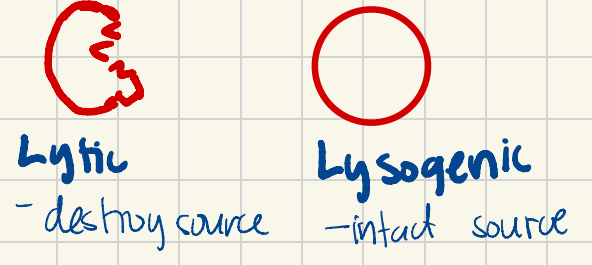
[Basics - Viral Life Cycle]
Intact source
a. Lysogenic
b. Lytic
b. Lytic
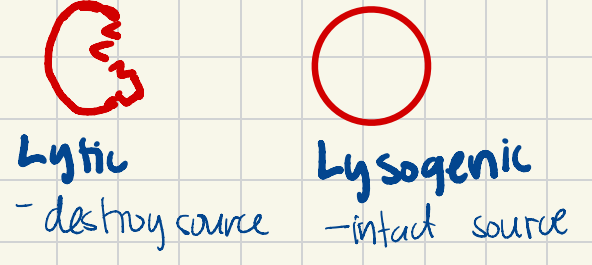
[Basics - Viral Life Cycle]
Destroy source
a. Lysogenic
b. Lytic
Double-stranded
Icosahedral
Replicate in nucleus
[Basics - DNA Virus]
General characteristics of DNA viruses
a. Double-stranded, icosahedral, replicate in nucleus
b. Single-stranded, icosahedral, replicate in nucleus
c. Double-stranded, complex, replicate in cytoplasm
d. Single-stranded, complex, replicate in cytoplasm
b. Nucleus
[Basics - DNA Virus]
DNA viruses replicated in _______
a. Mitochondria
b. Nucleus
c. Cytoplasm
d. Thylakoid
a. Parvovirus
[Basics - DNA Virus]
The DNA virus that is single-stranded
a. Parvovirus
b. Poxvirus
c. Herpesvirus
d. Adenovirus
b. Poxvirus
[Basics - DNA Virus]
The DNA virus that is complex in symmetry
a. Parvovirus
b. Poxvirus
c. Adenovirus
d. Papovavirus
Parvovirus
Adenovirus
Papovavirus
Papilloma
Polyoma
📌Mnemonic: “PAP”
[Basics - DNA Virus]
Naked DNA viruses [3]
Poxvirus
Herpes virus
Hepatitis B
📌Mnemonic: “PHH”
[Basics - DNA Virus]
Enveloped DNA viruses [3]
c. Replication
[Basics - DNA Virus]
Central dogma process where DNA copies itself
a. Transcription
b. Translation
c. Replication
d. Transduction
b. Transcription
[Basics - DNA Virus]
Central dogma process where DNA is converted to mRNA
a. Replication
b. Transcription
c. Translation
d. Transduction
c. Translation
[Basics - DNA Virus]
Central dogma process where mRNA is converted to protein (CHON)
a. Replication
b. Transcription
c. Translation
d. Transduction
b. Protein
[Basics - DNA Virus]
Product of translation in the central dogma
a. Nucleic acid
b. Protein
c. Lipid
d. Carbohydrate
Helical
Enveloped
Replicates in cytoplasm
Single-stranded
📌Mnemonic: “HECS”
[Basics - RNA Virus]
General characteristics of RNA viruses [4]
a. Helical, enveloped, replicate in cytoplasm, single-stranded
b. Icosahedral, naked, replicate in nucleus, double-stranded
c. Helical, naked, replicate in cytoplasm, double-stranded
d. Icosahedral, enveloped, replicate in nucleus, single-stranded
c. Helical
[Basics - RNA Virus]
RNA viruses are _______
a. Icosahedral
b. Complex
c. Helical
d. Cubic
b. Enveloped
[Basics - RNA Virus]
RNA viruses are _____
a. Naked
b. Enveloped
c. Complex
d. Variable
b. Cytoplasm
[Basics - RNA Virus]
RNA viruses replicates in ______
a. Nucleus
b. Cytoplasm
c. Golgi apparatus
d. Smooth ER
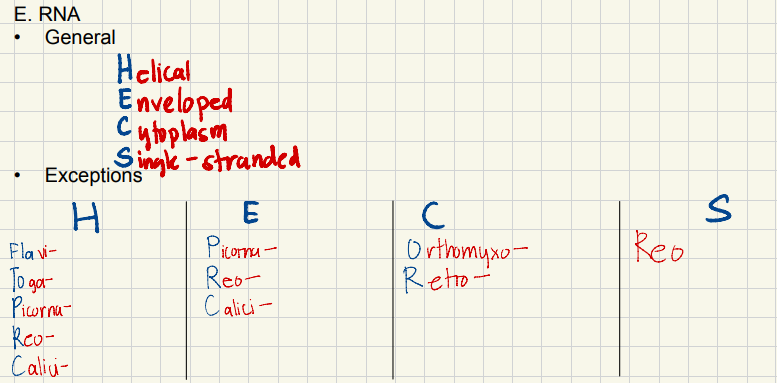
Flavivirus
Togavirus
Picornavirus
Reovirus
Calicivirus
'📌Mnemonic: “FT” “PRC”
[Basics - RNA Virus]
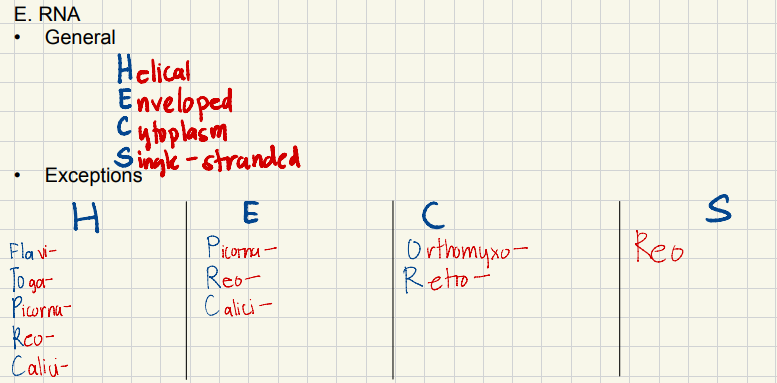
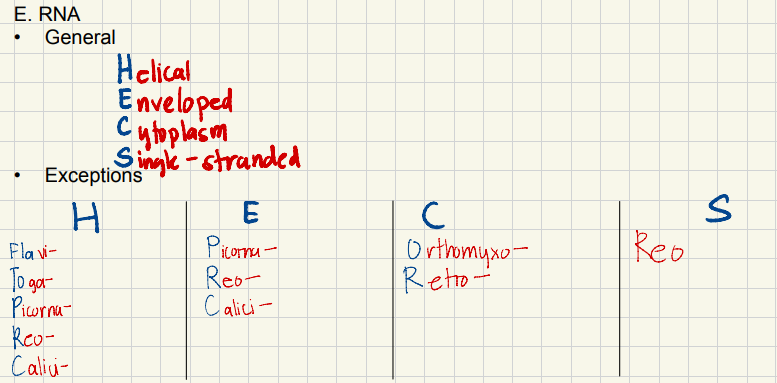
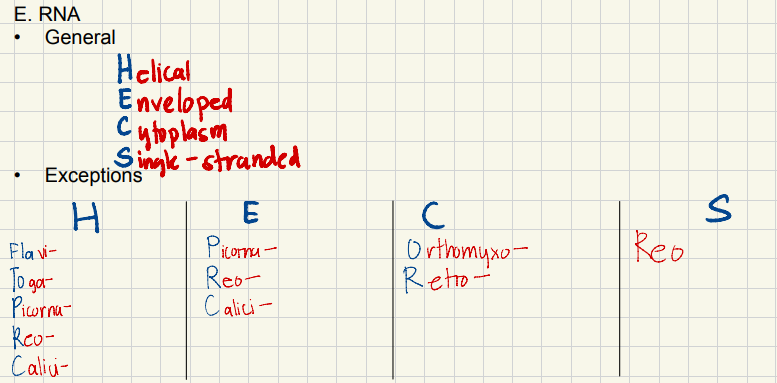
RNA viruses that are exceptions to Helical [5]
Picornavirus
Reovirus
Calicivirus
📌Mnemonic: “PRC”
[Basics - RNA Virus]
RNA viruses that are exceptions to Enveloped [3]
Orthomyxovirus
Retrovirus
📌Mnemonic: “OR”
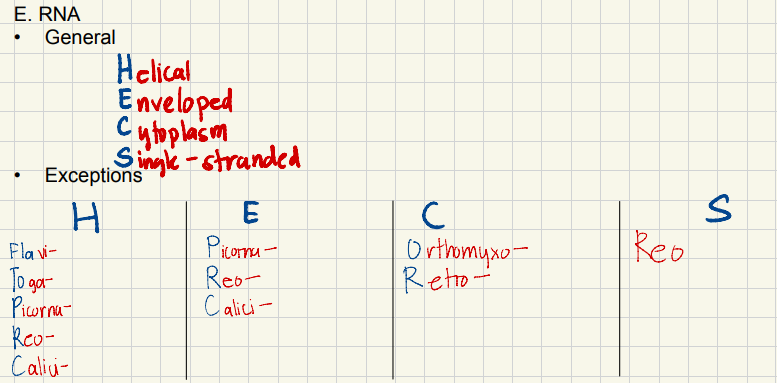
[Basics - RNA Virus]
RNA viruses that are exceptions to Cytoplasm [2]
Reovirus
[Basics - RNA Virus]
RNA viruses that are exceptions to Single-stranded [1]
Picornavirus
Calicivirus
[Basics - RNA Virus]
RNA viruses that are exceptions to _____ [2]
Helical
Enveloped
Reovirus
[Basics - RNA Virus]
RNA viruses that are exceptions to ______ [1]
Helical
Enveloped
Single-stranded
a. Positive sense RNA virus
[Basics - RNA Virus]
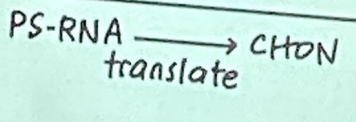
PS-RNA directly translates into protein (CHON)
a. Positive sense RNA virus
b. Negative sense RNA virus
b. Negative sense RNA virus
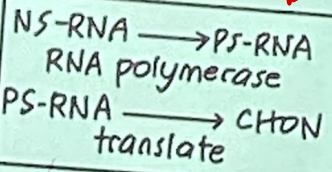
[Basics - RNA Virus]
BEQ: Requires RNA polymerase enzyme to convert
Negative sense RNA virus → Positive sense RNA virus before translation
a. Positive sense RNA virus
b. Negative sense RNA virus
b. RNA polymerase
[Basics - RNA Virus]
Enzyme used by:
Negative sense RNA virus → Positive sense RNA virus
a. DNA polymerase
b. RNA polymerase
c. Reverse transcriptase
d. Ligase
Picorna
Corona
Toga
Calici
Flavi
Retro
📌Mnemonic: “PiCoT” “Ca” “FlaRe”
[Basics - RNA Virus]
Positive sense RNA virus [6]
Paramyxovirus
Filovirus
Arenavirus
Bunyavirus
Orthomyxovirus
Rhabdovirus
📌Mnemonic: “Par” “FABOR”
[Basics - RNA Virus]
Negative sense RNA virus [6]