Anatomy of the Vertebral column and spinal cord Day 2
 Call Kai
 Learn
Learn Practice Test
 Spaced Repetition
 Match
Match Flashcards
 Knowt Play
1/36

There's no tags or description
Looks like no tags are added yet.
Name | Mastery | Learn | Test | Matching | Spaced | Call with Kai | Chat |
|---|
No analytics yet
Send a link to your students to track their progress
37 Terms
What sections of the spinal column make up the primary curvature and secondary curvature
Primary: Thoracic and Sacral/coccygeal
Secondary: cervical and lumbar
What special characteristics do Cervical vertebrae have
Bifed Spinous processes
Not vertebral discs between atlas, occipital bone, and axis.
What are thoracic vertebrae charactorized by
Their articulation with the ribs
what lumbar vertebrae has the thickst and heaviest vertebral body and what condition occurs most often at its inferior articulation
The L5 lumbar and spondylolisthesis
What section of vertebrae allow for a puncture to collect a sample of fluid from the cord and what is this procedure and fluid called
Lumbar, Lumbar Puncture, and CSF
what structure allows for things such as nerves and vessels to pass in and out of the vertebral canal
intervertebral foramen
what is the name and purpose of the nucleus pulposus
Absorb compression forces between vertebral discs
what is the purpose of the Annulus firbosus
limit rotation between vertebrae
what is the joints between superior and inferior facets called
Zygapophysial joint
what causes a herniated disc
weakening of the annulus fibrosus
What spinal ligament resists separation of spinal lamina by limiting abrubt flexion
Ligamentum flavus
what spinal ligament connects the C7 to to sacrum spinal processes
Supraspinous ligament
what spinal ligament connects from C7 to the skull specifically at the external occipital protuberance
nuchal ligament
What ligaments pass through the adjacent vertebral spinous processes
Interspinous ligaments
what two ligaments attach to the anterior and posterior portions of the vetebral bodies and which one of these ligments lines the anterior portion of the vertebral canal
Anterior and Posterior longitudinal ligaments
where does the vertebral canal terminate at
the sacral hiatus just above the coccyx
what are the different levels of spinal meninges from superficial to deep
Epidural space, Dura mater, subdural space, arachnoid mater, subarachnoid space, pia mater, and the spinal cord
what is the difference between epidural and spinal injections
Epidurals use a small plastic tube to inject anesthesia into the epidural space. The medication starts to work after about 15 minutes. A catheter is also left in for potential future use of medication
Spinal injections (specifically anesthesia) use thinner needles and inject it into the CSF
What meningeal layer contains the CSF
Sub arachnoid space
What meningeal layer gives rise to a certain type of ligament and what do these ligaments do
The pia mater and denticulate ligaments which anchor the spinal cord to the dura mater layer and play a key role in stabilization of the spinal cord
What part of the filum terminale is constructed of Pia mater and what does it do
the filum terminale internus and anchors the conus medullaris to the caudal end of the spinal dural sheath
What condition can a laminectomy help with
Spinal stenosis
whare does the spinal enlargement start
at the level of C8 spinal nerve
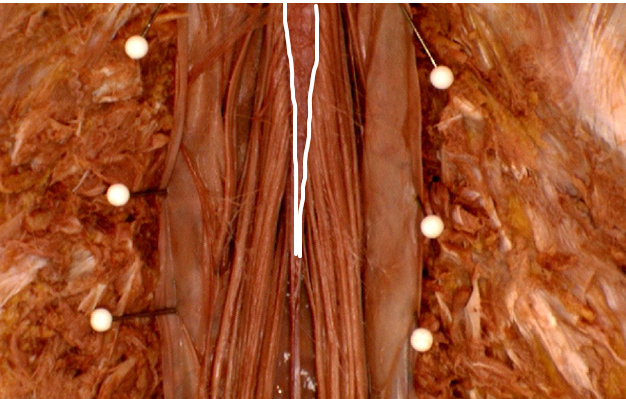
what is the highlighted structure and where does it begin at
Conus medullaris and L1/L2
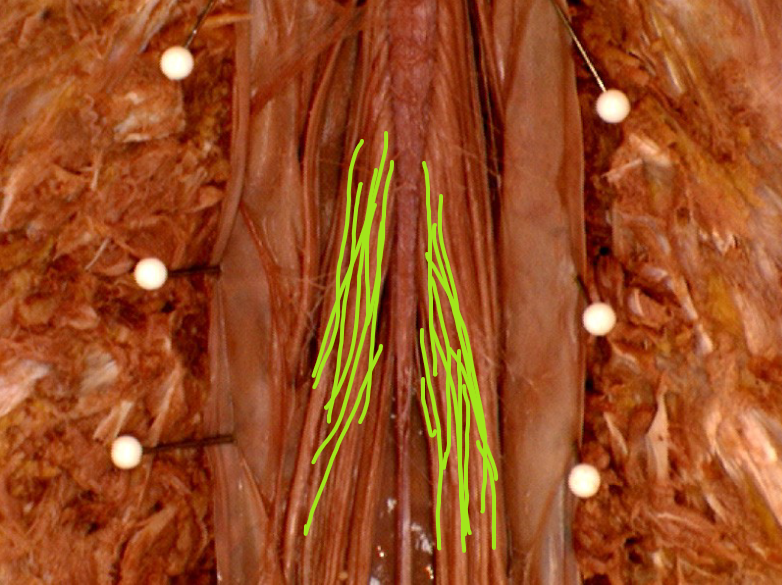
what is the highlighted structure
The cauda equina
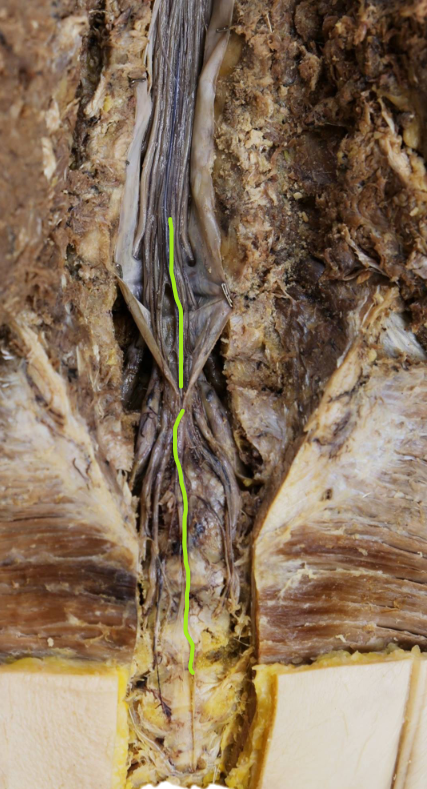
what are the highlighted structures and their purpose
The filum terminale externus and internus
what is the filum terminale internus made of and what is it purpose
Pia mater anchors the conus medullaris to the caudal end of the spinal dural sheath
what is the filum terminale externus made of and what is its purpose
Pia and dura matter and achors the spinal cord at the coccyx
what are The three most common types of spina bifida and their defining characteristics
Myelomeningocele: sac of fluid through an opening in the baby’s back with spinal cord and damaged nerves in the sac
Meningocele: sac of fluid comes through an opening in the baby’s back but does not contain nerves so they are not damaged
Spina Bifida Occulta: small gap in the spine, but no opening or sac on the back. The spinal cord and the nerves usually are norm
What is gray matter of rich in
Nerve cell bodies
what is white mater rich in
nerve cell processes and tracts
what does the posterior root carry
Sensory information to the CNS
what does the anterior root carry
motor information away from the CNS to the periphery
what part of the body do the posterior Rami innervate
The intrinsic back muscles and skin of the back
what part of the body do the anterior Rami innervate
other skeletal muscles and remaining areas of the skin
where does the spinal cord typically end
L1 or 2
What are the 2 enlargements in the spine and what are they for
The cervical enlargement is for the brachial plexus.
the lumbar enlargment is for the lumbosacral plexus