📸A&PII- Respiratory Anatomy
 Call Kai
 Learn
Learn Practice Test
 Spaced Repetition
 Match
Match Flashcards
 Knowt Play
1/50

Earn XP
Description and Tags
https://quizlet.com/495595322/apii-respiratory-anatomy-flash-cards/
Name | Mastery | Learn | Test | Matching | Spaced | Call with Kai | Chat |
|---|
No analytics yet
Send a link to your students to track their progress
51 Terms
c
What is the difference between the conducting zone and the respiratory zone of the respiratory system?
A.) The conducting zone moves oxygen into the cells and the respiratory zone takes carbon dioxide away from the cells.
B.) The conducting zone moves oxygen into the bloodstream and the respiratory zone takes carbon dioxide away from the bloodstream.
C.) The conducting zone exchanges gases between the lungs and the alveoli and the respiratory zone is a series of cavities and tubes that move air to the conducting zone.
D.) The conducting zone is a series of cavities and tubes that move air to the respiratory zone where gases exchange with the bloodstream.
D
What is the difference between the conducting zone and the respiratory zone of the respiratory system?
A.) The conducting zone moves oxygen into the cells and the respiratory zone takes carbon dioxide away from the cells.
B.) The conducting zone moves oxygen into the bloodstream and the respiratory zone takes carbon dioxide away from the bloodstream.
C.) The conducting zone exchanges gases between the lungs and the alveoli and the respiratory zone is a series of cavities and tubes that move air to the conducting zone.
D.) The conducting zone is a series of cavities and tubes that move air to the respiratory zone where gases exchange with the bloodstream.
b
Which of the following statements is mismatched?
A.) Base - Is concave and fits over the convex area of the diaphragm.
B.) Apex - Inferior portion of the lung.
C.) Left lung oblique fissure - Separates the superior lobe from the inferior lobe.
D.) Lobules - Compartments of each bronchopulmonary segment.
E.)Cardiac notch - Left lung concavity in which the heart lies.
Alveolar surface tension causes the lungs to assume the largest possible diameter.
Which of the following statements is INCORRECT?
A.) Alveolar surface tension causes the lungs to assume the largest possible diameter.
B.) Alveolar surface tension is responsible for much of the elastic recoil of the lungs.
C.) High compliance means that the lungs and chest wall expand easily while low compliance means that they resist expansion.
clean air of debris, conduct air into the lungs, add water to air, warm air
Functions of the conduction zone (4)
pharynx
passageway for air, food and water
epiglottis
what structure prevents food and water from entering the trachea
alveolus
where does the primary exchange of gases occur?
carina
The point where the trachea divides into right and left primary bronchi is a ridge called
simple squamous epithelium
What type of tissue forms the exchange surfaces of the alveolus?
diaphragm, external intercostals
During quiet inhalation, which respiratory muscles contract?
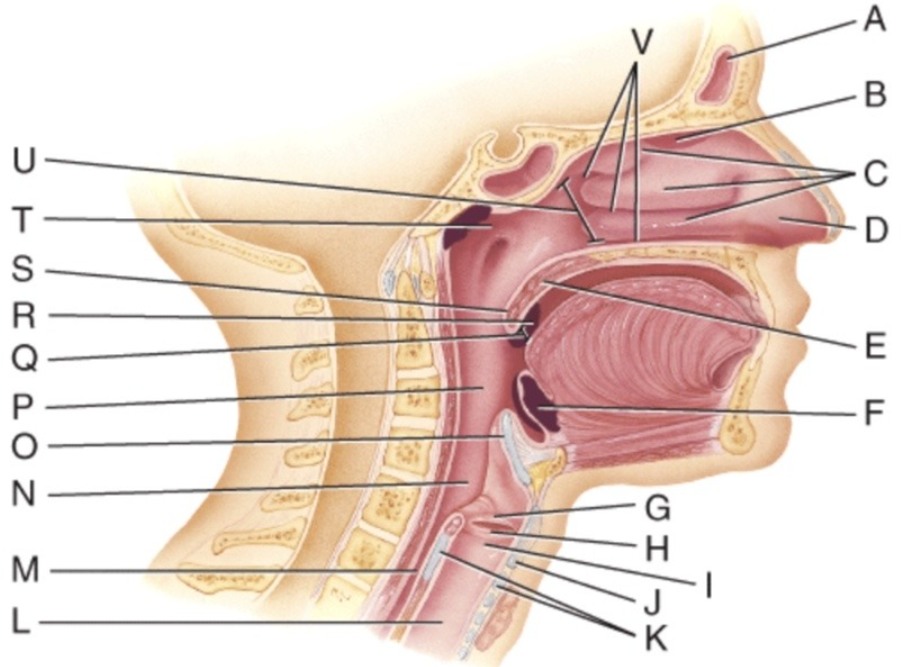
Soft palate
e
—
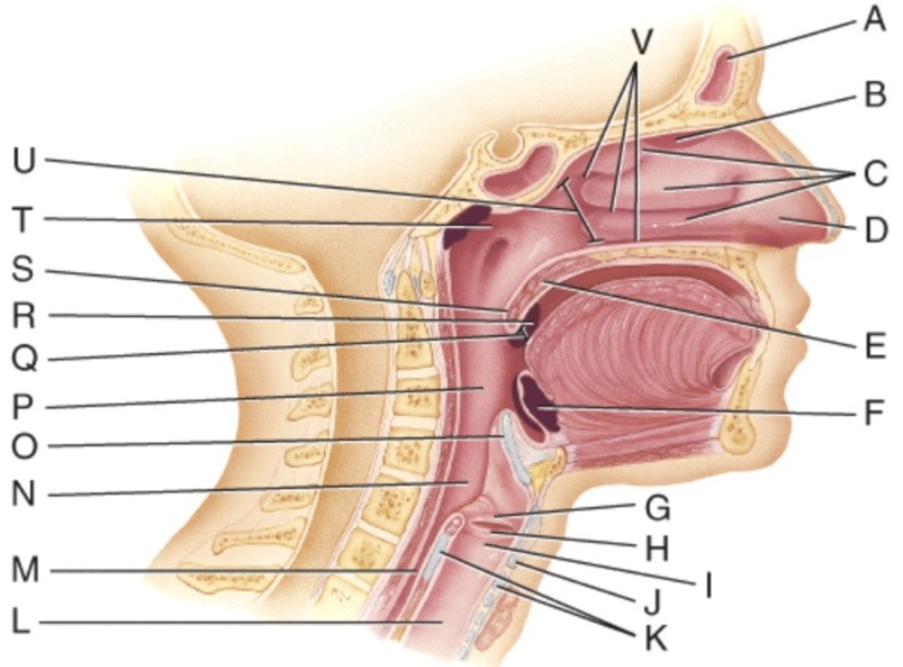
A – Frontal sinus
B – Olfactory epithelium
C – Nasal conchae
D – External naris
E – Soft palate
F – Lingual tonsil
G – Vestibular fold
H – Vocal fold
I – Larynx
J – Thyroid cartilage
K – Cricoid cartilage
L – Trachea
M – Esophagus
N – Laryngopharynx
O – Epiglottis
P – Oropharynx
Q – Fauces
R – Palatine tonsil
S – Uvula
T – Nasopharyx
U – Internal naris
V – Nasal meatuses
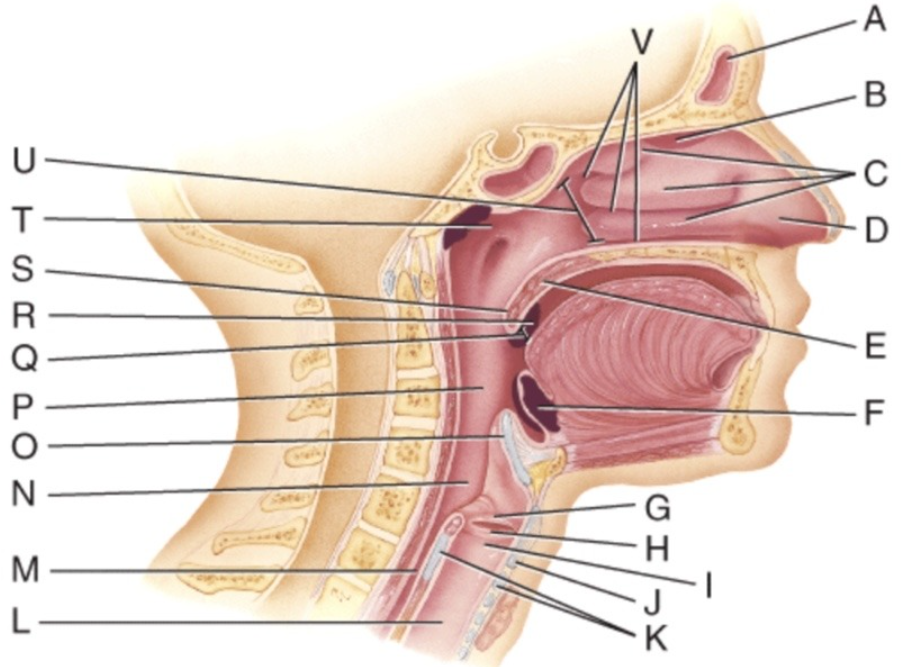
Lingual tonsil
f
—
A – Frontal sinus
B – Olfactory epithelium
C – Nasal conchae
D – External naris
E – Soft palate
F – Lingual tonsil
G – Vestibular fold
H – Vocal fold
I – Larynx
J – Thyroid cartilage
K – Cricoid cartilage
L – Trachea
M – Esophagus
N – Laryngopharynx
O – Epiglottis
P – Oropharynx
Q – Fauces
R – Palatine tonsil
S – Uvula
T – Nasopharyx
U – Internal naris
V – Nasal meatuses
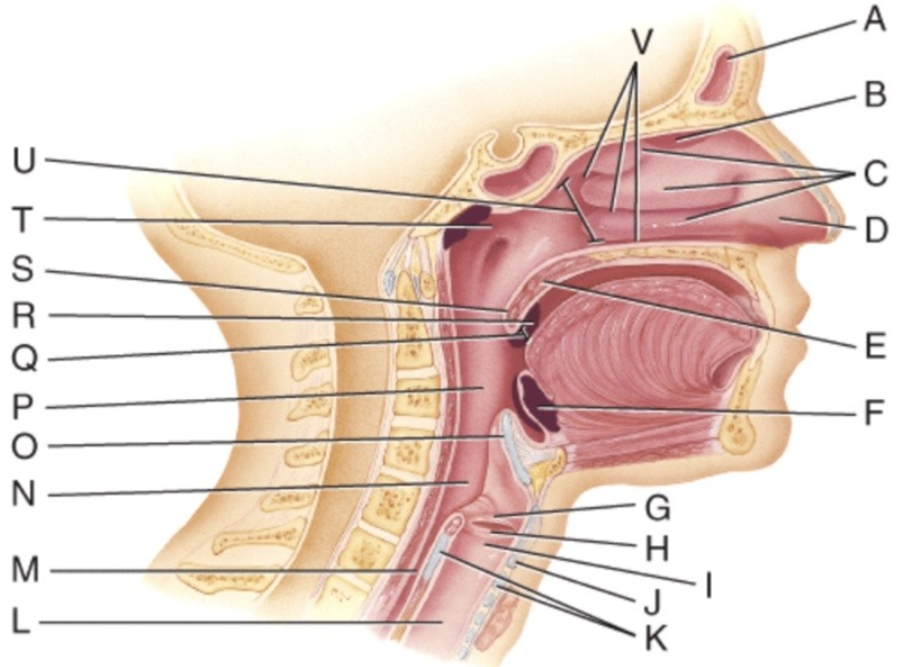
Palatine tonsil
r
A – Frontal sinus
B – Olfactory epithelium
C – Nasal conchae
D – External naris
E – Soft palate
F – Lingual tonsil
G – Vestibular fold
H – Vocal fold
I – Larynx
J – Thyroid cartilage
K – Cricoid cartilage
L – Trachea
M – Esophagus
N – Laryngopharynx
O – Epiglottis
P – Oropharynx
Q – Fauces
R – Palatine tonsil
S – Uvula
T – Nasopharyx
U – Internal naris
V – Nasal meatuses
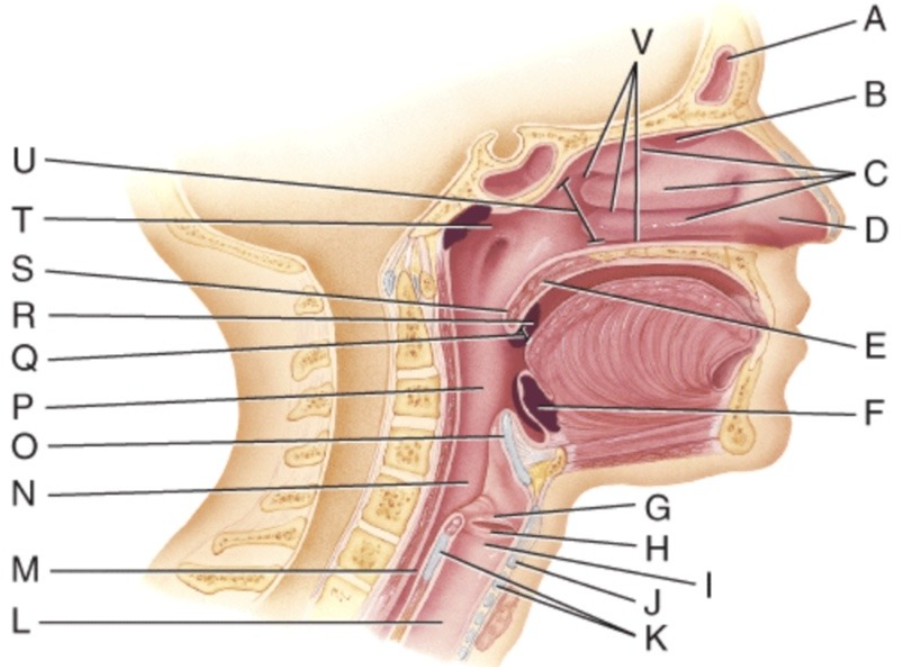
Meatus(es)
V
—
A – Frontal sinus
B – Olfactory epithelium
C – Nasal conchae
D – External naris
E – Soft palate
F – Lingual tonsil
G – Vestibular fold
H – Vocal fold
I – Larynx
J – Thyroid cartilage
K – Cricoid cartilage
L – Trachea
M – Esophagus
N – Laryngopharynx
O – Epiglottis
P – Oropharynx
Q – Fauces
R – Palatine tonsil
S – Uvula
T – Nasopharyx
U – Internal naris
V – Nasal meatuses
Pharyngeal tonsil
T
—
A – Frontal sinus
B – Olfactory epithelium
C – Nasal conchae
D – External naris
E – Soft palate
F – Lingual tonsil
G – Vestibular fold
H – Vocal fold
I – Larynx
J – Thyroid cartilage
K – Cricoid cartilage
L – Trachea
M – Esophagus
N – Laryngopharynx
O – Epiglottis
P – Oropharynx
Q – Fauces
R – Palatine tonsil
S – Uvula
T – Nasopharyx
U – Internal naris
V – Nasal meatuses
Carina
I
—
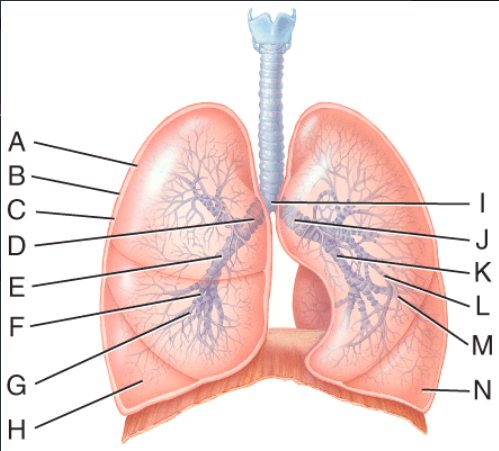
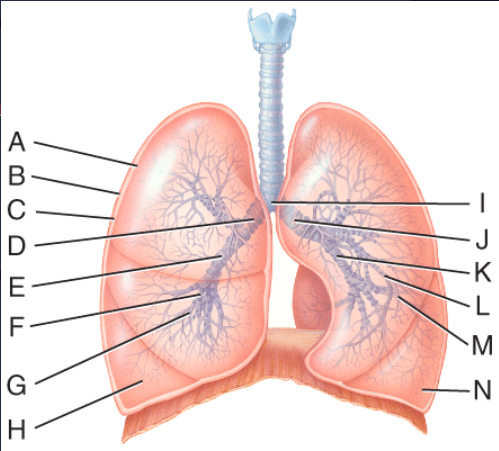
A — Visceral pleura
B — Parietal pleura
C — Pleural cavity
D — Right main bronchus
E — Right lobar bronchus
F — Right segmental bronchus
G — Right bronchiole
H — Right terminal bronchiole
I — Carina
J — Left chain bronchus
K — Left lobar bronchus
L — Left segmental bronchus
M — Left bronchiole
N — Left terminal bronchiole
Lobar bronchus (2)
E,K
—
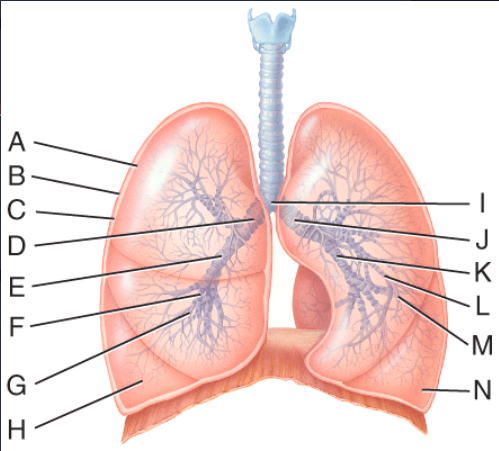
A — Visceral pleura
B — Parietal pleura
C — Pleural cavity
D — Right main bronchus
E — Right lobar bronchus
F — Right segmental bronchus
G — Right bronchiole
H — Right terminal bronchiole
I — Carina
J — Left chain bronchus
K — Left lobar bronchus
L — Left segmental bronchus
M — Left bronchiole
N — Left terminal bronchiole
Left terminal bronchiole
n
—
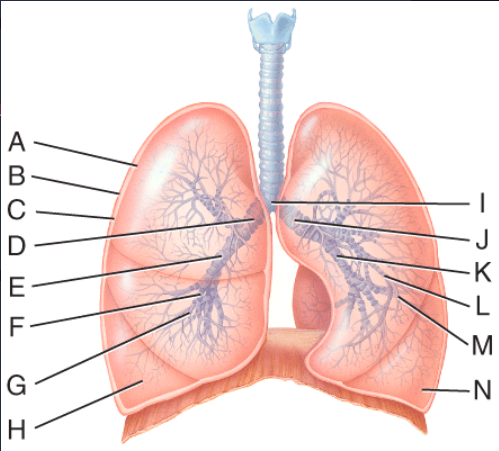
A — Visceral pleura
B — Parietal pleura
C — Pleural cavity
D — Right main bronchus
E — Right lobar bronchus
F — Right segmental bronchus
G — Right bronchiole
H — Right terminal bronchiole
I — Carina
J — Left chain bronchus
K — Left lobar bronchus
L — Left segmental bronchus
M — Left bronchiole
N — Left terminal bronchiole
Right bronchiole
g
—
A — Visceral pleura
B — Parietal pleura
C — Pleural cavity
D — Right main bronchus
E — Right lobar bronchus
F — Right segmental bronchus
G — Right bronchiole
H — Right terminal bronchiole
I — Carina
J — Left chain bronchus
K — Left lobar bronchus
L — Left segmental bronchus
M — Left bronchiole
N — Left terminal bronchiole
Identify the 3 divisions of the pharynx:
nasopharynx, oropharynx, laryngopharynx
What substance produced by great (Type II) alveolar cells?
surfacant
What is the function of surfacant?
to reduce the surface tension in the alveoli
Which covering of pleura is most closely adhered to the surface of the lungs?
visceral
Boyles' Law of respiration generally states that as the size of a closed container (_______) __________ , the __________ ___________. (4 words)
volume decreases, pressure increases
tubular airways that begin the respiratory zone
respiratory bronchiole
connects the laryngopharynx with the trachea
larynx
tube-like structure that conducts air from the larynx to the bronchi
trachea
closes over the glottis of the larynx during swallowing
epiglottis
C-shaped rings that keep the trachea from collapsing
tracheal cartilage
division of the bronchi that enter bronchopulmonary segments
tertiary bronchus
last division of the conducting zone
terminal bronchiole
conducts air from the nasopharynx to the laryngopharynx
oropharynx
small round sacs where gas exchange occurs
alveolus
small conduction airway that serves a lobule
bronchiole
Identify the epithelium(s) which has the function secrete mucus and trap/remove dust and debris (3)
pseudostratified ciliated, ciliated columnar, ciliated cuboidal
Identify the epithelium which has the function to diffuse gases
simple squamous
Identify the epithelium which has the function to protect underlying structures
stratified squamous
Where is stratified squamous epithelium located?
oropharynx through vocal cords of the larynx
Where is simple squamous epithelium located?
end of respiratory bronchiole though alveolus
Where is pseudostratified ciliated epithelium located?
nasal cavity through nasopharynx, larynx below vocal cords through primary bronchi
Where is ciliated columnar epithelium located?
secondary bronchi through tertiary bronchi
Where is ciliated cuboidal epithelium located?
bronchioles through beginning of respiratory bronchiole
Which of the following statements is NOT correct?
A.) The lungs surround the mediastinum.
B.) Air normally fills the pleural cavity.
C.) The visceral pleura covers the lungs.
D.) The parietal pleura lines the thoracic cavity.
E.) The parietal and visceral pleura are separated by the pleural cavity.
b
The _______ pleura covers the lungs
visceral
The _______ pleura lines the thoracic cavity
parietal
The parietal and visceral pleura are separated by the __________
pleural cavity
The lungs surround the __________
mediastinum
A bronchopulmonary segment is directly supplied by a ______________________.
tertiary (segmental) bronchus
The internal structures of the external nose serve which of the following functions?
1. warming, moistening, and filtering incoming air
2. creating resonance
3. increasing gas exchange
1 & 2
Where can you locate the pharyngeal tonsils
nasopharynx