LAB - L4:T3-T4 (Neuromuscular B.A./ Narcotic Analgesics)
 Call Kai
 Learn
Learn Practice Test
 Spaced Repetition
 Match
Match Flashcards
 Knowt Play
1/50

There's no tags or description
Looks like no tags are added yet.
Name | Mastery | Learn | Test | Matching | Spaced | Call with Kai | Chat |
|---|
No analytics yet
Send a link to your students to track their progress
51 Terms
What is pain generally related to?
Some type of tissue damage, serving as a warning signal.
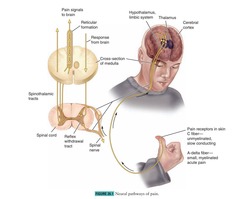
What are the two types of pain?
Acute pain and chronic pain.
What characterizes acute pain?
It occurs in response to recent tissue damage or injury.
What is chronic pain?
Constant or intermittent pain that persists long after the expected healing time.
What are nociceptive pain sources?
Pain from free nerve endings receiving painful stimuli, characterized by well-localized, dull, aching, or throbbing sensations.
Name the two kinds of nociceptive pain.
Visceral pain and somatic pain.
What is neuropathic pain?
Pain from damaged nerves, characterized by stabbing or shooting pain over a background of aching and burning.
What is an analgesic?
A drug that relieves pain.
What are the two main categories of analgesics?
Non-opioids and opioids.
What is a narcotic?
A general term for morphine-like drugs that produce analgesia and CNS depression.
Which receptors do opioids primarily act on?
Mu (μ) and kappa (κ) receptors.
What does 'agonist' mean in the context of opioids?
A substance that activates a receptor.
What does 'antagonist' mean?
A substance that blocks a receptor.
What are the indications for using narcotic analgesics?
Before and during surgery, invasive diagnostic procedures, labor and delivery, treatment of acute pulmonary edema, severe cough, and relief of acute and chronic pain.
List some effects of narcotic analgesics.
Euphoria, nausea, respiratory depression, urinary retention, diaphoresis, pupil constriction, and constipation.
What are some contraindications for narcotic analgesics?
Respiratory depression, chronic lung disease, chronic liver or kidney disease, BPH, increased intracranial pressure, and hypersensitivity reactions.
What should be monitored in patients receiving opioids?
Liver function, vital signs, neurological status, renal status, and side effects.
What are strong agonists in narcotic analgesics?
Drugs like alfentanil, fentanyl, hydromorphone, meperidine, morphine, heroin, oxycontin, tramadol, and methadone.
What characterizes moderate agonists?
Drugs like codeine and propoxyphene, which are less potent than strong agonists.
What are agonists/antagonists?
Drugs that stimulate one receptor while blocking another, with lower abuse potential.
What are antagonists used for?
To reverse opioid-induced respiratory depression.
What are common opioid antagonists?
Naloxone (Narcan), nalmefene (Revex), and naltrexone (ReVia).
What are the stages of opiate withdrawal symptoms?
Stage 1: Anxiety and drug craving; Stage 2: Anxiety, insomnia, GI disturbance; Stage 3: Chills, fever, tremors, seizures.
What medications can be used to manage withdrawal symptoms?
Methadone and clonidine.
What is the preferred route for administering narcotic analgesics?
Oral administration.
What is patient-controlled analgesia (PCA)?
An IV method allowing self-administration of pain medication.
When should narcotic analgesics be stopped?
After 72 hours of administration.
What is the effect of combining narcotics with non-narcotic analgesics?
They may work by different mechanisms, thus providing greater efficacy.
What are neuromuscular blocking agents used for during surgery?
They are primary adjuncts to ensure skeletal muscles are totally relaxed for safe surgical procedures.
What is a key requirement when using neuromuscular blocking agents during surgery?
Artificial mechanical ventilation is required as these drugs paralyze respiratory and skeletal muscles.
Do neuromuscular blocking agents cause sedation or pain relief?
No, they do not cause sedation or relief of pain; patients may be paralyzed yet conscious.
What are the two main types of neuromuscular blocking agents?
Depolarizing agents and nondepolarizing agents.
How do depolarizing agents work?
They act as acetylcholine agonists, causing stimulation of the muscle cell and preventing repolarization, leading to paralysis.
What is the mechanism of action for nondepolarizing agents?
They act as antagonists to acetylcholine at the neuromuscular junction, preventing depolarization of muscle cells.
What is succinylcholine?
A depolarizing neuromuscular blocking agent that causes prolonged depolarization and flaccid paralysis.
What serious side effect can succinylcholine cause related to heart function?
Abnormal or irregular heartbeat (cardiac arrhythmias).
What is a potential consequence of succinylcholine use related to muscle tissue?
Breakdown of muscle tissues (rhabdomyolysis).
What are some serious side effects of succinylcholine?
Cardiac arrest, excessive salivation, fast or slow heart rate, and malignant hyperthermia.
Name a short-acting nondepolarizing neuromuscular blocking agent.
Mivacurium (Mivacron).
What are examples of intermediate-acting nondepolarizing agents?
Atracurium (Tracrium), Rocuronium (Zemuron), and Vecuronium (Pavulon).
What is a long-acting nondepolarizing agent?
Pancuronium (Pavulon) or d-Tubocurarine (dTC).
What is the first sensation felt when using nondepolarizing agents?
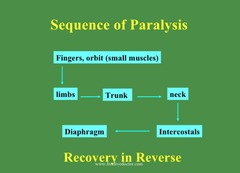
Weakness, followed by total flaccid paralysis.
Which muscles are affected first by nondepolarizing agents?
Small, rapidly moving muscles (like fingers and eyes), followed by limbs, neck, trunk, and finally intercostal muscles and diaphragm.
What are the therapeutic actions of nondepolarizing agents during surgery?
They serve as adjuncts to general anesthetics and facilitate mechanical intubation.
What adverse effects can nondepolarizing agents cause?
Prolonged paralysis, depressed respiration, bronchospasm, hypotension, and hyperkalemia.
What should be assessed before administering neuromuscular blocking agents?
Past history of surgeries, response to anesthesia, allergies, and use of other medications.
What monitoring is vital during the use of neuromuscular blocking agents?
Vital signs, baseline laboratory tests, ECG, and ABCs (airway, breathing, circulation).
What safety measure should be taken during recovery from neuromuscular blockade?
Monitor for cardiovascular and respiratory depression.
What should be taught to patients regarding the effects of neuromuscular blocking agents?
They may be paralyzed but still able to hear and feel.
What is the purpose of having a cholinesterase inhibitor available?
To overcome excessive neuromuscular blockade caused by nondepolarizing NMJ blockers.
What should be done if a patient does not respond or shows delayed response to neuromuscular blocking agents?
Discontinue the drug.