AP Biology - Enzymes
 Call Kai
 Learn
Learn Practice Test
 Spaced Repetition
 Match
Match Flashcards
1/46

There's no tags or description
Looks like no tags are added yet.
Name | Mastery | Learn | Test | Matching | Spaced | Call with Kai | Chat |
|---|
No analytics yet
Send a link to your students to track their progress
47 Terms
Metabolism
the totality of an organism's chemical reactions
Metabolic Pathway
begins with a specific molecule which is then altered through a series of defined steps to create a product
Metabolism manages _________ _________ resources of the cell
material and energy
catabolic pathways
release energy by breaking down complex molecules into simpler compounds
anabolic pathways
consume energy to build complex molecules from simpler ones
Example of anabolic pathway
synthesis of protein from amino acids
example of catabolic pathway
Cellular respiration, the breakdown of glucose in the presence of oxygen
Energy
The ability to do work or cause change
Kinetic energy
energy of motion
Potential energy
stored energy
Chemical energy
A form of potential energy that is stored in chemical bonds between atoms
Glucose is _______ in chemical energy
high
Thermodynamics
study of the flow and transformation of energy in the universe
first law of thermodynamics
Energy can be transferred and transformed, but it cannot be created or destroyed
second law of thermodynamics
Every energy transfer or transformation increases the entropy of the universe.
Entropy
A measure of disorder or randomness.
spontaneous process
a process that can occur without an input of energy
Free energy
energy that is available to do work
Equilibrium
A state of balance
When a reaction proceeds towards equilibrium, the free energy of the mixture of reactants and products ___________
decreases
Exergonic
Chemical reactions that release energy
Endergonic
A chemical reaction that requires the input of energy in order to proceed
Why is a living cell not in equilibrium?
there is a constant flow of materials in and out of the cell. This keeps the metabolic pathways from ever reaching equilibrium.
Enzymes are:
- Proteins
- Can be reused
- Function based on shape
- Serve as a catalyst
Reactions go ______
back and fourth. They can be reversed
Induced Fit
The change in shape of the active site of an enzyme so that it binds more snugly to the substrate, induced by entry of the substrate

What elements are important to enzymes?
Zinc, Iron, Copper, and Manganese
Cofactors
Any nonprotein molecule or ion that is required for the proper functioning of an enzyme. Cofactors can be permanently bound to the active site or may bind loosely with the substrate during catalysis
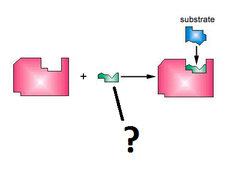
Coenzymes
organic cofactors

Inhibition in a chemical reaction
slows down chemical reactions
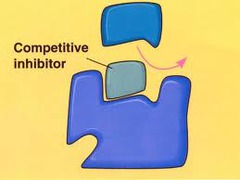
Competitive inhibition
Inhibitor that bonds to the active site so that the substrate may not bond
Substrate
reactant of an enzyme-catalyzed reaction
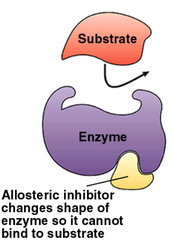
noncompetitive inhibitor
A substance that reduces the activity of an enzyme by binding to a location remote from the active site, changing its conformation so that it no longer binds to the substrate.

allosteric inhibition
the mechanism for inhibiting enzyme action in which a regulatory molecule binds to a second site (not the active site) and initiates a conformation change in the active site, preventing binding with the substrate
Activation energy
Energy needed to get a reaction started
Proteins, DNA, and other complex molecules are rich in _______ ________
free energy
High temperature
denatures enzymes
Instead of heat, what do organisms use to speed up their reactions?
catalysts
How does an enzyme catalyze a reaction?
by lowering the energy of activation of a reaction
enzyme-substrate complex
A temporary complex formed when an enzyme binds to its substrate molecule(s)
Active site
The part of an enzyme or antibody where the chemical reaction occurs
What factors effect enzyme activity?
pH and temperature
What determines the rate of a reaction?
The energy of activation (Ea)
Allosteric Regulation
The binding of a regulatory molecule to a protein at one site that affects the function of the protein at a different site
cooperactivity
a form of allosteric regulation that can amplify enzyme activity
Enzyme-inhibiting agents
act on an enzymes active site
feedback inhibition
A method of metabolic control in which the end product of a metabolic pathway acts as an inhibitor of an enzyme within that pathway