MCAT DNA
 Call Kai
 Learn
Learn Practice Test
 Spaced Repetition
 Match
Match Flashcards
 Knowt Play
1/138

There's no tags or description
Looks like no tags are added yet.
Name | Mastery | Learn | Test | Matching | Spaced | Call with Kai | Chat |
|---|
No analytics yet
Send a link to your students to track their progress
139 Terms
Which DNA polymerases have exonuclease activity?
I and III
Genetic material lost from the telomeres during the:
joining of Okazaki fragments.
Doxycycline would not affect human ribosomes, because human ribosomes are made up of _________ while prokaryotic ribosomes are made up of _______ subunits.
humans: 60S and 40S subunits
prokaryotes: 50S and 30S
Both DNA polymerase and reverse transcriptase catalyze the synthesis of DNA in the _____ direction.
5’ to 3’
________ cleave specific sequences of DNA, such as pyrimidine dimers resulting from UV light damage to DNA.
endonucleases
_______ join two separate nucleic acid strands by the formation of a phosphodiester bond.
ligases
________ synthesize nucleic acids, for example DNA polymerase catalyzes the synthesis of DNA.
translation occurs where?
ribosomes in cytosol
__________ linked nucleotides constitute the phosphodiester bonds in DNA.
covalently
Central Dogma of Molecular Biology
DNA-transcription-RNA-translation-protein
(DNA translation not included).
Exceptions that deviate from central dogma:
1. reverse transcription
2. RNA viruses
3. ncRNAs
4. Epigenetics
reverse transcription
RNA to DNA
enzyme used for reverse transcription:
reverse transcriptase
reverse transcription is needed for the replication of what organism?
retroviruses (HIV)
RNA viruses can
-have genome directly used by host cell machinery as if it were mRNA. and translated directly into protein.
-or can have RNA serve as template for another RNA strand then used for protein translation. (Coronavirus, influenza, paramyxovirus or measles).
ncRNA is what?
functional RNA molecule that skips the last step of being translated into a protein and can perform functions within cell as RNA molecule.
Ex: transfer RNAs and ribosomal RNAs.
If you hold a picture of such a DNA strand in your mind, you can turn it into an mRNA transcript by making two changes.
First, add a hydroxyl group to the 2’ carbon of each deoxyribose. In biochemist speak, you need to hydroxylate the 2’ deoxyriboses.
Second, snip the methyl group off of every thymine that occurs in the nucleotide strand. In biochemist speak, you need to demethylate each thymine.
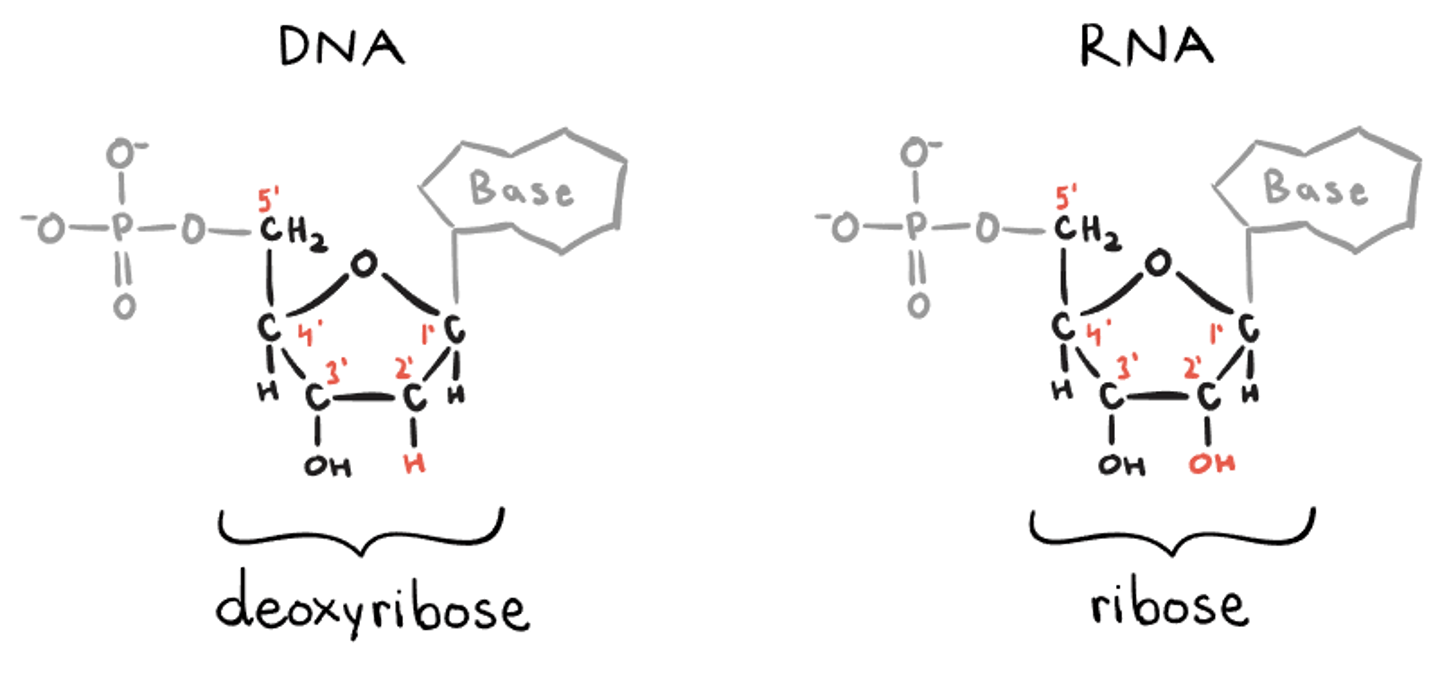
What is the difference between thymine and uracil?
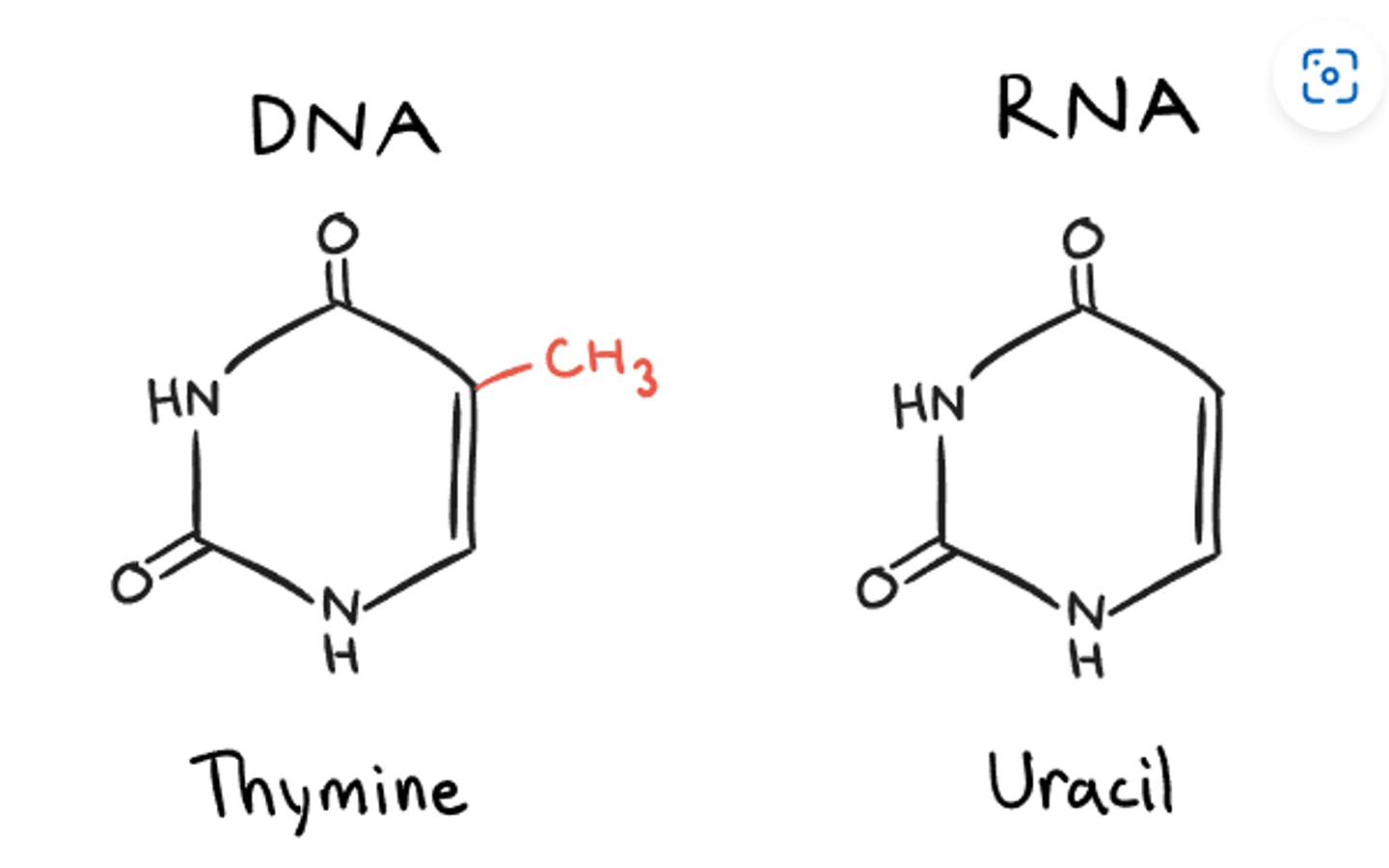
Hydroxylated deoxyribose is called
ribose
Demethylated thymine is called
uracil
do RNA and DNA both use phosphodiester bonds?
yes
mRNA transcript is made by an enzyme called:
RNA polymerase II
*the function of RNA polymerase II is broadly similar to DNA polymerase. The only high-level difference is in the building blocks used.
RNA polymerase II, like DNA polymerase, also uses a strand of DNA as a template. Instead of using this template to make a complementary strand of DNA, it uses it to make a complementary strand of:
RNA — the mRNA transcript.
Once RNA polymerase is done, the mRNA transcript has to be processed before it can make its journey out of the nucleus and to the ribosome. Processing has two phases:
protection and splicing.
What occurs during protection?
5' cap and 3' poly A tail
The purpose of splicing is to:
remove the introns from the mRNA transcript via a spliceosome, which cuts out introns and fuses ends back together.
The parts of the mRNA transcript that aren't spliced out by the spliceosome are called:
exons
Many call the mRNA transcript that still contains introns:
pre-mRNA
the intron-free transcript that the spliceosome produces ______ mRNA
primary or mature mRNA
where in the DNA helix is the genetic info stored?
In the rungs, outsides are backbone.
phosphate group in DNA is basic or acidic?
acidic, for each acid there is a base and these base pairs form the rungs.
The human genome contains _________- base pairs.
3 billion
The human genome contains _______-bases.
6 billion
A human has _______- chromosomes, _______ chromosome pairs.
46, 23
Average amount of base pairs per chromosome?
about 100 million
Why is DNA acidic and negatively charged?
phosphate groups deprotonated at physiological pH.
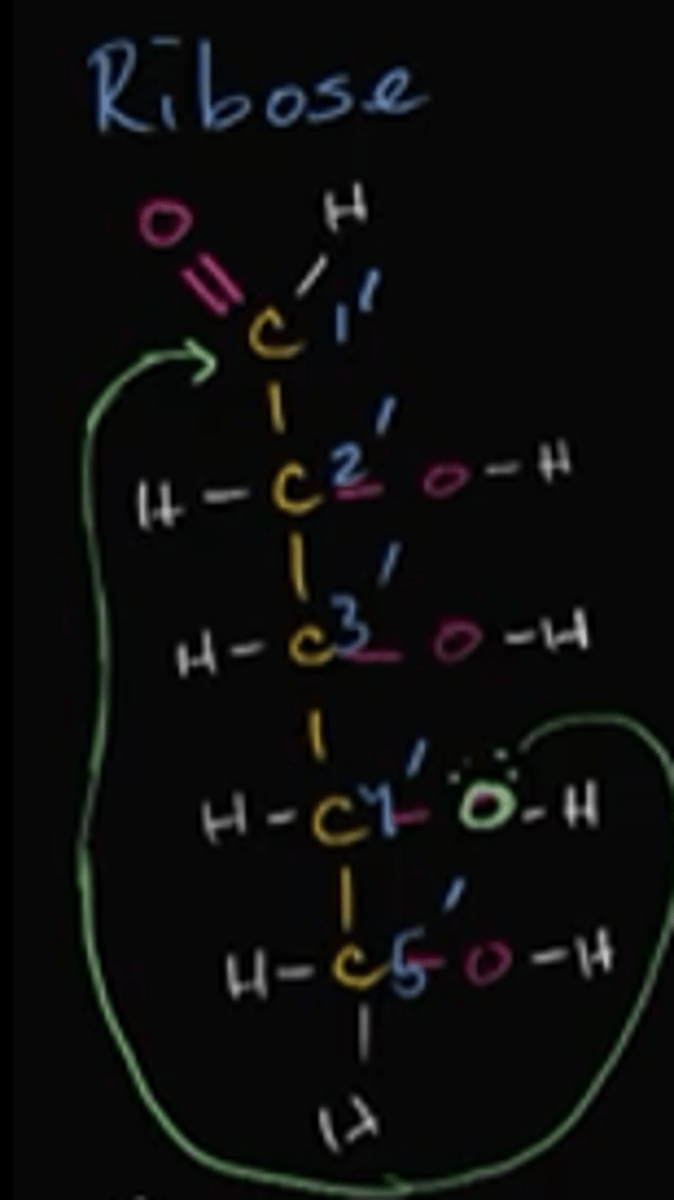
How does ribose form a ring structure for DNA?
nitrogenous bases with two rings:
purines, adenine, guanine
nitrogenous bases with one ring:
pyrimidines, C, T, and U
nitrogenous bases are attracted to each other via ________ bonds.
hydrogen, N (partial -) to H (partial +).
Why are they called nitrogenous bases?
N really electronegative (have an extra lone pair), can take up more H protons.
Why don't nitrogenous bases make DNA basic?
nitrogenous base basicity is offset to a good degree by hydrogen bonding to each other. Phosphates when protonated are acids although we draw them deprotonated.
DNA is antiparallel meaning
strands run in opposite directions
telomeres are:
chromosome caps, buffer zone protecting, do not contain coding genes, prevent chromosomes from sticking together.
telomerase is able to:
lengthen telomeres back to their original length.
single copy DNA:
DNA sequence that does not repeat itself. opposite of repetitive DNA that does keep repeating itself.
Single copy DNA holds:
most organisms' important genetic information, low mutation rate.
DNA that is somewhat repetitive is located where?
near centromeres (mammals and insects). higher mutation rate May contain genes that are transcribed or not.
DNA that is highly repetitive has:
no genes, not transcribed or translated, even higher rate of mutation. TELOMERES.
Telomerase has a repeating sequence:
TTAGGG
you can only add nucleotides to the _________ end.
3' end, or you can only extend the DNA going from
5' ---> 3'.
The enzyme that unwinds DNA is:
topoisomerase
after the topoisomerase unwinds the DNA what happens next?
helicase breaks hydrogen bonds between nucleotides, unzipping DNA.
Nucleotides can only be added going from the:
5' to 3' direction.
What do you need to start the process of adding nucleotides from 5' to 3'?
RNA primer
What places the RNA primer?
DNA primase
Once a primer is placed then ____________ can begin adding nucleotides,
DNA polymerase
nucleotides must be added at the _____ end.
3' end
A primer is roughly how many nucleotides?
10
Unlike the leading strand that can just add nucleotides from 5' to 3', the lagging strand does what?
adds primers at the opening via DNA primase, once this primer is added the polymerase can add in the 5' to 3' direction.
In the lagging strand when skipping in-between primers this creates sections called:
Okazaki fragments
Okazaki fragments
Small fragments of DNA produced on the lagging strand during DNA replication, joined later by DNA ligase to form a complete strand. The RNA from primers will also be replaced by DNA.
Transcription means we are going from _______ to _________.
DNA to mRNA
Enzyme used to create a sequence that will become a nucleotide sequence that will become mRNA.
RNA polymerase
How does RNA polymerase know where to start?
Attaches to sequence known as a promoter. Every gene has a promoter associated with it especially eukaryotic cells.
What exactly does the RNA polymerase do?
copies RNA from a DNA template (At the 3' end, from 5' to 3'.
The strand that RNA polymerase is interacting with is what?
template strand
The strand that RNA polymerase is not interacting with:
coding strand, while not interacting with this side this is the information that will be incoded by its complement via the RNA polymerase.
Types of terminators
-hairpin
-stop sequence
Unlike prokaryotes, eukaryotes must ____________ mRNA.
process, via splicing and protective caps, 5' caps and poly A tail.
At the end of the mRNA processing, you will have what?
mature mRNA
mature mRNA then goes where?
out of nucleus, to ribosomes in cytosol
How fast can DNA polymerase add nucleotides?
as fast as 700+ /second in humans 1000/second in e coli.
The process is so precise that in the first pass of the polymerase there is one mistake for every __________ nucleotides.
10 million or 10^7
After proofreading it becomes one mistake for every _______ nucleotides.
10^9 or 1 billion nucleotides
before splicing and caps the mRNA is called _______ and after it is called ________.
pre-mRNA, mature mRNA.
ribosomes are made of what?
rRNA and proteins
how many possible permutations per codon?
64
What are the names of the pockets of ribosome (sites) going from right to left?
APE
What happens at the E site?
tRNA exits the ribosome. E=exit.
What happens at the P site of the ribosome?
It holds the tRNA with the most recent amino acid to be added to the polypeptide chain. P = polypeptide chain forms.
What does the A site of a ribosome do?
holds the tRNA that carries the next amino acid to be added to the chain A= new AMINO ACID.
The sequence in prokaryotes that ribosomes will bind to:
Shine-Dalgarno sequence
Describe sequence of prokaryote mRNA:
NC region> SDG sequence> NC region> start codon> protein coding region> stop codon> NC region.
describe the 5' cap of eukaryotic RNA:
methyl guanine
Describe sequence of eukaryotic mRNA:
methyl G 5' cap> NC region> start codon> protein coding> stop codon> NC region> poly A tail.
How many nucleotides long is the poly A tail?
100-250 nucleotides
What is the purpose of 5' cap and poly A tail?
prevent enzymatic degradation.
Why don't prokaryotes need caps on their mRNA?
because transcription and translation occur in the same place, can happen at the same time. In eukaryotes, transcription in nucleus, and translation in the cytosol.
In prokaryotic cells the first amino acid will be the ______ and _____ in eukaryotic cells.
prokaryotic: f-met (formyl methionine)
eukaryotic: met
Formyl methionine acts as a _______- in the human body.
alarm system, triggers immune response
Enzyme that replicates DNA
DNA polymerase
Which DNA polymerase synthesizes new DNA? Also can proofread.
DNA polymerase III
exonuclease activity
The ability of DNA Pol III to move backwards to remove a nucleotide from the end of a DNA strand in DNA replication. from 3' to 5' in DNA poly III and 5' to 3' in DNA poly I.
endonuclease
An enzyme that cleaves its nucleic acid substrate at internal sites in the nucleotide sequence. Can remove from the middle.
DNA poly 1 and 3 are able to repair mistakes so that errors decrease from 1:100,000 -> 1/ 1 million to ?
1: 100 million
mismatch repair mechanism:
scans DNA immediately after it has been replicated and corrects any base-pairing mismatches
1. mark with cut
2. exonuclease removes nucleotide
3. DNA poly inserts correct nucleotide.
4. DNA ligase connects nucleotides on either side and to opposite strand.
In bacteria, how does mismatch repair mechanism know which is the strand with the mismatch and which is an original parental strand?
In bacteria, parental strand will have adenines that are methylated. NOT sure how it works in eukaryotes.
pyrimidine dimers
form when DNA is exposed to UV light, two Ts or two Cs stuck together.
Difference between mutation and DNA damage?
mutation= change to DNA sequence.
DNA damage= damage to structure of DNA but genome in correct order.