Human Anatomy and Physiology - Chapter 1 Vocabulary
 Call Kai
 Learn
Learn Practice Test
 Spaced Repetition
 Match
Match Flashcards
 Knowt Play
1/86

Earn XP
Description and Tags
Vocabulary flashcards covering introductory concepts in Human Anatomy and Physiology Chapter 1, including structural organization, life functions, homeostasis, anatomical directions, planes, and body cavities.
Name | Mastery | Learn | Test | Matching | Spaced | Call with Kai | Chat |
|---|
No analytics yet
Send a link to your students to track their progress
87 Terms
Anatomy
Study of the structure of body parts and their relationship to one another.
Physiology
Study of the function of body parts and how they work to carry out life-sustaining activities.
Subdivisions of anatomy
Gross or macroscopic anatomy
Microscopic anatomy
Developmental anatomy
Gross or Macroscopic Anatomy
The study of large, visible structures.
Microscopic Anatomy
Deals with structures too small to be seen by the naked eye.
includes cytology & histology
Cytology
Microscopic study of cells.
Histology
Microscopic study of tissues.
Developmental Anatomy
Studies anatomical and physiological development throughout life.
Embryology
Study of developments before birth.
To study anatomy, one must know…
anatomical terminology and be able to observe, manipulate, palpate, and auscultate
Subdivisions of physiology
based on organ systems (ex: renal or cardiovascular physiology)
Often focuses on cellular & molecular levels of the body
looks at how the body’s abilities depend on chemical reactions in individual cells
To study physiology…
understand basic physical principles (currents, pressure, & movement), basic chemical principles
Anatomy & physiology are…
Inseperable!!
Principle of Complementarity of Structure and Function
The principle that function always reflects structure, and what a structure can do depends on its specific form.
Example of the Principle of Complementarity of Structure and Function
Teeth!
Front teeth- sharp edges of incisors (structure) → ideal for cutting (function)
Molars- flat surfaces (structure) → ideal for grinding (function)
Order of Structural Organization
Atoms → Molecules (Chemical level) → Organelle → Cellular level → Tissue level → Organ level → Organ system level → Organismal level
Atoms
tiny building blocks of matter, combine to form molecules (waters & proteins)
Molecules
Waters, proteins, etc. associate in different ways to form organelles
Organelle
Basic components of cells
Cellular level
Cells are formed from molecules and vary in structure, to preform different functions in the body, some have similar functions
smallest units of living things
Tissue level
groups of similar cells that have
a common function
4 basic types: epithelial tissue, muscle tissue, connective tissue, and
nervous tissue
Organ level
discrete structure composed of at least two tissue types (four is more common) that performs a specific function for the body
complex functions become possible
life-sustaining function for each, no other can preform
Organ System Level
Organs that work together to accomplish a common purpose
For example, the cardiovascular system consists of the heart and blood vessels which the blood vessels are constantly flowing blood to the heart, providing oxygen and nutrients to the body.
Organismal Level
Many organ systems make up the organism, the highest level of organization.
Represents how all levels are constantly working together to sustain life.
Maintenance of life involves
Maintaining boundaries
Movement
Responsiveness
Digestion
Metabolism
Excretion
Reproduction
Growth
Maintaining boundaries
Separation between internal and external environments must exist
Plasma membranes separate cells
Skin separates organism from environment
Movement
Muscular system allows movement
Of body parts via skeletal muscles
Of substances via cardiac muscle (blood) and smooth muscle (digestion, urination)
Contractility
Contractility
Refers to movement at the cellular level.
Responsiveness (when it hurts you’re going to check it!)
Ability to sense and respond to stimuli
Withdrawal reflex prevents injury
Control of breathing rate, which must change in response to different activities
Digestion
Breakdown of ingested foodstuffs, followed by absorption of simple molecules into blood
Metabolism
all chemical reactions that occur in body cells
breaking down substances, synthesizing complex ones, using nutrients & oxygen to produce ATP for cell activity
Excretion
Removal of wastes from metabolism and digestion
Sweat from sweat glands
Urination
Exhalation
Reproduction
Cellular level, involves division of cells for growth or repair
Organismal level, reproduction is the production of offspring
Growth
Increase in size of a body part or of organism
Interrelationships among systems
Integumentary System
Skeletal System
Muscular System
Nervous System
Endocrine System
Cardiovascular system
Lymphatic System/Immunity
Respiratory System
Digestive System
Urinary System
Male Reproductive System
Male sex hormone and sperm are produced from testes.
Glands and ducts help deliver sperm to the female reproductive tract.
Female Reproductive System
Eggs and female sex hormones are produced by ovaries.
The other structures are responsible for fertilization and fetus development.
Milk is produced from the mammary glands in the breast to provide nourishment to the newborn.
Survival Needs
Too much or too little can be harmful
Nutrients
Oxygen
Water
Normal body temperature
Appropriate atmospheric pressure
Nutrients
Chemicals for energy and cell building
Oxygen
Essential for release of energy from foods
The body can survive only a few minutes without oxygen
Water
Most abundant chemical in body; provides the watery environment needed for chemical reactions
Also is fluid base for secretions and excretions
Normal body temperature
If body temp falls below or goes above 37°C, rates of chemical reactions are affected
Appropriate atmospheric pressure
Specific pressure of air is needed for adequate breathing and gas exchange in lungs
Homeostasis
Maintenance of relatively stable internal conditions despite continuous changes in the environment (dynamic state & has contributions from all organ systems)
Body must constantly be monitored and regulated to maintain homeostasis (Nervous & Endocrine~major role
Homeostatic control of variables involves three components: receptor, control center, and effector
Receptor
Sensor in homeostatic control that monitors the environment, sends input
Control Center
determines the set point at which a variable is maintained
receives input from the receptor
determines the appropriate response.
Effector
receives output from the control center and provides the means to respond to the stimulus
response either reduces stimuli (negative feedback) or enhances stimulus (positive feedback)
Negative Feedback
Control mechanisms are usually negative feedback
Original effect of stimulus is shut off or reduced in intensity by output, causing the variable to change in the opposite direction of the initial change.
OPPOSITE DIRECTION
Positive Feedback
SAME DIRECTION as original stimulus
Mechanism where the response enhances or exaggerates the original stimulus
Exhibits a cascade effect: each reaction feeding into the next
Usually controlling infrequent events that don’t need constant adjustment (like contractions which are enhanced by oxytocin or platelet plug formation and blood clotting)
Homeostatic Imbalance
Disturbance of homeostasis
Increases risk of disease
Aging
control systems become less efficient, internal environment less stable
produce aging changes
If negative feedback mechanisms become overwhelmed, destructive positive feedback mechanisms may take over
Heart failure
Standard Anatomical Position
Body erect, feet slightly apart, palms facing forward with thumbs pointing away from the body.
Directional terms
describe one body structure in relation to another body structure
Direction is always based on standard anatomical position
Right and left refer to the body being viewed, not right and left of observer
Superior (cranial)
Toward the head end or upper part of a structure or the body
Above
Ex: The head is superior to the abdomen

Inferior (caudal)
Away from the head end or toward the lower part of a structure or the body
Below
Ex: The naval is inferior to the chin

Anterior (ventral)
Toward or at the front of the body
in front of
Ex: The breastbone is anterior to the spine
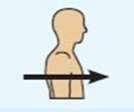
Posterior (dorsal)
Toward or at the back of the body
Behind
ex: the heart is posterior to the breastbone
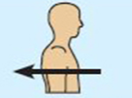
Medial
Toward or at the midline of the body
On the inner side of
Ex: the heart is medial to the arm
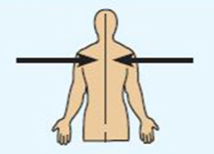
Lateral
Away from the midline of the body
On the outer side of
The arms are lateral to the chest
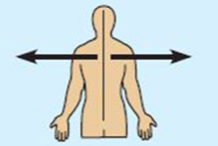
Intermediate
Between a more medial and a more lateral structure
The collarbone is intermediate between the breastbone and shoulder
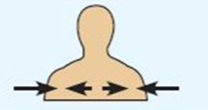
Proximal
Closer to the origin of the body part or the point of attachment of a limb to the body trunk
The elbow is proximal to the wrist
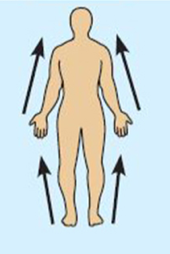
Distal
Farther from the origin of a body part or the point of attachment of a limb to the body trunk
The knee is distal to the thigh

Superficial (external)
Toward or at the body surface
The skin is superficial to the skeletal muscles

Deep (internal)
Away from the body surface, more internal
The lungs are deep to the skin

Axial
Major division of the body consisting of the head, neck, and trunk.
Appendicular
Major division of the body consisting of the limbs (legs and arms).
Regional terms
designate specific areas within body divisions
Body planes
Surfaces along which body or structures may be cut for anatomical study
Sagittal Plane
Plane that divides the body vertically into right and left parts.
Midsagittal Plane
A sagittal cut made perfectly on the midline.
Parasagittal Plane
A sagittal cut that is off-centered and not on the midline.
Frontal (coronal) Plane
Plane that divides the body vertically into anterior and posterior parts (front and back); also called coronal plane.
Transverse Plane
Plane that divides the body horizontally at 90degrees to vertical plane into superior and inferior parts.
Oblique Section
Result of cuts made at an angle other than 90degrees to the vertical plane.
Dorsal Body Cavity
Body cavity that protects the fragile nervous system and contains the cranial cavity and vertebral cavity.
Ventral Body Cavity
Body cavity that houses the internal organs (viscera) and contains the thoracic and abdominopelvic cavities.
Viscera
Collective term for internal organs housed within the ventral body cavity.
Synovial Cavities
Joint cavities that are not exposed to the environment.