EXCRETION in HUMANS
 Call Kai
 Learn
Learn Practice Test
 Spaced Repetition
 Match
Match Flashcards
 Knowt Play
1/11

Earn XP
Description and Tags
FLASHCARDS
Name | Mastery | Learn | Test | Matching | Spaced | Call with Kai | Chat |
|---|
No analytics yet
Send a link to your students to track their progress
12 Terms
Excretion
The removal of toxic materials from organisms, the waste products of metabolism (chemical reactions in cells including respiration) and substances in excess of requirements
Substances should include carbon dioxide (lungs), urea, excess water and ions (kidney).
The importance of excretion is due to the toxicity of the urea.
Function of livers
The role of the liver is in the assimilation of amino acids by converting them to proteins
.
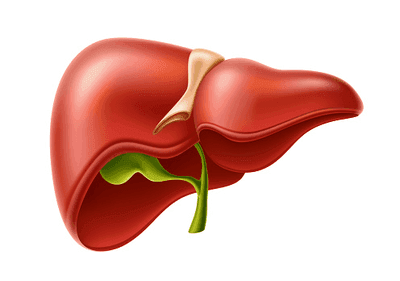
Deamination
A critical process involving the removal of an amino group (-NH2) from a molecule, usually an amino acid
This reaction mostly takes place in the liver and is an essential part of the body's metabolism of proteins and nitrogen.
Assimilation
Uptake and use of nutrients by body cells
Urea is formed in the liver from excess amino acids.
Alcohol, drugs & hormones are broken down in the liver
Function of kidney
Removal of urea and excess water and the re-absorption of glucose and some salts
salts
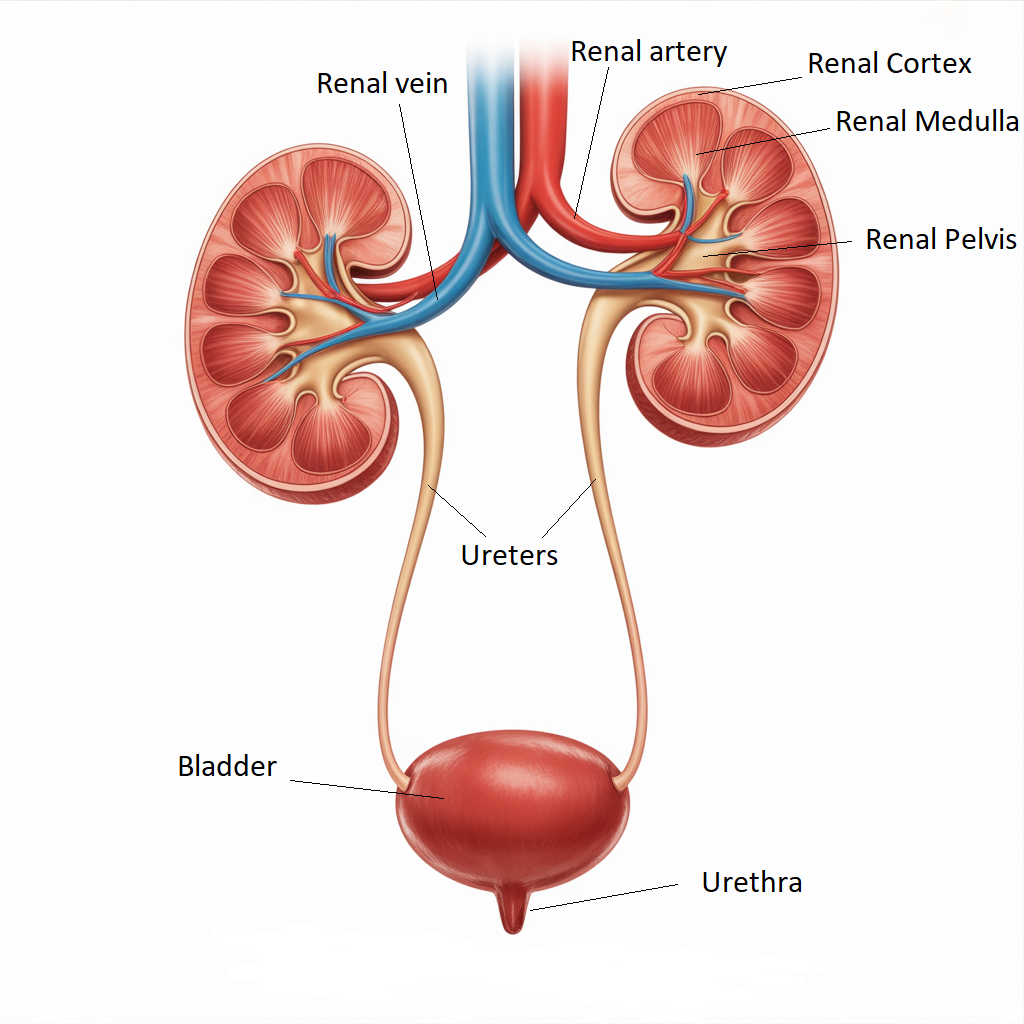
Cortex: contains Bowman’s capsules and coiled tubules.
Ureter: carries urine from the kidney to the bladder
Medulla: has loops of Henlé and collecting ducts
Urethra: carrying urine from the bladder to the outside.
Bladder: stores urine
Renal artery: brings wastes and water from the blood
Renal vein: reabsorbs water and functional molecules and leaves wastes behind
Cortex
Contains Bowman’s capsules and coiled tubules.
Ureter
Carries urine from the kidney to the bladder
Medulla
Has loops of Henlé and collecting ducts
Urethra
Carrying urine from the bladder to the outside
Bladder
Stores urine
Renal artery: brings wastes and water from the blood
Renal vein: reabsorbs water and functional molecules and leaves wastes behind
Structure and Function of the Nephron
Structure and Function of the Nephron
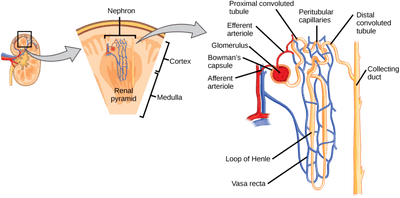
Ultrafiltration:
blood from the renal artery enters the glomerulus under high pressure.
Water, urea, salts, and glucose are forced into the Bowman’s capsule.
Blood cells and large proteins cannot pass through.
Selective reabsorption: in the tubule, two-thirds of the salt and water and all the glucose move out of the nephron by active transport. These substances are reabsorbed back into the blood capillary.
Loop of Henlé: this part is permeable to water but not salt. Water is drawn out of the filtrate in the nephron by osmosis because of the low water potential of the medulla tissue fluid.
Collecting duct: the remaining substances move into the collecting duct, forming urine