5- adhesion
 Call Kai
 Learn
Learn Practice Test
 Spaced Repetition
 Match
Match Flashcards
 Knowt Play
1/28

There's no tags or description
Looks like no tags are added yet.
Name | Mastery | Learn | Test | Matching | Spaced | Call with Kai | Chat |
|---|
No analytics yet
Send a link to your students to track their progress
29 Terms
What is adhesion?
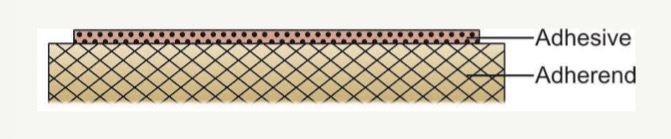
Force/intermolecular attraction between molecules of 2 unlike substances when in contact
Adhesive- substance added to produce adhesion
Adherend- material to which it’s applied
What are the 3 types of adhesion mechanisms?
Chemical- primary forces- covalent, ionic , metallic- weakest
Physical- secondary forces- occur at molecular dipoles (van der walls) or interaction of induced dipoles (dispersion forces) or electron clouds (h bonds)
Mechanical- strongest, e.g formation of hybrid dentin- resin polymers entangled with collagen fibrils
What forces do most adhesives rely on?
Van der Waals + mechanical adhesion
If surface rough and porous- mechanical adhesion predominates
If smooth and polished- van der waals
What are the 3 factors that affect adhesion?
Surface energy
Wetting
Contact angle
How does surface energy affect adhesion?
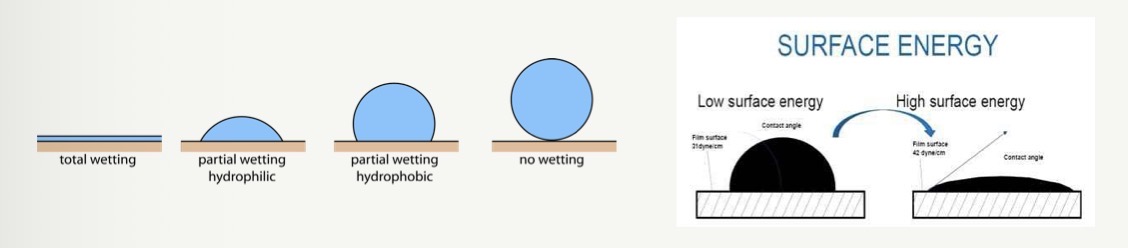
Harder surface, higher surface energy- more adhesion
What is wetting and what does it depend on?
How much does adhesive stretch over the surface
Depends on surface energy (higher better) and cleanliness of surface
Metals tend to have high surface energy
What is a contact angle and how does it affect adhesion?
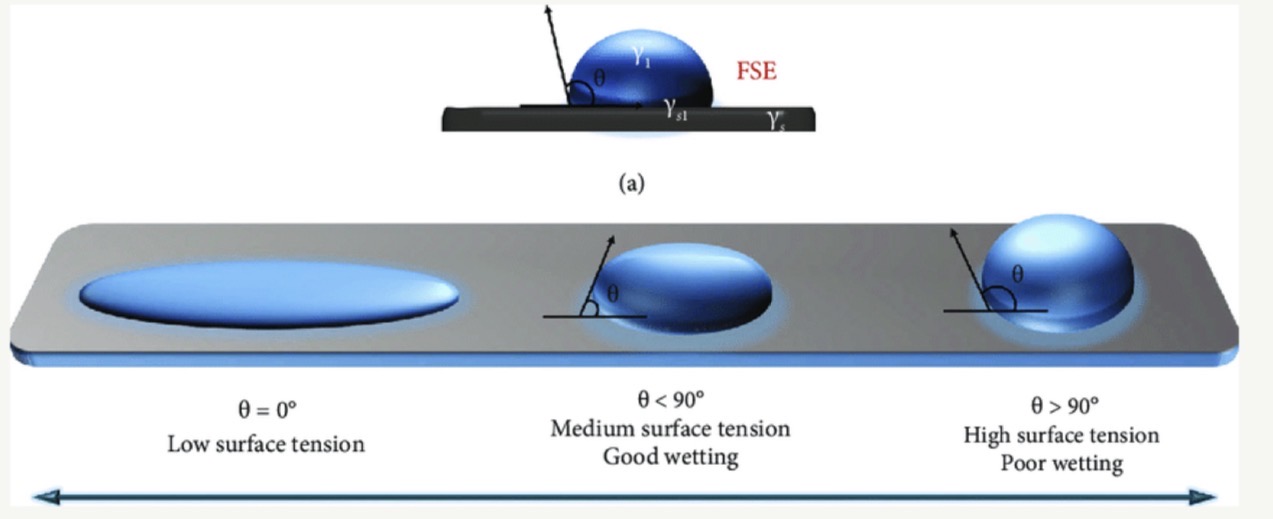
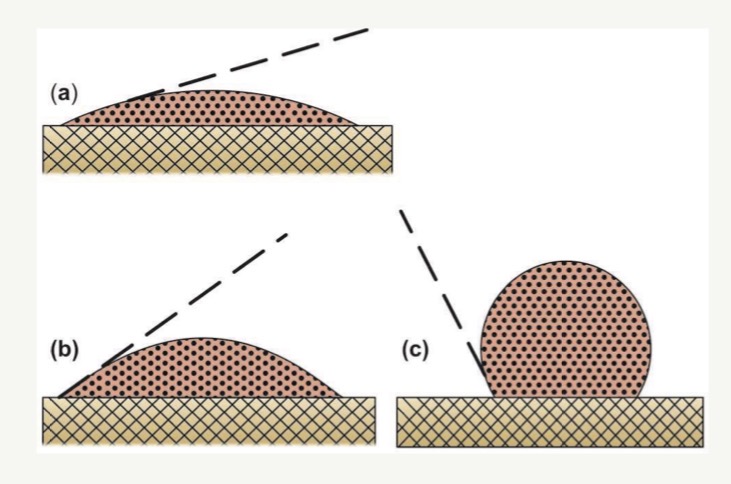
Angle formed between adhesive and adherend at interface
Bigger angle- less wettability, smaller angle- better
When large contact angle- liquid doesn’t wet surface completely
Important to bevel to penetrate all enamel prisms
What are 7 requirements for an ideal bonding agent?
Biocompatible
Bond effectively to E + D
Sufficient strength to resist masticatory forces
Mechanical properties close to tooth structure
Resist degradation in oral environment
Easy to use
Prevent micro leakage
Surface energy of enamel is…
Low surface energy
Pellicle (organic layer) covers untouched enamel
Smear layer covers ground enamel
What is conditioning?
Removal of organic/smear layer to make enamel surface more reactive
What is etching?
Procedure that leads to demineralisation of superficial calcium ion
What is the smear layer?
Caused by instrumentation
Covers normal dentin structure by 1-2um, penetrates 1-5um into tubules to form smear plugs
How does acid conditioning/etching affect enamel?(5)
Removes residual pellicle to expose the inorganic crystallite
Removes approx 10 μm of surface enamel
Creates porous layer with depth of 5 - 50μm— when low viscosity resin applied- flows into the microporosities and polymerises to form resin tags
Increases the wettability and surface area of the enamel substrate
Raises surface energy of enamel by creating reactive polar sites

How to etch- what to do before, objectives and material
Place bevel in all cavities
Clean surface, create microporosities, dilute hydroxypatite crystals
30-37% orthophosphoric acid 30s
If a surface is left without acid…
Will remain unconditioned- won’t adhere- causing micro leakage
Why is bonding to dentin more difficult than to enamel?
Structure- contains a lot of fluids
50% inorganic content
30% organic
20% fluid- must stay moist
Hybrid layer formed
Vs in enamel
96% inorganic
Dry bonding surface
Micro mechanical retention
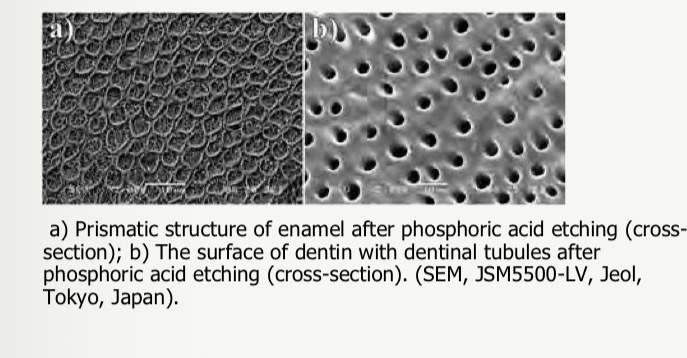
What is the hybrid layer?
Micro mechanical attachment between resin and demineralised, primed layer of intertubular dentin
Achieved by etching to remove smear layer and produce demineralisation of 3-6um
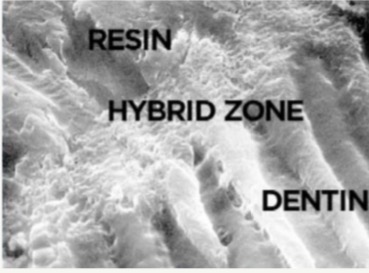
What are the steps of bonding to dentin?
Conditioning of dentin
Primer- monomer- HEMA and 4-META dissolved in acetone or ethanol- promotes resin diffusion into demin dentin
Bonding- stabilised hybrid layer formed, production of resin tags
How can dentin adhesive systems be classified based on their clinical approach to smear layer?
1- modifies in 1 or 2 steps, doesn’t remove smear layer- natural barrier to pulp, prevents invasion, limits outward flow of pulpal fluid that might impair bonding efficiency
2- Removes smear layer- 2 or 3 step application- (type 1) dentin conditioning (acid) + combined primer and adhesive, acid + primer + bond
3- Dissolve not remove smear layer- (type 2) combined acid and primer + adhesive resin
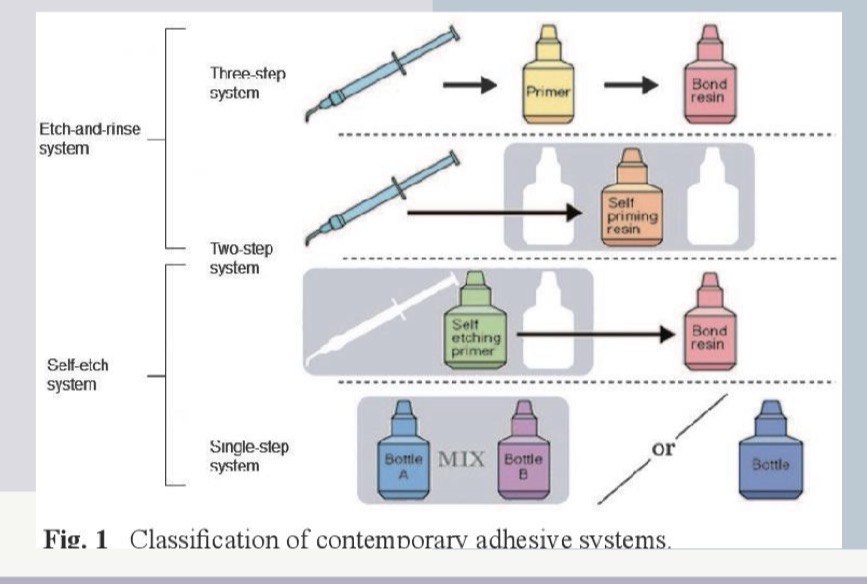
What are characteristics of 3 step technique?
Etch > prime > bond
Requires most technique
Great bond strength and durability
Total-etch technique (can also be 2 step)
What’s the 3 step total etch technique?
Etch
Primer for 10secs + dry
Adhesive for 10secs + dry
Light cure for 10-20 secs
The 2 step total etch TYPE 1 technique characteristics?
Etch > prime + bond
More susceptible to water degradation
Most cases of post operative sensitivities
Total-etch technique
How do you do 2 step (type 1) total etch technique?
Etch, rinse with water
Prime and bonding (in same bottle)
What are 2 step (type 2) characteristics?
Self etch technique
Etch + prime > bond
Less effective at bonding to enamel– may need to selectively etch enamel first
Less dependant on hydration state of dentin
If deep cavity close to pulp- use self etch- doesn’t remove smear layer can be used with adhesive to create hybrid layer
What does 2 step type 2 technique include?
1 bottle with self-etch primer 10 secs
Dry with air and can use aspiration too
Put adhesive for 10s and light cure for 15s
Total etch (etch and rinse) protocol
Isolate
35-37% phosphoric acid on enamel 15-30secs, rinse for 15-20secs- should be frosty/chalky white
On dentin 10-15secs, rinse, dry- must be moist (glistening)
Apply primer- scrubbing motion 15-20secs, evaporate solvent, surface should be shiny
Apply adhesive- light cure 10-20sec
What is the protocol recommended for universal adhesives?
Selective etching of enamel- etch orthophsophoric acid 15-30s, rinse, dry
Apply universal adhesive to enamel + dentin, active scrubbing for 20s, gentle drying then light cure
What does selective enamel etch + universal adhesive provide?(3)
Strong enamel bond
Reduce post op sensitivity
Simple technique
What 5 common mistakes to avoid when using universal adhesives?
Over-etching dentin (>15 sec)
Overdrying dentin
Not evaporating solvent properly
Inadequate light curing
Contamination with saliva (if contaminated → re-etch enamel 5 sec)