Envirothon Soils K4: Soils, Land Use, and Society
 Call Kai
 Learn
Learn Practice Test
 Spaced Repetition
 Match
Match Flashcards
 Knowt Play
1/25

There's no tags or description
Looks like no tags are added yet.
Name | Mastery | Learn | Test | Matching | Spaced | Call with Kai | Chat |
|---|
No analytics yet
Send a link to your students to track their progress
26 Terms
Land Capability Classification (LCC) System
categorizes land into 8 classes for agricultural purposes based on suitability for sustained cultivation, risk of erosion/soil damage, and the most intensive long-term use for the land
Criteria:
slope
texture of soil
depth of soil material
drainage
LCC Class I
Land suitable for cultivation and other uses
Soils that have few limitations restricting their use. Lowest management risk. may be safely used for intensive production (continuous row crops, pasture, woodland, wildlife habitat)
nearly level
very low erosion hazard
deep
well-drained
easily worked, hold water well, naturally fertile/responsive to fertilizer
LCC CLass II
Land suitable for cultivation and other uses
Soils that have some limitations, reducing the choice of plants or requiring moderate conservation practices(special tillage methods). conservation practices easy to apply. can be used for crops, pasture, woodland, wildlife habitat.
one or more limitations:
gentle slopes
slight wind/water erosion hazard
moderate soil depths
occasional damaging overflow
LCC Class III
Land suitable for cultivation and other uses
Soils that have moderate limitations that reduce the choice of plants or require special conservation practices, or both. conservation practices more difficult to apply/maintain. can be used for crops, pasture, range, woodland, wildlife habitat.
one or more limitations:
moderate slopes
moderate wind/water erosion hazard
moderately shallow rooting depth
wetness
moderately low moisture holding capacity
LCC Class IV
Land suitable for cultivation and other uses
Soils that have severe limitations that restrict the choice of plants, require very careful management, or both. conservation practices more difficult to apply/maintain. can be used for crops, pasture, woodlands, wildlife habitat.
one or more limitations:
steep slopes
severe wind/water erosion hazard
shallow rooting depth
wetness
low moisture holding capacity
LCC Class V
Land generally NOT suitable for cultivation (without major treatment). Suited for pasture, woodland, and wildlife.
Soils that have little or no erosion hazard, but have other limitations, impractice to remove, that limit their use largely to pasture, range, woodland, or wildlife food cover.
LCC Class VI
Land generally NOT suitable for cultivation (without major treatment). Suited for pasture, woodland, and wildlife.
Soils that have severe limitations that make them generally unsuited for cultivation and limit their use largely to pasture or range, woodland, or wildlife food and cover. can be used for crops with specific conservation and agronomic practices (drainage, stone removal). conservation practices needed for all land uses
one or more limitations:
steep slopes
severe wind/water erosion
shallow rooting depths
excessive wetness
low moisture capacity
stony
LCC Class VII
Land generally NOT suitable for cultivation (without major treatment). Suited for pasture, woodland, and wildlife.
Soils that have very severe limitations that make them unsuited to cultivation and that restricts their use largely to pasture, woodland, or wildlife. need to use carefully for pasture (impractical) and improve for woodland/wildlife habitat. needs careful conservation.
stony/sandy on moderate slopes
any soil on very steep slopes (>30%)
LCC Class VIII
Land generally NOT suitable for cultivation (without major treatment). Suited for pasture, woodland, and wildlife.
Soils and landforms that preclude their use for commercial plant production and restrict their use to recreation, wildlife, water supply, or aesthetic purposes. Highest management risk. can use for wildlife production. reserved for non-soil areas
one or more limitations that cannot be overcome
erosion/erosion hazard
stones
very low moisture capacity
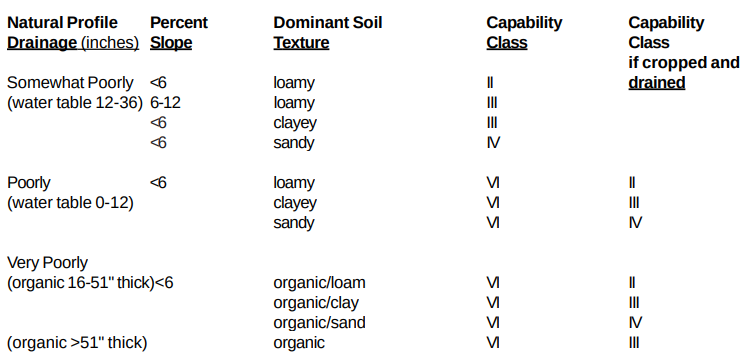
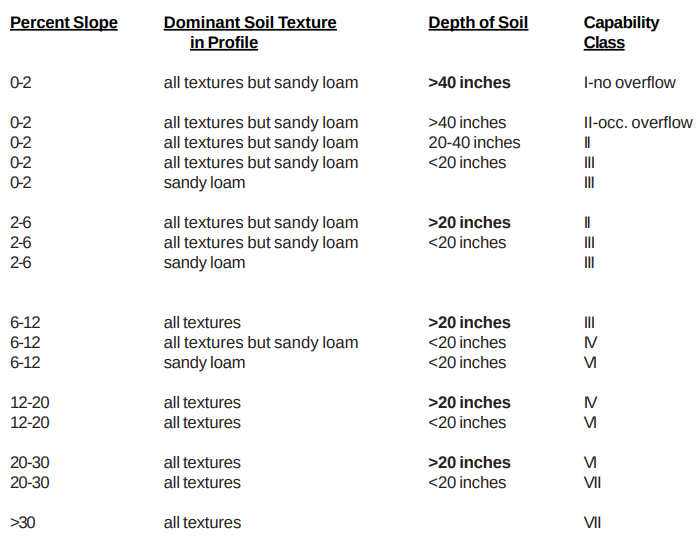
Identifying LCC
non-soil areas (river wash, quarries, dumps) —> VIII
if not:
Stony soils (>20% slope) —> VII
Stony soils (0-20% slope) —> VI
if not:
water table within 36 in of surface —> use chart on front
if not:
dominant texture = sand/lomay sand
0-6% slope —> IV
6-12% slope —> VI
>12% slope —> VII
if not:
all other soils —> use this chart (slope range —> soil texture —> soil depth)
Soil health
the continued capacity of a soil to function as a vital, living ecosystem that sustains plants, animals, and humans. —> views soil as a living ecosystem home to bacteria, fungi, and other organisms
ways soil ecosystems can be managed
cycling nutrients
absorbing/draining/retaining rainwater and snowmelt for dry periods
filtering and buffering water to remove pollutants
providing habitat for soil biological population to flourish and diversify
four soil health principles
minimize disturbance (protect)
maximize soil cover (protect)
maximize biodiversity (feed soil organisms)
maximize presence of continuous living roots (feed soil organisms)
protecting soil habitat
minimize disturbance & maximize soil cover
maintain/increase stable soil aggregates and soil organic matter (SOM) —> protect surface of the soil (susceptible to wind/water degradation)
soil cover buffers against temperature fluctuations —> less stress to plants and organisms, reduces evaporation, increases infiltration
SOM stabilizes soil aggregates —> increased water infiltration, drainage, and storage; increased nutrient-holding capacity and release —> incresed habitat for organisms
feeding the soil organisms
maximize biodiversity & maximize presence of continuous living roots
more diversity of food + aboveground plants/animals —> more diversity of soil organisms —> breaks disease cycles, makes habitat for pollinators, stimulates plant growth
eliminate fallow + diverse crop rotation + cover crops + grasslands —> maximize presence of continuous living roots —> breaks disease/pest cycles + maintain/increase SOM content + enhance nutrient cycling
soil disturbances
physical: tillage, compaction
chemical: fertilizer, pesticide
biological: intro of invasive species, use of monocultures, over-grazing (compaction, reduction of perennial root systems)
soil cover
living plant canopy (growing crop, cover crop, grassland)
mulch (dead plant material - crop residues, prunings, thatch - or amendment - compost, bark chips)
healthy soil functions
effective nutrient cycling
carbon + nutrient storage in organic matter
good aeration for root growth
improved farm/ranch resiliency/profitability
improved yield stability
runoff/erosion reduction
improved water storage & plant available water (also protect WQ)
drought/heavy rainfall/temperature extreme resilience
disease/pest reduction
conservation crop rotation
grow diverse crops in a planned sequence to increase organic matter and biodiversity
increase nutrient cycling, manage pests, reduces erosion, holds soil moisture, adds microbe diversity
cover crop
grow unharvested crop as part of planned rotation for conservation benefits
increase organic matter, prevent erosion, conserve moisture, increase nutrient cycling, provide nitrogen for plants, suppress weeds, reduce compaction
no till
grow crops w/o disturbing soil with tillage
improve water holding capacity, increase organic matter, reduce erosion, reduce energy use, reduce compaction
mulch tillage
use tillage methods where soil surface is disturbed by maintains high levels of crop residue on surface
reduce wind/rain erosion, increase moisture, reduce energy use, increase organic matter
mulching
apply plant residues to soil surface to compensate for loss of residue from excessive tillage
reduce wind/rain erosion, moderate temperatures, increase organic matter, control weeds, conserve moisture, reduce dust
nutrient management
manage soil nutrients to meet crop needs while minimizing impact on environment/soil
increase plant nutrient uptake, improve physical/chemical/biological soil properties, budget/supplies/conserves nutrients for plant production, reduce odors/nitrogen emissions
pest management
follow an ecological approach to manage for pests that promotes healthy plant growth while increasing stress on pests and enhancing habitat for beneficial organisms
reduce pesticide water contamination, reduce chemical air contamination, decreases pesticide risk to pollinators/other beneficial organisms, increase organic matter
The Dust Bowl - 1930s
environmental disaster resulting from poor farming practices and policies on the Great Plains
plowing + removal of native grasses + overgrazing + drought —> wind erosion (huge sand/dust storms up to east coast)
fertile grassland —> desert