CPA FAR
 Call Kai
 Learn
Learn Practice Test
 Spaced Repetition
 Match
Match Flashcards
 Knowt Play
1/450

There's no tags or description
Looks like no tags are added yet.
Name | Mastery | Learn | Test | Matching | Spaced | Call with Kai | Chat |
|---|
No analytics yet
Send a link to your students to track their progress
451 Terms
What are the purposes and uses of the Balance Sheet?
What is the accounting equation?
Who gets first claims if the company goes bankrupt?
Evaluate liquity and solvency
Assets = Liabilities + Owner’s Equity
Liabilities get first claim
What are limitations of the BS?
Don’t tell you market value of assets. Many valued at historical costs. Eg depreciated buildings
Some measurements subjective. Eg inventory + depreciation
Who are the users of the income statement? What are they looking at?
External users - investors. ROE, EPS, profitability
Lenders - EBIT
Internal users - ROA
What items make up the I/S? 2 Types + how are they reported
REGL - Revenue, Expenses, Gains + Losses
Operating. Gross amount. Normally rev + exp
Nonoperating. Net amounts (NRV - book value). Gains + losses
Period vs unexpired cost - what principle, examples
Period. Expenses immediately + recurring. Eg SG&A costs
Unexpired. Capitalized as an asset for future. Appears on the BS. Expenses in future periods according to the matching principle. Eg prepaid insurance to insurance expense
Now all unusual or infrequent, or unusual and infrequent items are reported under…
… nonoperating
Income from Continuing Operations Formula
Income from Continuing Operations = Operating Income + Nonoperating Income
Single Step Income benefits + drawbacks
Benefits:
Simple design
Does not make 1 item appear more important than another
Drawback:
Does not distinguish between core business + incidental business
Benefits of the multi-step I/S
Enhances user info
Separates operating from nonoperating
Readily available info for ratio analysis
Multi-Step I/S Format
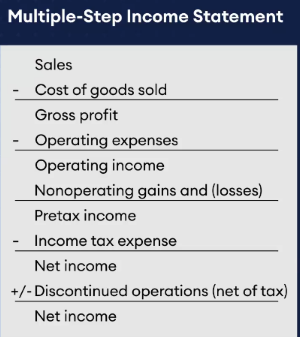
Limitations of the I/S
Subjectivity - rev + exp accrual basis. Estimates
Management bias - choice of accounting methods
Aggressive v conservative accounting
Accrual v cash basis adv + dis
Accrual adv:
Income smoothing
Better performance assessment
Dis:
Management may alter performance. Eg companies change operating losses to nonoperating to make them look better
2 ways a component can be considered discontinued operations
Has been disposed of during that year
Is classified as held for sale in that year
6 Criteria for Held for Sale Classification
Management commits to a plan to sell the activity
Activity is available for immediate sale in its present condition
Active program to locate a buyer
Sale of activity is probable + expected to occur within a year
Acitivity marketed at a reasonable sales price relative to its fair value
Significant changes in the plan are not expected to sell
No ___ when segment available for sale
Depreciation
Impairment loss formula
The impairment loss can’t be reverse more than…
Impairment loss = NRV - book value
… the amount writen down
Discontinued Operations calculation. All amounts should be shown…
Impairment loss + Results of operations + Gain/Loss on sale
… net of tax
Where is discontinued operation disclosed?
In the face of the FS or in the notes to the FS
Are transactions between a subsidiary and parent considered foreign currency transacations?
No
Direct v indirect exchange rate
Direct. Domestic price of one unit of another currency. Eg 1 euro costs $1.47
Indirect. Foreign price of one unit of the domestic currency. Eg 0.68 euros buys $1
Accounts receivable - If foreign currency increased, gain or loss?
Accounts payable - If foreign currency increased, gain or loss?
AR → gain
AP → loss
Items NOT on the I/S. Only on the Statement of Comprehensive Income
PUFI
Pension adjustment
Unrealized gains/losses - Available for sale debt securities + hedges
Foreing Currency Items
Instrument Specific Credit Risk
Comprehensive Income Formula
Comprehensive Income = Net Income + Other Comprehensive Income
Accumulated Other Comprehensive Income calc
AOCI = Beginning Balance ± PUFI ± Reclassification Adjustment
2 ways the Statement of Comprehensive Income can be presented. What does each start with
Single Statement - starts with revenue
2 Statement - starts with net income
NRV calculation
Sales value - costs to put into sellable condition
Net income is closed into…
Other Comprehesive income is closed into…
Retained earnings
AOCI
How to translate euros into dollars? Eg 0.79 euros = $1
1/0.79 = $1.27 USD to 1 euro
Net Income excludes
OCI items
Where does discounts on bonds payable go on the FS?
Contra liability to bonds payable - subtracted
The income tax benefit/expense from discontinued operations is calculated by?
Gains/losses from discontinued operations x tax rate
What does the form 10k disclose?
Annual
The business of a company + risks
Financial + operating results
Perspecitve of its executive leadership
Filing deadline for form 10k relative to fiscal year end
60 days for large accelerated filers - $700+ million market value
75 days for accelerated filers - $75-700 million market value AND annual rev of $100+ mil
90 days for all other
What does Part II, Item 7 on the Form 10k include?
Management’s Discussion and Analysis
Management’s assessment
Critical accounting estimates + assumptions
Summarized financial trends
What does Part II, Item 7A on the Form 10k include?
Market risk due to changes in:
Interest rates
Exchange rates
Other factors like inflation or war
3 ways you can disclose market risks
Tabular presentation
Sensitivity analysis
Value at risk disclosures
What does Part II, Item 8 on the Form 10k include?
Financial Statement + Supplementary Data
Audited FS + Notes
BS for the 2 most recent fiscal years
Everything else 3 fiscal years
Auditor’s report
Certifications from the CEO + CFO
What is the form 10-Q? Filing deadlines?
The quarterly report that must be filed by US registered companies for each of the first 3 quarters of every fiscal year
40 days for large accelerated + accelerated filers
45 days for others
What does Part I, Item 1 on the Form 10-Q include?
Financial Statements
Similar to Form 10-K, Part II, Item 8 except generally unaudited
BS at the end of the most recent fiscal quarter + end of the preceding fiscal year
I/S + Comprehensive Income + CF - the most recent fiscal quarter + end of the preceding fiscal year and end of most recent fiscal quarter + corresponding periods of the preceding fiscal year
Detailed decsription of the nature + amounts of adjustments that are not normal + recurring
What does Part I, Item 2 on the Form 10-Q include?
Management’s Discussion + Analysis of Financial Condition + Results of Operations
Similar to Form 10-K, Part II, Item 7
What does Part I, Item 3 on the Form 10-Q include?
Quantitative and Qualitative Disclosures about Market Risk
Similar to Form 10-K, Part II, Item 7A
What is Form 8-K? How many days do companies have to file this form
Changes in material events
Eg bankruptcy, changes in accounting firm
4 days to file
Under US GAAP, all public entities are required to present EPS on…
An entity has a simple capital structure if it only has…
… the face of the Income Statement
… common stock outstanding
The simple entity presents basic per share amounts…
All other entities must present…
If an entity reporst a discontinued operation, the entity must present…
… for income from continuing operations AND for net income on the face of the I/S
… basic AND diluted per share amounts for income from continuing operations AND for net income on the face of the I/S
… the basic + diluted per share amounts either on the face of the I/S OR in the notes to the FS
Basic EPS Formula. Numerator breakdown. Preferred dividends 2 types
Income Available to Common Shareholders/ Weighted Average # of Common Shares Outstanding (WACSO)
Income available = net income - preferred dividends
Cumulative = # of preferred shares x par value x rate. What was owed.
Noncumulative = what was declared
Weighted Average # of Common Shares Outstanding calculation
Which ones are retroactively adjusted?
Beginning shares outstanding
+ Shares sold during the period
- Shares reacquired
+ Stock dividends + splits (retroactively adjusted)
- Reverse Stock splits (retroactively adjusted)
= WACSO
An entity has a complex capital structure when it has securities that:
Examples
Can potentially be converted to common stock
Dilute EPS
Eg convertible securities, warrants, contracts that may be settled in cash or stock, contingent shares
Diluted EPS formulas
Income Available to the CS shareholder + Interest on dilutive securities/ WACSO (assuming all dilutive securities are converted to CS)
Options and similar instruments are only dilutive when…
If they are antidultive what do you record?
the average market price of the CS > exercise price of the option
The same as the EPS
Treasury Stock Method. Used for what?
Check average market price > exercise price
How many shares can be repurchased. (Number of shares x exercise price)/ average market price
Additional shares outstanding = Number of shares - Step 2
Options + warrants
The “if-converted method” convertible bonds. Also applies to
Add to the numerator the interest expense, net of tax
Add to the denominator the # of bonds x # of CS per bond
… convertible preferred stock
Earnings per share disclosures:
Weighted average
Options + Warrants
Convertible Bond
Converible Preferred Stock
Contingent issues
Disclose
Treasury stock method if diluted
If-converted method if diluted
If-converted method if diluted
Disclose if conditions have been fully satisfied
Stock dividends and stock splits are treated as if
they had occured at the beginning of the fiscal year (retroactively)
Stockholders’ Equity Section Format
Capital Stock:
Preferred
Common Stock
Additional Paid in Capital
Retained Earnings
Accumulated Other Comprehensive Income
Less: Cost of shares in treasury
Total Capital Corp. shareholders’ equity
Noncontrolling interest
Total Equity
3 Classifications of Common Stock
Authorized - what a company may legally issue
Issued - what stock is issued
Outstanding - what stock is issued minus treasury stock
Common Shareholders v Preferred
Common:
Right to vote
Right to share earnings
Right to share in assets upon liquidation after creditors + preferred
Preferred:
Normally no voting rights
Right to share in assets upon liquidation after creditors
Preferred stock:
Cumulative v noncumulative
Participating v nonparticipating
Preference upon liquiation
Convertible
Callable
Mandatorily Redeemable Preferred Stock
Cumulative - preferred dividends not paid in any year accumulate + must be paid in the future before dividends can be paid to commons shareholders
Participating - preferred shareholders can share with common shareholders in dividends in excess of a specific amount. May be full or partial
Preference upon liquiation - preference to assets. Must be disclosed
Convertible - may be exchanged for common stock at a specified conversion rate
Callable - may be repurchased at a specific price. Must be disclosed
Mandatorily Redeemable Preferred Stock - Liability. Must be bought back by the company on the maturity date
Is additional paid in capital only from contributed capital in excess of par?
No! Can arise from other transactions. Eg liquidating dividends
Retained Earnings Formula
Net Income/ (loss)
- Dividends
+- Prior period adjustment
+- Accounting changes retrospectively
= Retained Earnings
2 Classifications of Retained Earnings
Appropriated → disclose to shareholders why it isn’t paid as dividends. Restricted due to legal or contractual reasons
Unappropriated → available to shareholders as dividends
What is treasury stock? What are the two methods of accounting? Gain or loss calculated when?
Treasury stock - corp’s own stock that has been issued to shareholders and subsequently reacquired
Cost method. Gain or loss calculated upon reissue
Legal. Gain or loss calculated immediately upon repurchase
Cost Method Treasury Stock Calculation
Gain or loss = Reissue price - Repurchase cost
Losses: decrease paid-in capital treasury stock, excess decrease retained earnings
Gains: increase paid-in capital treasury stock
Legal Method Treasury Stock Calculation
Gain or loss = Original selling price - Repurchase price.
Losses: decrease APIC - C/S, excess decrease retained earnings
Gains: increase APIC - C/S
Reverse original entry for shares repurchased. Debit treasury stock at par
Credit cash price paid
Retirement of Treasury Stock
When price paid for TS less than par
When price paid for TS greater than par
Cost method v Par Value method entry
CR Paid-in capital
DR Paid-in capital OR retained earnings
Cost:
DR CS (par)
DR APIC (excess)
DR R/E (excess)
CR TS
Par Value:
DR CS (original price)
CR TS
Journal Entries for donated stock + when it is sold
DR Donated Treasury Stock (FMV)
CR APIC (FMV)
Sold:
DR Cash (sales price)
DR APIC (if SP < FMV)
CR APIC (if SP > FMV)
CR Donated Treasury Stock
Direct Retirement of Stock Journal Entries
Originally: 10,000 shares $10 par value CS sold for $15/share
200 shares were acquired and immediately retired for $20/share
200 shares were acquired and immediately retired for $8/share
DR CS (200 × 10) 2000
DR APIC - C/S (200 x (15-10)) 1000
DR R/E (200 x (20-15)) 1000
CR Cash (200 × 20) 4000
DR CS (200 × 10) 2000
DR APIC - C/S (200 x (15-10)) 1000
DR R/E (200 x (15-8)) 1400
CR Cash (200 × 8) 1600
Treasury Stock Journal Entries Differences Par Value v Cost Method
Issuance
Buy Back
Re-sell
Issuance same
Par Value Buy back:
DR TS (par)
APIC - C/S (original APIC)
R/E (difference)
CR Cash (full amount)
Cost buy back:
DR TS (full)
CR Cash (full)
Par Value Re-sell:
DR Cash
CR APIC - C/S
TS
Cost Re-Sell:
If SP < Repurchase price
DR Cash (selling)
R/E (difference)
CR TS (repurchase)
If SP < Repurchase price
DR Cash (selling)
CR APIC - T/S (difference)
TS (repurchase)
If stock is issue above par value journal entry
DR Cash
CR Common Stock
CR APIC
Journal entries for:
Sale of subscriptions
Collection of subscriptons
Issuance of stock previously subscribed
DR Subscriptions Receivable (sales price)
CR CS subscribed (par)
CR APIC (excess)
DR Cash
CR Subscriptions Receivable
Only if fully paid
DR Common Stock Subscribed
CR Common Stock
Journal entry for default/forfeiture of a subscription options
Issue stock in proportion to amount paid
DR Common Stock Subscribed
CR Common Stock
Refund the partial payment
Retain the partial payment as liquidating damages
DR Common Stock Subscribed
CR APIC
Define:
Date of declaration
Date of record
Date of payment
Date the BOD approves a dividend. Liability credited
Date the BOD specifes the names of shareholders to receive dividends
Date dividend actually distributed
Property (In-Kind) Dividends Journal Entry On the date of declaration
DR Retained Earnings (residual)
DR Acc Dep
CR PPE
CR Gain (FMV - NBV)
What are scrip dividends? Journal on date of declaration
Used when there is a cash shortage. Company expected to pay a dividend but doesn’t
DR Retained Earnings
CR Notes Payable
What are liquidating dividends? Journal entry
Occur when dividends to shareholders exceed retained earnings
DR Retained Earnings
DR APIC
DR CS
CR Cash
What makes it a small stock dividend? Journal entry?
Less than 20% of shares oustanding are distributed
FMV
DR Retained Earnings (FMV)
CR CS (par)
CR APIC (plug)
What makes it a large stock dividend? What value do you record at? Journal entry for declaration + distribution
More than 25% of shares outstanding are distributed
Par value
Declaration:
DR Retained Earnings
CR Common Stock Distributable
Distribution:
DR Common Stok Distributable
CR Capital Stock
A stock split normally does not affect…
Retained earnings or total shareholders’ equity
If dividends are declared on Feb 1 2026, and FS are Dec 31 2025 what do you record?
Nonrecognized subsequent event. No liability recorded, but disclosed
Stock splits occuring in subsequent years what does it affect?
EPS in prior years
What happens to total stockholder’s equity due to donation of its own stock from a stockholder?
No effect. No cost to the corporation
Income available to common shareholders is determined by deducting dividends on non cumulative vs cumulative stock?
Non cumulative → declared
Cumulative → regardless of whether they’ve been declared
Regulation _-_ sets forth the form and content of and requirements for interim and annual financial statements to be filed with the SEC.
S-X
Revenue recognition occurs when…
… an entity satisfies a performance obligation br transferring either a good or service
5 Step Approach for Revenue Recognition
I STAR
IDENTIFY the contract with the customer
Identify the SEPARATE performance obligations
Determine the TRANSACTION price
ALLOCATE the transaction price to the separate performance obligations
RECOGNIZE revenue when the entity satisfies each performance obligation
If the criteria for identifying the contract are not met but consideration has been paid by the customer, an entity can recognize revenue if:
If not recognized as a revenue:
Consideration is nonrefundable AND
No remaining obligations to transfer goods or services OR contract has been terminated
If not recognized as a revenue:
DR Cash
CR Unearned Revenue
What should be used to determine the transaction price?
Variable consideration → expected value or range
Significant financing → time value of money
Noncash considerations → fair value
Consideration payable to a customer → reduction in the transaction price
What is the transaction price?
$4000, interest free credit. %. 3 years
4000 × 1/(1.08)³
Step 5 Revenue Recognition
Performance obligations may be satisfied either:
Over time →
Output methods → value to the customer of the goods/services transferred to date. Eg units produced
Input methods → entity’s efforts to the satisfaction of the performance obligation. Eg costs incurred relative to total expected costs
At a Point in Time → when customer obtains control of the asset
On Jan 1, Anderson enters into a noncancelable contract with Tanner for the sale for $350k. Excavator will be delivered to Tanner on April 1. Contract requires Tanner to pay the 350k in advance on Feb 1. Tanner makes the payment on March 1. Journal entries
Feb 1
DR Receivable 350k
CR Contract Liability 350k
Mar 1
DR Cash
CR Receivable
April 1
DR Contract Liability
CR Revenue
Construction Contract Revenue Recognized Over Time
Compute gross profit of completed contract. Contract price/gross profit
Compute percentage of completion. Total cost to date/total estimated cost of contract
Compute gross profit earned. Step 1 x Step 2 = Profit to Date
Compute gross profit earned for the current year. PTD/Current Year to Date Gross Profit
Construction estimated loss is recognized over time…
Any previous gross profit reported in prior years…
immediately in the year it is discovered
Must be adjusted when calculated the total estimated loss
Construction estimated profit is recognized at a point in time…
Unless
when the contract is completed
Unless a loss is recognized, then recognize
Construction Over Time vs a Point in Time Journal Entries
Costs incurred
Billings on contract
Record payments received
Record estimated gross profit during construction
Both:
DR Construction in progress
CR Materials
DR AR
CR Progress billings
DR Cash
CR AR
Just Over time:
DR Cost of long-term construction contracts (actual costs incurred)
DR Construction in progress (gross profit)
CR Revenue from LT construction contracts (% of contract price completed)
Over time v point in time. Construction in progress includes
Over time: costs incurred + estimated gross profit earned to date
At a point in time: costs incurred
Over time v point in time. Construction Completed journal entries
Over Time:
DR Progress Billings
CR Construction in Progress
Point in Time:
DR Progress billings
CR Revenue
DR Cost of LT construction contract
CR Construction in progress
Other Rev Recognition - how are they classified?
Incremental costs of obtaining a contract
Costs to fulfill a contract
Costs incurred if the contract have not been obtained → asset. Eg commission
Costs would have incurred regardless of whether a contract was obtained → expense. Eg salary
Asset if they relate directly to the contract, generate or enhance the entity resources, expected to be recovered
Agent vs Principal. Revenue recognition?
Who is responsible for fulfilling the contract?
Who has inventory risk?
Who has the right to establish the price?
Agent:
Arranges for the other party to provide the good or service to the customer
Revenue recognized → commission fee
Principal:
Entity controls the good or service before it is transferred to the customer
Revenue recognized → gross consideration
Principal
Principal
Principal
Forward or call option what is it? Journal entries:
Recognize financial liability
Interest expense
Records sale
Forward → entity’s obligation to repurchase the asset
Call → entity’s right to repurchase the asset
DR Cash
CR Financial Liability
DR Interest expense
CR Financial Liability
DR Financial Liability
CR Revenue
What is a put option? How does the entity account for it if the repurchase price is more/less than expected market value?
Entity’s obligation to repurchase the asset at the customer’s request
More → financing agreement
Less → sale with a right of return
What is a bill and hold arrangement? Generally ___ can’t be recognized unless
Contract in which an entity bills a customer for a product that it has not yet delivered
Revenue … unless substantive reason. Eg customer has requested because they don’t have space for the product. And product currently ready for transfer + entity can’t transfer to another customer