Topic 10 - Earth's Resources
 Call Kai
 Learn
Learn Practice Test
 Spaced Repetition
 Match
Match Flashcards
 Knowt Play
1/30

There's no tags or description
Looks like no tags are added yet.
Name | Mastery | Learn | Test | Matching | Spaced | Call with Kai | Chat |
|---|
No analytics yet
Send a link to your students to track their progress
31 Terms
What is potable water
It’s water that’s been treated or is naturally safe for humans to drink - it’s essential for life
Why do chemists call potable water not pure
Pure water only contains H2O molecules, whereas potable water can contain lots of other dissolved substances. The important thing is that the levels of dissolved salts aren’t too high, that it has a PH between 6.5 and 8.5, and that there aren’t any dangerous bacteria or other microbes swimming around in it
What does how potable water is produced in a specific place depend on
The climate
Landscape
Cost
these all play a part in finding ways to obtain drinking water
What is fresh water
Fresh water is water that doesn’t have mush dissolved in it. Rainwater, a type of fresh water, can either be collected as surface water in lakes, rivers and reservoirs) or as groundwater (in rocks called aquifers that trap water underground)
Treatment of fresh water
Filtration - a wire mesh screens out large twigs, etc, and then gravel and sand beds filter outcany sold bits
Sterilisation - the water is sterilised to kill any harmful bacteria or microbes. This can be done by bubbling chlorine gas through it or by using ozone or ultraviolet light
Separation of mixtures
Mixtures are different substances that are not chemically combined
This means they can be easily separated by physical methods
When selecting a method to separate the different substances we look at the differences in physical properties of each substance in a mixture
Examples of physical properties:
Solubility (do they dissolve or not)
Boiling points
Evaporation
Magnetism
Filtiration
Used in separating insoluble solids from a solution
The solution passes through the paper but the insoluble solid does not
How to filter -
Fold the filter paper into a cone
Slowly pour the mixture into the filter paper
Make sure no mixture goes over the top of the paper
What is the definition of:
Residue
Filtrate
Residue - an insoluble solid that remains on the filter paper
Filtrate - the solution/water that has been filtered
Sea water
In some dry countries, there’s not enough surface water or ground water so instead sea water must be treated by desalination to provide potable water. Desalination of sea water can be done via distillation or by processes that use membranes - like reverse osmosis
What happens during reverse osmosis
Salty water is passed through a membrane that only allows water molecules to pass through. Ions and larger molecules are trapped by the membrane and so separated from the water.
Simple distillation
Used in separating dissolved solids from a solution
Both water & solid remain after distillation:
Solid residue (eg salt) remains in the round flask, and distillate (water) is collected in the beaker when it leaves the condenser
Diagram:
The thermometer bulb is positioned near the opening of the condenser to measure the boiling point of water
Water goes in at the bottom of the condenser & out at the top to make cooling the steam/vapour more efficient
Describing simple distillation:
Heat the mixture to vaporise/evaporate the water
Steam rises & then condenses on cooling in the condenser
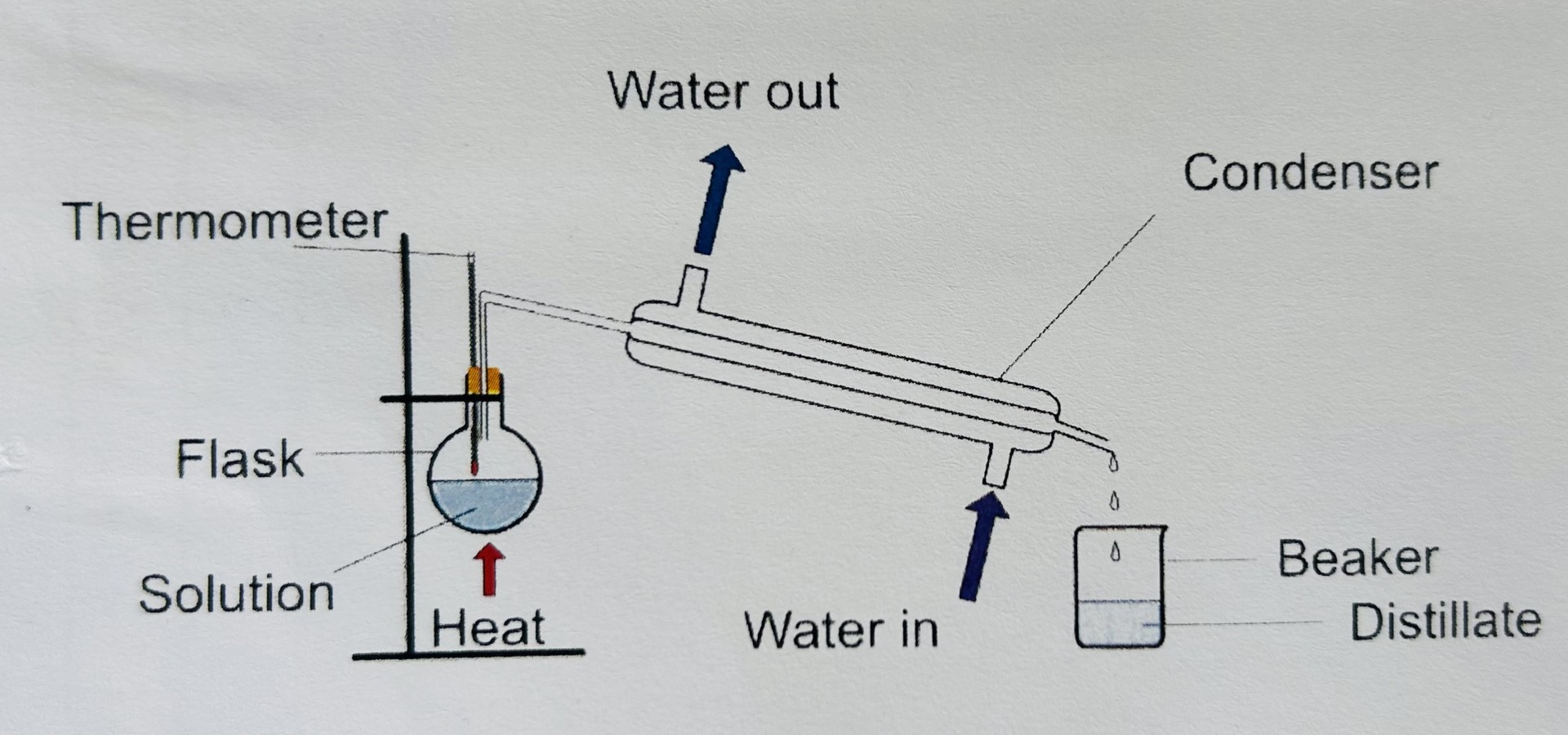
How to test and distil salt water
Before water can be drunk, it must be tested to make sure it is safe
First, test the PH of the water using a PH meter. If the PH is too high or too low, you will need to neutralise it with a titration, but use a PH meter, rather than an indicator, as this won’t contaminate the water
TO TEST:
To test for sodium ions, do a flame test on a small sample. If the sodium ions are present, the flame will turn yellow.
To test for chloride ions, take another sample of your water and add a few drops of dilute nitric acid, followed by a few drops of silver nitrate solution. If chloride ions are present, a white precipitate will form
TO DISTILL:
To distil the water, pour the salty water into a distillation apparatus. Heat the flask from below. The water will boil and form steam, leaving any dissolved salts in the flask. The steam will condense back to liquid water in the condenser and can be collected as it runs out
Then, retest the distilled water for sodium chloride to check it has been removed, also retest the PH of the water with a PH meter to check that it’s neutral (has a PH of 7)
Tests for water
Physical test:
→ Tells us if water is pure
Boil it & measure its bpt
Pure water boils at 100 degrees
Impure water boils above 100 degrees and has a range of values
Chemical test:
→ Only show that it is water & not how pure it is
Fractional distillation
Used in separating a mixture of liquids with different boiling points
It is very useful if the liquids have similar BPTs
Describing fractional distillation:
Heat the mixture to vaporise the liquids
The lowest boiling liquid rises up to the top of the column
The column is cooler at the top, so this vapour cools, condenses & collects in flask (1st distillate)
Vapours of higher boiling liquids only rise part of the way up the column before cooling & condensing back into the liquid mixture
Once 1st liquid has completely distilled, temperature is raised until next highest boiling liquid boils
Its vapour rises to the top of the column, then cools & condenses & is collected as 2nd distillate
This repeats until highest boiling liquid remains in heated flask (residue)

Sources of waste water
In the home water is used for many things - having a bath, going to the toilet, doing the washing up. When you flush the water down the drain, it goes into the sewers and towards sewage treatment plants
Agricultural systems also produce a lot of waste water including run-off from fields, which may contain chemicals from fertilisers, and slurry from animal farms
sewage from domestic or agricultural sources has to be treated to remove any organic matter and harmful microbes before it can be put back into fresh water sources like rivers or lakes. Otherwise it could pollute them and pose health risks
Industrial processes also produce a lot of waste water that has to be collected and treated. As well as organic matter, industrial waste water can contain harmful chemicals - so it has to undergo additional stages of treatment before it’s safe to release into the environment
Stages of waste water treatment
Screening -
Before being treated, the sewage is screened - this involves removing any large bits of material (like twigs or plastic bags) as well as any grit
Sedimentation -
The screened waste is allowed to stand in a settlement tank and undergoes sedimentation - the heavier suspended solids sink to the bottom to produce sludge, while the less dense effluent floats on the top
Aerobic digestion -
The effluent in the settlement tank is removed and treated by biological aerobic digestion. This is when air is pumped through the water to encourage aerobic bacteria to break down any organic matter - including other microbes in the water
Anaerobic digestion -
The sludge from the bottom of the settlement tank is also removed and transferred into large tanks. Here, it gets broken down by bacteria in a process called anaerobic digestion. Anaerobic digestion breaks down the organic matter in the sludge, releasing methane gas in the process. The methane gas can be used as an energy source, and the remaining digested waste can be used as a fertiliser

Potable water from waste water
Potable water can be retrieved from waste water using these processes, and could be a viable alternative in areas where there’s not much fresh water.
Evaporation
Used in separating a soluble substance from a solution
The water evaporates & the soluble substance is left as a solid
How to evaporate:
→ Slowly heat the solution to concentrate the solution by evaporation & initiate crystallisation
Evaporation by heating quickly removes water, but:
Anhydrous powder will form instead of crystals (anhydrous means ‘contains no water’)
The method can only be used if the substance does not break down when heated
To make large, hydrated crystals (hydrated means ‘contains water’):
Allow solution to evaporate very slowly after gentle heating (called ‘cool to crystallise’)
Crystallisation
Produces large, hydrated crystals by slow evaporation
Useful if crystals break down when heated strongly
How to crystallise:
→ Filter mixture to remove any insoluble solids
→ Gently warm for a short time to concentrate the solution by evaporation & initiate crystallisation
Haber Process - What is Ammonia
Ammonia is an important chemical in the production of lots of other chemicals
Haber Process - What is Ammonia used to make
Fertilisers
Cleaning products
Explosives
Haber Process - What is the effect of making Ammonia
It consumes of 1% of all man made power (a significant amount of all world energy)
Haber Process - Ammonia equation
Nitrogen + Hydrogen ⇌ ammonia
N2 (g) + 3H2(g) ⇌ 2NH3 (g)
This reaction produces heat, so it is exothermic
What is the temperature, pressure and catalyst used to make ammonia
Temperature - 450 degrees
Pressure - 200 atm
Catalyst - Fe
How the haber process works (making ammonia)
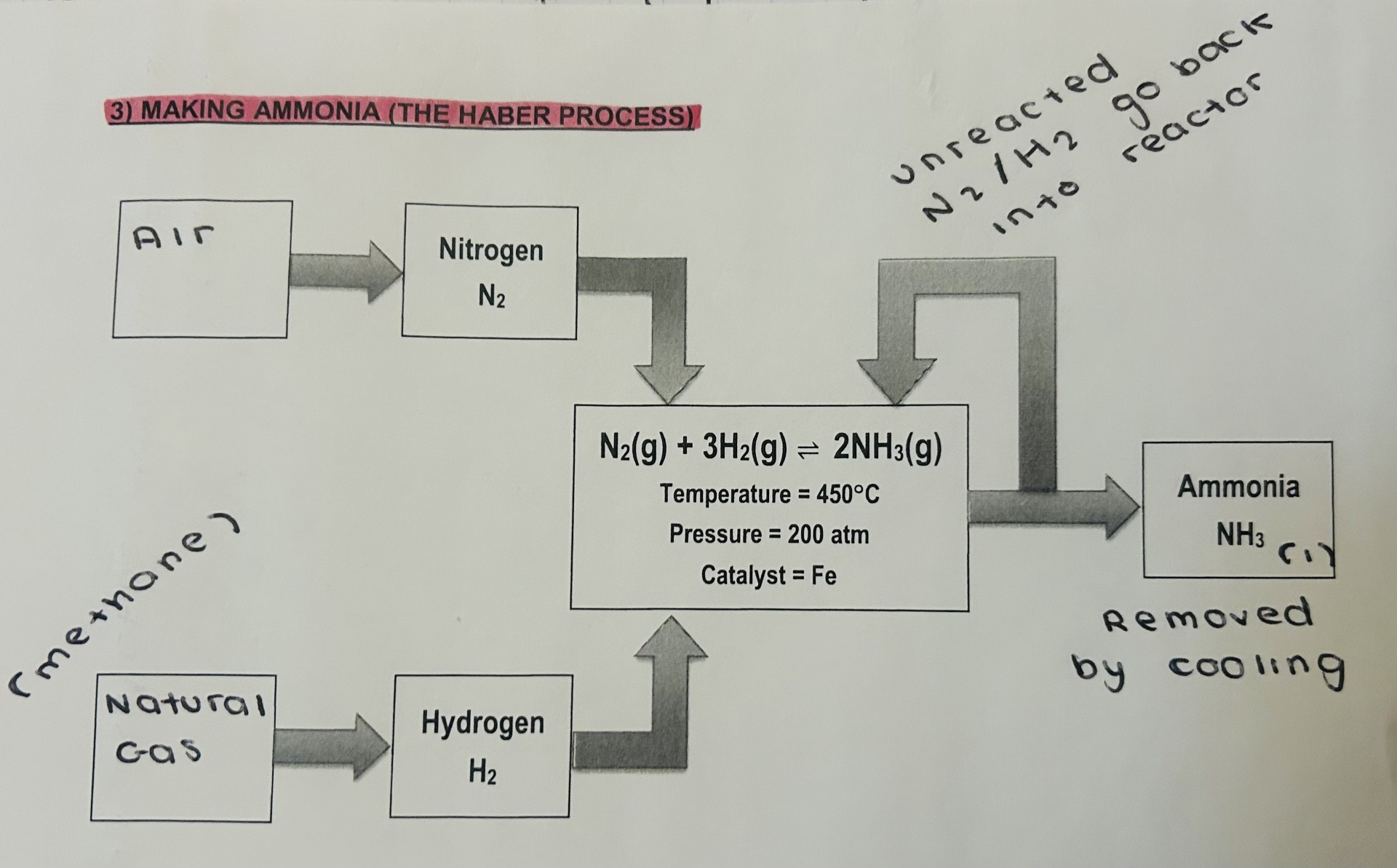
Haber compromise - factors to think about
Yield
Rate
Cost
Haber compromise - why does the haber process use the condition of Fe catalyst
Catalysts speed up both reactions equally so we reach equilibrium faster
We use an iron catalyst so no compromise

Haber compromise - why does the haber process use the condition of 200 atm (pressure)
The forward reaction produces less molecules so high pressure needed
But high pressure is difficult to maintain, could explode and costs a lot
Compromise = 200 atm
High enough to favour forwards reaction
But low enough so it is safe/costs less

Haber compromise - why does the haber process use the condition of 450 degrees (temperature)
Needs to be low to favour forwards (exo) reaction
But low temp = low rate
Compromise = 450 degrees
Low enough to favour forwards reaction
But high enough so rate is good
Fertilisers
In order to grow good crops we need fertilisers
Fertilisers contain minerals which help plants to grow
They contain 3 key elements:
Nitrogen
Potassium
Phosphorus
Fertilisers usually have an N:P:K value on the side, this tells us the proportions of each of these chemicals in the fertilisers
Nitrogen (N), Potassium (K), Phosphorus (P)
Nitrogen (N):
Nitrate ions are used to tackle poor growth and yellow leaves
Amino acids contain nitrogen, which are the building blocks of protein
Potassium (K):
Potassium ions are used to tackle poor flower and fruit growth, as well as discoloured leaves
Potassium must be present for photosynthesis and respiration enzymes to work
Phosphorus (P):
Phosphate ions are used to tackle poor root growth and discoloured leaves
Phosphorus is a component of DNA molecules and cell membranes
