week 9-12 biophysics
 Call Kai
 Learn
Learn Practice Test
 Spaced Repetition
 Match
Match Flashcards
 Knowt Play
1/12

There's no tags or description
Looks like no tags are added yet.
Name | Mastery | Learn | Test | Matching | Spaced | Call with Kai | Chat |
|---|
No analytics yet
Send a link to your students to track their progress
13 Terms
What is the difference between a conductor and an insulator?
Conductors have some electrons that can move freely around the entire material — these are not tied to a particular nucleus, and this motion results in electric currents. Insulators have all electrons tightly bound to specific atoms and cannot travel far from the nucleus, so these materials do not conduct electric currents.
What are the three ways charge can be transferred between objects?
Via friction (triboelectric effect) — when two materials are rubbed together, one is more electropositive, so electrons move between them, leaving one with an excess charge.
By conduction — when two objects touch, charge flows between them until the difference is balanced, distributing evenly.
By induction — a negative charge brought near an object repels electrons away, attracting positive charges to one end (polarisation); if you then separate that end, the induced charge is retained.
Why can a neutral molecule still be attracted to a charged object?
Most neutral atoms/molecules are not perfectly symmetric — even though the net charge is zero, the charge is distributed unevenly. When a charged object (Q) is brought close to a polar molecule, the molecule rotates/aligns due to electrostatic attraction. When Q is close, it is much nearer to one end than the other, so the charges no longer cancel — it feels a net attractive force. This underlies intermolecular forces (like van der Waals / dipole interactions) and explains molecular bonding behaviour.
What is the Resting Membrane Potential (RMP) and what three things create it?
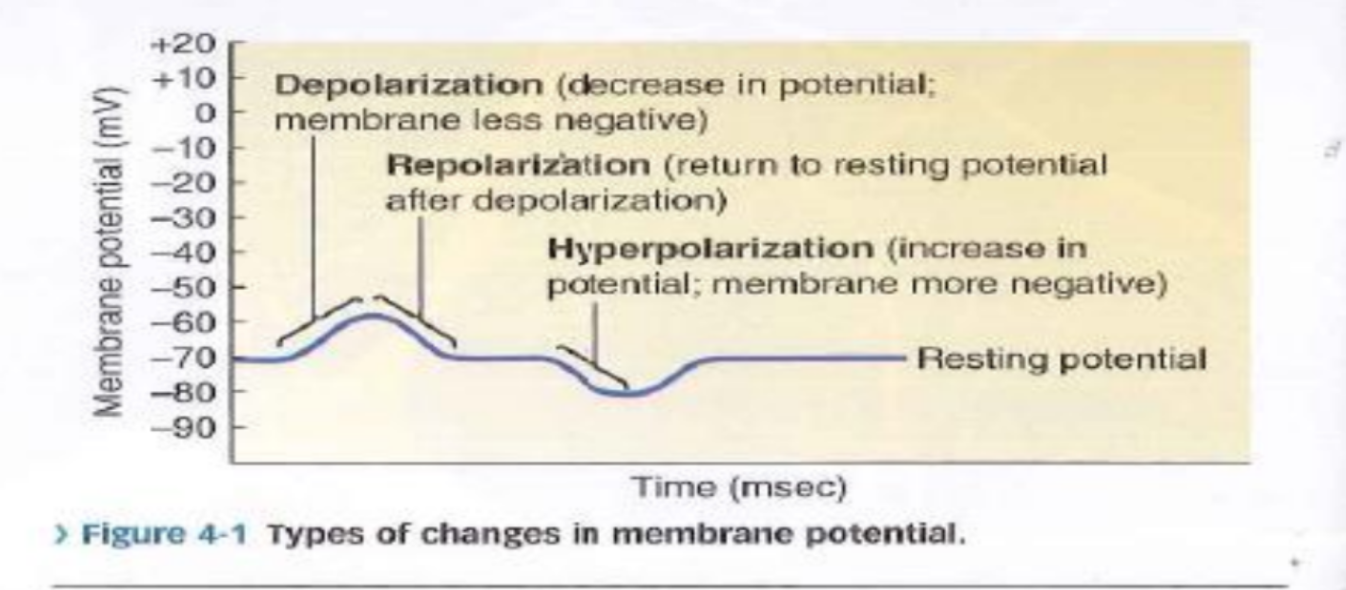
RMP = -70 mV (inside negative, outside positive). It is a property of ANY cell membrane, not just neurons. Three things create it: ions diffusing down their concentration gradients, selective permeability of the membrane (some ions get through more easily), and electrical attraction between opposite charges.
What are the ion concentrations inside and outside the cell at rest?
K⁺ — mostly inside (150 mM inside, 5 mM outside). Na⁺ — mostly outside (15 mM inside, 150 mM outside). Cl⁻ — mostly outside (10 mM inside, 110 mM outside). A⁻ — large protein anions stuck inside, can never leave.
What are the four types of ion channels and how does each work?
Leak channels — always slightly open; many more K⁺ leak channels than Na⁺, so at rest the membrane is 25–30x more permeable to K⁺, which is why K⁺ dominates RMP. Voltage-gated channels — only open when the voltage changes; key players in action potentials. Mechanically gated — opened by pressure or temperature. Ligand-gated — opened when a neurotransmitter binds to the outside of the channel, causing it to open and let ions through.
What does equilibrium potential mean, and does ion movement actually stop?
At equilibrium potential, the concentration gradient and electrical gradient exactly cancel out. Equal amounts of ions cross in both directions, so the NET movement is zero — but individual ions are still physically moving. Think of it like a down escalator — you're walking up at the same speed it pushes you down, so you don't go anywhere overall.
What is special about Cl⁻ at RMP?
Cl⁻ is a special case. Its equilibrium potential is already approximately -70 mV — which is basically the same as RMP. This means at rest, Cl⁻ is already at equilibrium and has no net drive to move in either direction. Because of this, Cl⁻ doesn't influence RMP — instead, RMP influences where Cl⁻ ends up. It passively distributes itself according to whatever the membrane potential already is, rather than helping create it.
How does the GHK equation work as a concept?
hink of it as a tug of war. K⁺ pulls voltage toward -90 mV, Na⁺ pulls toward +61 mV, Cl⁻ pulls toward -60 mV. How hard each ion pulls depends on how many channels are open for it — more open channels = more ions crossing = bigger influence on voltage. At rest, K⁺ has far more channels open than Na⁺, so K⁺ wins and pulls voltage to -70 mV (close to -90 mV but not quite, because Na⁺ still pulls a little).
How does the electrical circuit model represent the cell membrane?
Ion channels = resistors — a resistor slows down the flow of electricity, just like a closed channel slows the flow of ions. The more closed the channel, the higher the resistance. Equilibrium potentials = batteries (voltage sources) — each ion has its own equilibrium potential which acts like a battery trying to push current in a certain direction. Current (I) = flow of ions through channels. The key formula is Ohm's law: V = IR, which rearranges to I = ΔV / R.
Why can extra Na⁺ channels cause epilepsy?
When there are multiple channels of the same type (e.g. extra Na⁺ channels due to a gene mutation in epilepsy), they act as resistors in parallel. More channels in parallel = lower total resistance = more current flows = more Na⁺ gets in = membrane depolarises more easily. This is why extra Na⁺ channels can cause epilepsy — the neuron becomes too easy to fire.
What are the key properties of an action potential?
All-or-nothing — once threshold is reached, the AP always fires with the same size; you can't have a "half" action potential. Brief — lasts only 1–4 ms. Large — ~100 mV change in voltage. Travels long distances — 1 metre or more. In neurons it is always Na⁺ and K⁺ driving the action potential.
What happens at each of the 7 points of an action potential?
Point 1 (Resting): voltage = -70 mV, all voltage-gated channels closed.
Point 2 (Threshold): depolarising stimulus brings membrane to -50 to -55 mV.
Point 3 (Depolarisation): voltage-gated Na⁺ channels open fast, Na⁺ floods in, positive feedback loop, voltage shoots to ~+30 mV.
Point 4 (Peak): Na⁺ channels begin to inactivate, K⁺ channels start to open, depolarisation halts.
Point 5 (Repolarisation): K⁺ channels fully open, K⁺ rushes out, voltage falls back toward -70 mV.
Point 6 (Hyperpolarisation): K⁺ channels slow to close, membrane overshoots to ~-80 mV, Na⁺ channels reset from inactivated to closed.
Point 7 (Return): K⁺ channels close, membrane returns to -70 mV, Na⁺/K⁺ pump restores ion concentrations.