Science 8th Grade Midterm
 Call Kai
 Learn
Learn Practice Test
 Spaced Repetition
 Match
Match Flashcards
 Knowt Play
1/101

There's no tags or description
Looks like no tags are added yet.
Name | Mastery | Learn | Test | Matching | Spaced | Call with Kai | Chat |
|---|
No analytics yet
Send a link to your students to track their progress
102 Terms
Ionization Energy
The energy required to remove an electron from a neutral atom
Electronegativity
The ability of an atom to attract electrons
Ion
An atom that has gained or lost electrons
Octet Rule
Atoms tending to gain, lose, or share electrons in order to have a full valence shell of 8 electrons
Chemical Bond
The attractive force between atoms that binds them together as a unit, having one of these will decrease the potential energy of these atoms and increase their stability
Ionic Bond
This forms between a metal and a non metal that become ions due to the transfer of electrons
Characteristics of atoms in an ionic bond
Conduct electricity, dissolve in water, form crystals, and have increased melting points
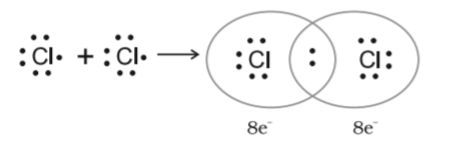
Covalent Bond
Bond formed by the sharing of electron pairs
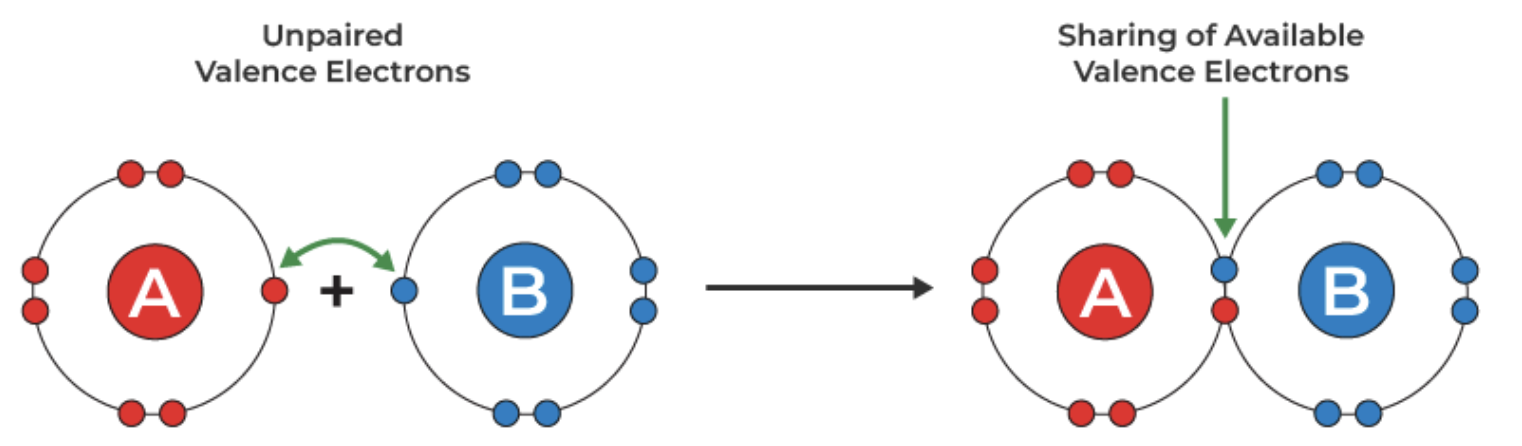
Characteristics of atoms in a covalent bond
Will NOT conduct electricity, dissolve in water, form crystals, and will have decreased melting points. These will also be odorous.
Non-polar Covalent Bond
When two atoms share electrons equally
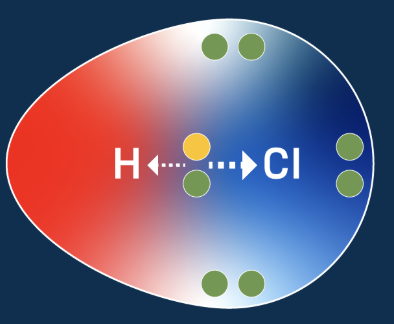
Polar Covalent Bonds
When electrons are shared, but not equally
Up and to the Right
The ionization energy and electronegativity of an atom increases going _____, meaning non-metals have more of these qualities because they are the “takers”
Bigger atoms
It is easier to take electrons from _____ because their valence electrons are farther from the nucleus
Ionic
The greater the difference in electronegativity between atoms, the more ____ the bond becomes
Subscript
a small number written to the right and slightly below a chemical symbol to indicate the number of atoms of that element present in a molecule or compound
Oxidation State
the hypothetical charge an atom would have when involved in an ionic bond
Cation
Atom with a positive oxidation state
Anion
Atom with a negative oxidation state
Polyatomic Ions
A group of covalently bonded atoms that act as a single ion
Dipole
A region of positive and negative charge in a molecule or formula unit
Chemical Formula
A shorthand representation of a substance using the the symbols for the atoms as well as subscript to indicate the number of each ato
Democritus
Stated the idea that all matter is made of tiny, indestructible, things called atoms
Ernest Ruthorford
Stated the idea that most of an atoms mass is in its tiny nucleus, and the rest is mainly empty space
John Dalton
Revolutionized our knowlege of atoms with his four part theory
Dalton’s Four Part Theory
All matter is composed of atoms. 2. Atoms of a given element are identical in mass and properties. 3. Atoms cannot be subdivided, created, or destroyed. 4. Atoms of different elements combine or be rearranged to form chemical reactions.
Dimitri Mendeleev
Came up with the original periodic table based on atomic mass rather than atomic numbers like the one today
JJ Thomson
Discovered that electrons make up atoms, made the plum pudding diagram
Plum Pudding Model

Chemistry
The study of matter and its interactions with other matter
Atoms
The basic units of matter, consisting of a nucleus surrounded by electrons. They determine the chemical properties of elements.
Elements
Pure structures that cannot be broken down further by chemical means
Protons
These make up an atoms nucleus and have a positive charge
Neutrons
These make up an atoms nucleus and have a neutral charge
Electrons
Subatomic particles that have a negative charge and orbit the nucleus of an atom.
Atomic Number
The number of protons (and electrons) in an atom's nucleus, which determines the chemical element and its properties. These organize our periodic table
Atomic Mass
The mass of an atoms nucleus, determined by the # of protons + neutrons, this organized Mendeleev’s periodic table
Electron Clouds
The area where electrons orbit the nucleus of an atom
Orbital
A region in an atom where there is a high probability of finding electrons.
Isotopes
Atoms of the same element with different numbers of protons (resulting in different atomic mass)
Average Atomic Mass
What you get when you average the masses of all isotopes of an element
amu
(atomic mass unit), standard unit of mass used to measure atomic weight
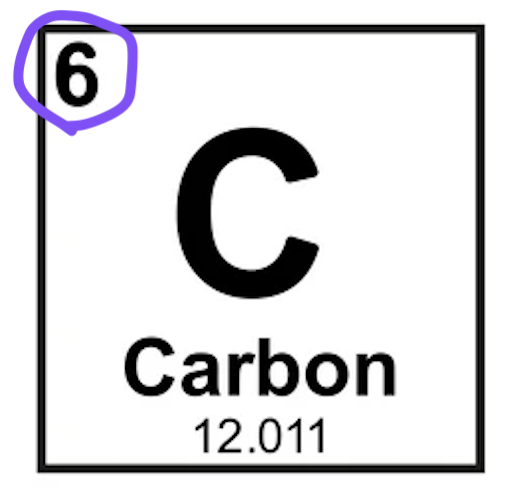
Atomic Number
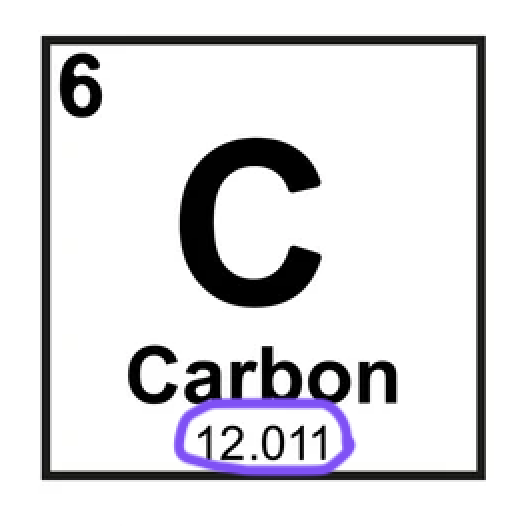
Avg. Mass Number
Length
The distance between two points, also called height, distance, or width
Mass
The amount of matter in an object
Volume
The amount of space an object takes up
Storin’ and Pourin’
Purpose of a Beaker
Measuring the Volume of Liquid
Purpose of a Graduated Cylinder
Derived Unit
2 or more simple units combined
Density
Mass over Volume
Kelvin
SI unit for Temperature
Second
SI unit for time
Meter
SI unit for length
Gram
SI unit for mass
Liter
SI unit for volume
Meniscus
The middle of the curve at the top of a liquid in a graduated cylinder
100 degrees
Temperature at which water boils (Celcius)
0 degrees
Temperature at which water freezes (Celcius)
Accuracy
Getting close to the right answer
Presicion
Consistently getting a specific answer
Line Graphs
Can show relationships where the DV changes due to changes in the IV, often shows changes over time
X axis
Horizontal axis, always the IV
Y axis
Vertical Axis, always the DV
Solubility Curve
Shows how much of a substance will dissolve in 100 mL of water at a given temp
Bar Graph
Good for comparing multiple things and info gathered by counting
Pie Chart
Used to show how a fixed quantity is broken up, shows percentages
The motion of molecules
What is the Kelvin System Based on?
Hypothesis
An educated guess / a possible answer
A hypothesis proven to be true by a lot of evidence
Theory
Independent Variable
The variable that can be changed by the controller of the experiment
Dependent Variable
The variable that is measured in an experiment
Constant Variables
The variables that are kept consistent to achieve accurate results
Energy
the ability to do work
Kinetic Energy
The energy of motion
Potential Energy
Stored energy
Concentration
The number of something in a specific area
[]
Shorthand for concentration
Kinetic Molecular Theory
All matter is in constant, random motion. Motion is dependent on temperature. The higher the temp the faster the motion. The lower the temp the slower the motion until absolute zero is reached and all motion stops.
Absolute Zero
The hypothetical temperature when all motion of particles stops. (0 degrees Kelvin)
KE + PE
Thermal Energy formula
2nd Law of Thermodynamics
Particles will flow in random but constant motion to a high concentration to a low one until and equilibrium is reached (DIFFUSION)
Heat Transfer Methods
Conduction, Convection, Radiation
Heat
When Thermal Energy flows
Conduction
the transfer of heat through the direct contact of particles
Convection
The transfer of heat through fluids by the movement of heated particles
Radiation
The transfer of heat through electromagnetic waves of light
Cp
Specific Heat shorthand
Specific Heat
the amount of energy it takes to raise the temp of 1 kg of a substance by 1 degree kelvin
Jouls
Unit of measurement for specific heat
Solid
State of matter with definite volume and definite shape
Liquid
State of matter with definite volume and indefinite shape
Gas
State of matter with indefinite volume and indefinite shape
Melting
Phase change from a solid to a liquid
Freezing
Phase change from liquid to solid
Evaporation
Phase change from liquid to gas
Condensation
Phase change from gas to liquid
Sublimation
Phase change from solid to gas
Deposition
Phase change from gas to solid
Heat of Vaporization
The energy required for matter to turn from a liquid to a gas
Heat of Fusion
The energy required for matter to turn from solid to a liquid