HISTORY OF ANCIENT SHIP CONSTRUCTION
 Call Kai
 Learn
Learn Practice Test
 Spaced Repetition
 Match
Match Flashcards
 Knowt Play
1/22

There's no tags or description
Looks like no tags are added yet.
Name | Mastery | Learn | Test | Matching | Spaced | Call with Kai | Chat |
|---|
No analytics yet
Send a link to your students to track their progress
23 Terms
Buoyed raft
Multiple numbers of
inflatable materials were
soon assembled to support
greater weight
In Mesopotamia, natives put together inflated skins

Coracles
A watercraft that has a stretched
animal skin over a frame—a
form of skin boat.Are generally saucer-
or bowl-shaped but sometimes
are square or oblong and are
intended for use of one to three
people.

curragh/currach
People of western Ireland, having
little wood available, created
watercrafts made of animal skin
stretched over boat-shaped frames,
which were sometimes large enough
to carry as many as twenty people.
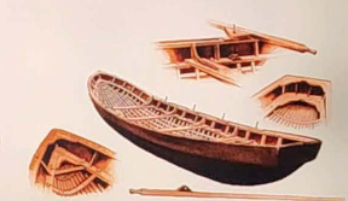
umiak
A double-ended boat of the Inuit people is
covered with sealskin or walrus' hide, around
thirty feet long and five to six feet wide, and
driven by a dozen rowers or a large square sail.

pot rafts
a raft made out of big pots as a buoy

reed boats and rafts
Bundled reeds that were assembled with each other until it becomes a single unit that can carry several people or cargo

bark canoes
are lightweight, flexible watercraft made from the outer bark of large trees.

dugout canoes
started simply with a hollowed half-cylinder, its ends plugged with clay. From this they graduated to shaping the trunk, more or less proficiently; where trees of good size were available
the great Maori war canoes.

UBAID PERIOD
The bundled reed boats were coated or caulked with
bitumen on the exterior, especially of the vessels from
Magan and Dilmun, which were also referred to by
cunelform texts (Hnalhen, 2020).
bitumen
is a naturally occurring substance that is
similar to modern asphalt - black, olly, viscous, and tar-
Ilke (Huebner, 2016).
ma, magur
The generic Sumerian
term for a boat was
while the term _ was
often used to denote the
sacred or ceremonial
boats of the gods and
kings.
Sargon
The king of Kish, triumphed in
thirty-four battles over the cities up to the
edge of the sea and destroyed their walls.
He made the ships from Meluhha, the ships
from Magan, and the ships from Dilmun tie
up alongside the quay of Akkad
Hammurabi
Took the Babylonian throne
during circa 1790 BC, is known to have
united the disparate kingdoms of his time
into a Babylonian Empire, and pronounced
his law code throughout the empire.
234
If a shipbuilder build a boat of sixty gur
for a man, he shall pay him a fee of two
shekels in money-
235
If a shipbuilder build a boat for some
one, and do not make it tight, if during that
same year that boat is sent away and suffers
injury, the shipbuilder shall take the boat
apart and put it together tight at his own
expense. The tight boat he shall give to the
boat owner.
275
If any one hire a ferryboat, he shall
pay three gerahs in money per day.
276
If he hire a freight-boat, he shall pay
two and one-half gerahs per day.
277
If any one hire a ship of sixty gur, he
shall pay one-sixth of a shekel in money
as its hire per day.
236
If a man rent his boat to a sailor, and the
sailor is careless, and the boat is wrecked or goes
aground, the sailor shall give the owner of the boat
another boat as compensation.
237
If a man hire a sailor and his boat, and provide
It with corn, clothing, oil and dates, and other things
of the kind needed for fitting it: if the sailor Is
careless, the boat is wrecked, and its contents
ruined, then the sailor shall compensate for the
boat which was wrecked and all in it that he ruined.
238
If a sallor wreck any one's ship, but saves it,
he shall pay the half of its value in money.
239
If a man hire a sailor, he shall pay him six gur
of corn per year.
240
If a merchantman run against a ferryboat, and
wreck it, the master of the ship that was wrecked
shall seek justice before God; the master of the
merchantman, which wrecked the ferryboat, must
compensate the owner for the boat and all that he
ruined.