PSY389 Lecture 4 - Neurobiology of Alcohol and Other Drugs
 Call Kai
 Learn
Learn Practice Test
 Spaced Repetition
 Match
Match Flashcards
 Knowt Play
1/19

There's no tags or description
Looks like no tags are added yet.
Name | Mastery | Learn | Test | Matching | Spaced | Call with Kai | Chat |
|---|
No analytics yet
Send a link to your students to track their progress
20 Terms
Drug Administration, Absorption, Distribution and Elimination
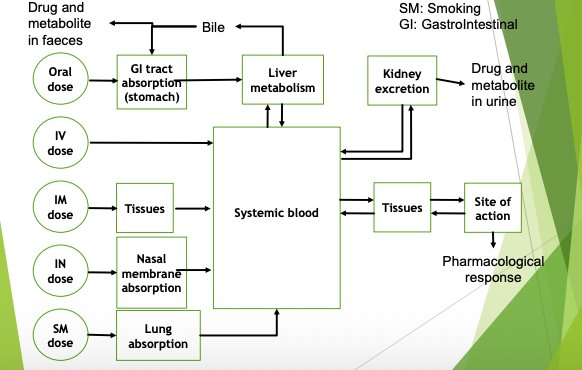
IV: Intravenous
IM: Intramuscular
IN: Inhalation via snort/sniff
SM: Smoking
GI: GastroIntestinal
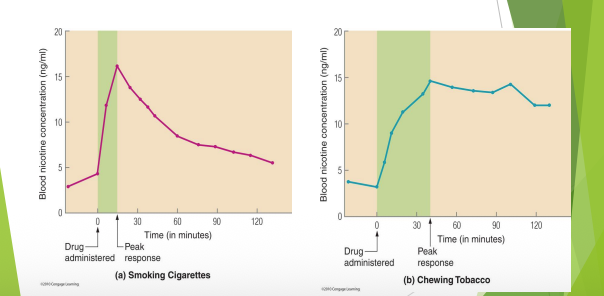
Concentration of a Drug in the Blood Supply Depends on the Method of Administration
Penetration of drug through cell membrane in the body
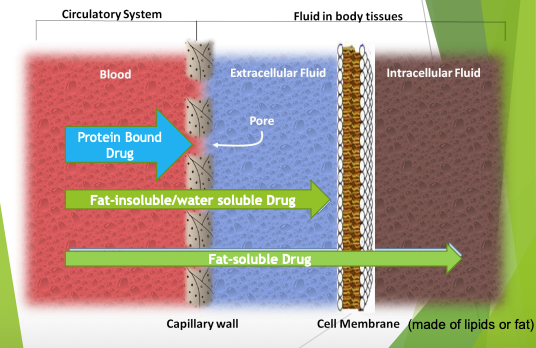
How does drug get distributed in the brain?

Feltenstein et al. (2021): Neural substrates and circuits of drug addiction
a comprehensive overview of the neural mechanisms underlying drug addiction.
the role of the mesolimbic and mesocortical pathways in the development and persistence of addictive behaviours.
Different theories and stages of addiction
Early Stage - Acute Reinforcement (Feltenstein et al. (2021)
Drugs of abuse activate the mesolimbic pathway,
release of dopamine in the nucleus accumbens (NAc).
This release reinforces the behaviour → more likely to repeat drug use.
Dopaminergic Systems: Mesolimbic pathway
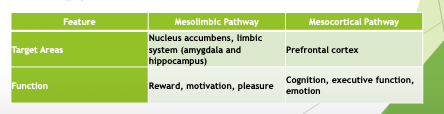
Mesolimbic pathways originates from the Ventral tegmentum area (VTA) and projects to Nucleus accumbens, limbic system (amygdala and hippocampus)
Functions: Reward, motivation, pleasure, emotion

Later stage: Escalation and Dependence (Feltenstein et al. (2021)
With prolonged drug use, the mesocortical pathway and regions like the dorsal striatum become more involved.
This shift contributes to the escalation of drug intake and the development of dependence, → characterized by compulsive drug-seeking behaviours.
Dopaminergic Systems: Mesocortical pathway
Mesocortical pathways originate from the Ventral tegmentum area (VTA) and projects to the prefrontal cortex (PFC)
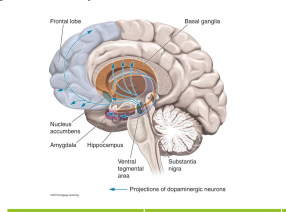
Changes in neurophysiology with prolonged drug use
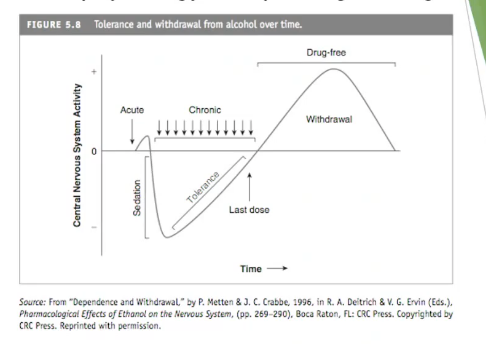
Tolerance, Withdrawal, Dependence
Tolerance
Lessened effects as a result of repeated administration (a higher dose is required)
Withdrawal
Occurs when substance use is discontinued
Dependence
(Addiction) - Compulsive need to use the drug repeatedly
History of Nucleus accumbens and Dopaminergic Pathways

Relapse and Craving
Conditioned responses and cues associated with drug use can trigger cravings and relapse.
The neural circuits involved in these conditioned responses include the amygdala and hippocampus, → process emotional and contextual memories related to drug use.
Any drug has a specific effect on one or more neurotransmitters

Ceceli et al. (2022). The neurobiology of drug addiction: cross-species insights into the dysfunction and recovery of the prefrontal cortex.
The Prefrontal Cortex and Its Functions:
responsible for higher-order executive functions (e.g., decision-making, impulse control, emotional regulation, and assigning value to stimuli.
essential for adaptive behaviour and goal-directed actions.
In the context of addiction, the PFC's role becomes significantly important as it: 1.helps individuals assess the consequences of their actions; and 2. exert self-control over potentially harmful behaviours
Ceceli et al. (2022): Impact of Chronic Drug Use on the PFC
Chronic exposure to addictive substances (e.g., cocaine, opioids, and alcohol) disrupts the normal functioning of the PFC
Neuroimaging studies reveal structural and functional abnormalities in PFC among individuals with substance use disorder.
Prolonged drug use leads to PFC impairments across species.
Ceceli et al. (2022). Two primary deficits in PFC
1. Impaired Response Inhibition: A diminished capacity to suppress maladaptive behaviours →compulsive drug seeking and consumption despite adverse consequences.
2. Altered Salience Attribution: A heightened sensitivity to drug-related cues coupled with a reduced responsiveness to natural rewards→ prioritisation of drug use over other life activities.
-The balance between inhibitory control and reward processing is disrupted → the cycle of addiction.
Ceceli et al. (2022): Therapeutic approaches aimed at restoring PFC function
Cognitive Behavioural Therapy (CBT): modifying dysfunctional thought patterns and behaviours → enhancing PFC-mediated executive control.
Pharmacotherapy: Medications (e.g., modafinil and methylphenidate) may have potential to improve PFC function and reduce cravings (further research is needed).
Neuromodulation: Non-invasive brain stimulation methods (e.g., transcranial magnetic stimulation, and transcranial direct current stimulation (tDCS) – may modulate PFC activity and reducing addictive behaviours