Radiation Bio. - Cancer Biology
 Call Kai
 Learn
Learn Practice Test
 Spaced Repetition
 Match
Match Flashcards
 Knowt Play
1/29

Earn XP
Description and Tags
Terms, types of cancer and their stages of it
Name | Mastery | Learn | Test | Matching | Spaced | Call with Kai | Chat |
|---|
No analytics yet
Send a link to your students to track their progress
30 Terms
What is cancer and where does it originate?
It originates due to DNA damage and unregulated cell division growing at any pace
Histology
Study of microscopic anatomy of cells & tissues —> tumors originate from normal tissues
Does cancer cells remain in the same place?
No, cancer moves and spreads to new places
Benign
Tumors that grow locally w/o invading tissues —> can be dangerous depending on location
Malignant
Tumors invading nearby tissues & spawn metastas
Carcinoma
Tumors arising from epithelial
Squamous cell carcinomas - seal large caviaties/channels that they line, protecting the cell population; e.g., lung or skin
Adenocarcinomas - secrete substances into ducts/cavities they line; e.g., ovary or lung
Sarcomas
Derived from mesenchymal cells in body
1% of tumors found in oncology clinics
Angiosarcoma & Synovial sarcoma are two types of variety of types of common sarcomas

Hematopoietic
Derived from blood-forming tissues/cells forming the immune system
Leukemia: white blood, non-pigmented
Lymphomas: aggregate to form SOLID tumors in lymph nodes
Hodgkin’s disease & Multiple myeloma
Multiple Myeloma (MM)
Malignancy of plasma cells of B-cell lineage
Responsible for producing/secreting antibody molecules
Neuroectodermal Malignancies
Tumors arisen from neutral crest
E.g.: Melanomas →derived from melanocytes, small-cell lung carcinomas (SCLCs)
Dedifferentiated
JUST the cells are affected of the tumor
Anaplastic
The WHOLE tumor is affected
Hyperplastic
Minimum changes seen → excessive # of cells where they shouldn’t be, they don’t necessarily FIT
A early indication of premalignant change in the esophagus is called what?
A metaplastic condition called Barrett’s esophagus
Dysplastic
Slightly abnormal tissue
usually cytlogically abnormal
State between benign & malignent
“pre-cancerous” they haven’t invaded
Neoplastic
Growths invading the underlying tissue
Can be benign or malignant
Described as cancer b/c it’s second to last in the progression of tumor growths

Monoclonal
Growths that have a single common ancestor
Polyclonal
“growth besties”
A mixture of different immune cell lineages (or the antibodies they produce) that respond to the same target → GOOGLE ANSWER BTW

How do we find out if tumors are monoclonal & polyclonal?
Look at the gene glucose-6-phosphate dehydrogenase (G6PD) on X chromosome
Tumors ARE monoclonal
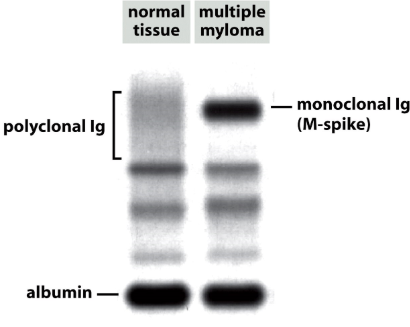
How did they prove these are tumors?
Looking at the myelomas → usually expressed in their own antibodies

Proto-oncogenous
“Woho cancer”
Positive growth regulators: one copy used
Tumor Suppresor
“Boohoo cancer”
Negative growth regulators that stop the growth
DNA Stability
Keeps control, monitors, and maintaining integrity of DNA quality control
Metaplasia
Cell layer that migrated from where it originally started →look NORMAL
Radiation Carcinogenesis
“creation of cancer”
Radiation DOES NOT lead to the formation of genetic damage, but it does increase the likelihood of genetic damage occurring → like Repair, mutations, chromosomal changes, DEATH in the cell
There is NO safe dose of radiation
Chromosomal changes
Deletions - loss of genes by loss of either part or all of it
Translocations - addition of extra genes
Inversion - rearrangement of genes
Death of a cell defined by radiation is…
Mitotic
Somatic Cell Damage causes…
impairment of organ functions
Germ Cell Damage causes….
Most dangerous
Variety of birth defects
Affect the gene pool