4.44-4.50 Synthetic polymers
 Call Kai
 Learn
Learn Practice Test
 Spaced Repetition
 Match
Match Flashcards
 Knowt Play
1/20

There's no tags or description
Looks like no tags are added yet.
Name | Mastery | Learn | Test | Matching | Spaced | Call with Kai | Chat |
|---|
No analytics yet
Send a link to your students to track their progress
21 Terms
What are polymers?
Large molecules of high relative molecular mass, made by linking monomers
What is the process of linking monomers to create polymers called?
Addition polymerisation
How are the monomers connected (through what type of bonding?) in addition polymerisation?
Covalent bonding
What do polymerisation reactions usually require?
High pressures and the use of a catalyst
Name 4 everyday polymers:
Resins
Plastics
Polystyrene cups
Nylon
What are the two types of polymers?
Synthetic polymers and natural/biological polymers

What happens to the double C=C bond in monomers during addition polymerisation?
One of the bonds in each C=C bond breaks and forms a bodn with the adjacent monomer
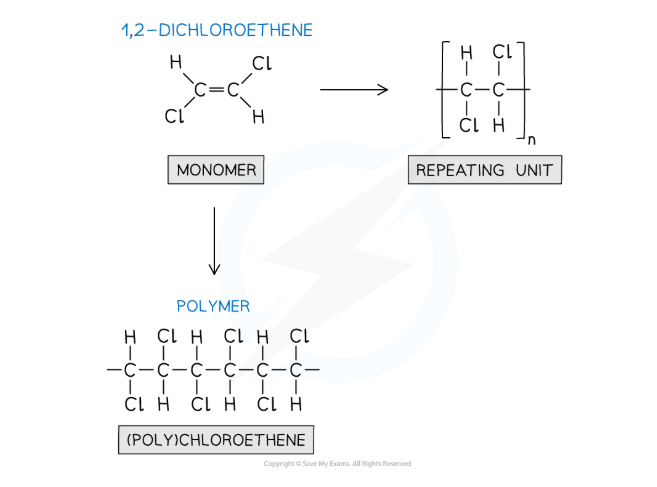
What can we consider each monomer?
We can consider each monomer as a repeat unit

Why are addition polymers unreactive and chemically inert? (This means they also don’t easily biodegrade)
Because addition polymers are formed by the joining up of many strong molecules with strong C-C bonds
Why do landfill sites quickly fill up with waste polymers?
Microorganisms such as decomposers cannot break addition polymers down as they are non-biodegradable
When they burn, how do polymers contribute to climate change?
Polymers release a lot of heat energy and produce carbon dioxide which is a greenhouse gas
What do polymers that contain chlorine, such as PVC, release when burned?
They release toxic hydrogen chloride gas
If polymers are incinerated by incomplete combustion, what toxic gas may be produced?
Carbon monoxide
When are condensation polymers formed?
When two different monomers are linked together with the removal of a small molecule, usually water
What is the difference between condensation polymers and addition polymers?
Addition polymerisation forms the polymer molecule ONLY
Whereas, condensation polymerisation forms BOTH the polymer molecule and one water molecule per linkage
Why must each monomer have two functional groups present (one at each end)?
So they can form long alternating chains
What are polyesters formed from?
Two different monomers (dicarboxylic acid and diol), producing water as a byproduct
What happens to the water when an ester linkage is formed?
One molecule of water is eliminated per link through the combination of an -H group from the alcohol and an -OH group from the acid
What is terylene formed from (it is a polyester)?
Terylene is a polyester formed from dicarboxylic acid monomers (-COOH at both ends) and diols (-OH at both ends)
What are biopolyesters?
Synthetically made biodegradable polymers produced from sugars and plant oils using microorganisms
What functional groups do biopolyesters contain?
They contain ester, amide, and ether functional groups that allow them to naturally biodegrade in the environment