Exam 1
 Call Kai
 Learn
Learn Practice Test
 Spaced Repetition
 Match
Match Flashcards
 Knowt Play
1/64

There's no tags or description
Looks like no tags are added yet.
Name | Mastery | Learn | Test | Matching | Spaced | Call with Kai | Chat |
|---|
No analytics yet
Send a link to your students to track their progress
65 Terms
The good, the bad, and the ugly
Good = ferment (yummy)
Bad = make you sick :(
Ugly = spoilage (yucky)
Pasteur is the father of microbio
Types of microbes
Microbes are too small to see as individuals by the unaided eye
Bacteria: prokaryotes, no membrane-bound organelles, single cell
Fungi: single, multi-cellular, or filamentous; eukaryotic → have membrane-bound nucleus and organelles
Viruses: infectious agent consisting of nucleic acids wrapped in a protein coat, not living
Parasites: organism that lives off of host organism to hosts expense
Parasite vs pathogen
Pathogen: cause disease in host, defined by outcome: causes harm to host (may kill them!), simple, often single host life cycle
Ex: viruses, bacteria, fungi, prions, some parasites
Parasite: live on or in host at host expense, eukaryotes (protozoa, helminths, ectoparasites), defined by relationship: dependence on host for survival → usually keeps hot alive to continue sapping resources
Complex life cycles, often multiple hosts, but not always
Naming
3 domains of life: bacteria, archaea, eukaryotes
We often focus on Family, Genus, Species
Rules:
Genus species or can be underlined instead
Abbreviated: G. species
subspecies is unitalicized and not capitalized
How are microorganisms classified
Morphology → how it looks
Biochemical characteristics → what it eats and synthesizes
Physiology → key attributes of the cell
Genetic relatedness → based on DNA
Morphology
Colony (form, elevation, margin) vs cell (shape + organization)
Ex: form = how it looks overall → circular, irregular, filamentous
Margin is like if you took a slice of it how does it look
Organization is how the cells are in relation to each other
Reproductive structures → mainly for fungi
Anamorph = asexual
Teleomorph = sexual
Holomorph = everything (freaky)
Biochemical characteristics
Ex: carbohydrate fermentation
Indicator products (catalase or oxidase)
Based on what substrates they use, enzymes they produce, and metabolites (products) they make
Physiology
Cell envelope → gram + or gram -
Anaerobic vs aerobic
Toxin production → not defined genetically, but has relevance for clinical
Pathotypes - have same pathology on given host (similar ways of causing disease)
Spore formation
Serovars or serotypes → defined based on cell surface antigens and the serological response they generate
DNA and genetic relatedness
Central dogma: DNA → RNA → Protein
DNA encodes info for proteins “gene expression”
G+C% same species have >90% similarity
DNA-DNA hybridization (seeing if their DNA will zipper together) (>70%)
Single locus sequence identity (>98% for 16S)
locus = region, not each region is a gene
16S used for bacteria because highly conserved rDNA sequences
rDNA = DNA encoding rRNA or spacers
ITS used for fungi
PCR → sequence → database → compare to ID
Whole genome sequencing
More complex guys will have more genes
ANI = average nucleotide identity → similarity index b/w given pair of genomes → they will compare orthologous genes
Determines taxonomic assignments
Quantifying microbial growth
Exponential growth is ideal
We use a log scale because it is easier to interpret results than a linear scale and you can see the relative or full differences in data points??
Fresh produce
Fruits and vegetables → leaves, stems, roots
Produce commodities are most often related to outbreaks
Risk factors:
Typically grown outside in field (huge contamination risk)
No “kill step” → only chemical sanitizers used
Sold as ready to eat consumer product
Gold axiom of food safety
dookie happens
dookie flows downstream
we all live downstream (ruh roh)
Since all fresh produce and foods can never be risk-free, we must mitigate the risk as much as possible
Food safety programs
Food safety modernization act (FSMA)
established produce safety rule (PSR) → science-based minimum standards for safe production and harvesting of fresh produce based on foundation of good agricultural practices → this is law
Good agricultural practices (GAPs) → collection of principles applied on-farm and post-harvest to promote food safety in fresh produce → these are voluntary guidelines
Contamination risks
included under the PSR
Biological soil amendments, worker health/hygiene/training, agricultural water (production and post-harvest), domesticated and wild animals, equipment/tools/buildings/sanitation
It can be harder to remove contaminants if they get into crevices, calyx, core, cuts, webbing → “internalization”
There are lots of different pathogens on lots of different produce because there are so many routes for contamination to occur
Soil amendment contamination
material added to soil to improve its quality → compaction, aeration, nutrients
A source of pathogens:
Highest risks → lowest risk
Raw animal manure → raw green (plant) manure → aged animal manure → compost teas → meals and vermicompost → composted animal manure → composted plant material
For raw manures we use national organic program standards:
If edible portion likely to contact → apply 120 days before harvest to allow pathogens to die off
If not likely → 90 days before harvest
Composting phases
Mesophilic: dominated by, you guessed it, mesophilic organisms! They are releasing a lot of CO2, H2O, heat → T rises
Thermophilic: when pathogens are killed
Maturation: nutrients for microorganisms are depleted and compost cools down → susceptible to contamination so we must store it away from production fields, packing houses, processing → store it down hill of production fields and away from water sources
Wildlife and domestic animals contamination
all manure carries pathogens:
Domestic: livestock, cats, dogs, rabbits, horses
Wildlife: like everything else and insects
We must keep the wildlife out with physical barriers, noise makers, decoys, netting, strings across open water sources, falcons, bait stations
And also identify when they do get in → look for signs of contamination (tracks, poop, damage), flag, and do not harvest contaminated produce within a 5ft radius
We also gotta keep the domestic guys out of growing rows at least 7 days before harvest and working animals out of everywhere the food goes
Personnel contamination
caused by workers directly or indirectly due to clothing, personal hygiene, etc.
basically use your common sense: handle raw manure after you touch the plants and do not wear clothing that you used to handle livestock
Farms must also provide the proper infrastructure to maintain worker hygiene
Ex: bathrooms away from production fields but close by (w/in 10 min walk) and enough for everyone (1 per 20 workers), handwashing stations
Equipment and utensil sanitation
Goal: prevent cross contamination from surfaces into produce
4 step process
pre rinse → clean/wash → rinse → sanitize (rinse*)
Clean/wash = removing foreign material from a surface through friction
Sanitation = applying a disinfecting chemical to clean surface to kill bacteria rather than physically removing it → you cannot sanitize a dirty surface
Tool design and harvest containers are also important in mitigating risk of cross - contamination
Agricultural water contamination
source and treatment pose different risk
Overhead more risky than drip irrigation because overhead will touch the edible portion (therefore must use potable H2O and apply in the morning to allow it to dry), while drip only reaches the root system
Highest → lowest risk
Surface water → recycled water → ground water → Municipal water
Flood water bad… exposed to many contaminant and large volumes increase risk
Based on FDCA, if it directly contacts produce (edible portion) we cannot use it. If it is indirect (splash), it requires a kill step
Produce labeling
by region, not by farm → the supply chain is complex and hard to trace back to farm
water quality assessment
Physical and chemical: T, pH, salinity, turbidity
Biological: indicator microorganisms used to evaluate presence of pathogens and monitor conditions
Coliforms are typically present on produce so they are not great indicators for produce??
Interpreting results:
Top is lab and client info, sample details, date
then physical and chemical parameters, then biological parameters
Results must provide an actual count (presence or absence not acceptable) and they use generic E. coli count
And the fda changed the psr to be a systems-based assessment??
Post harvest microbial water standards
Post harvest requires potable water used for washing produce, cleaning equipment and surfaces, and cooling
To prevent cross-contamination, sanitizers are used for wash water: Chlorine-based, Peroxyacetic acid/PAA is common
Only use EPA registered products at recommended rates and monitor sanitizer effectiveness via concentration, pH (for chlorine), T, turbidity, oxidation reduction potential (ORP)
Spoilage biota
vegetable soft rot caused by gram negative bacteria
Acidic fruit spoilage caused by LAB, yeast, and molds
Leads to lots of food waste
But remember, plant pathogens = food spoilage, but does not necessarily equal human pathogens → spoilage mainly decreases quality, not safety
Processing of fruits and vegetables
fresh-cut, drying, fermentation, thermal processing, freezing, HPP, UV
History of dairy microbiology
Raw milk is widely associated with disesases → tuberculosis, typhoid fever, diphtheria, scarlet ever, gastrointestinal distress
Milk pasteurization introduced in late 1800s
Initially controversial and slow to be adopted as commercial practice → was not more widespread until 1920s
Microbial growth in milk
Milk has lots of fat, protein, sugars → good for microbial growth
Also lots of vitamins and ash (minerals)
Notice how the poopy booty hole is next to the udders? yeah… contamination is highly likely
Also, the dairy supply chain is long:
Farm → milking parlor → transport and bulk storage → processing → stores
So, there are many places for things to go wrong
Dairy farm
conditions cow lives in → feed conditions, bedding
not the cleanest…
Bedding types: sawdust, rubber mattresses, water beds, sand, straw
Milk producing animals: dairy cows (diff from beef cows), dairy goats, camels. water buffalo
Dairy cow breeds vary in volume and composition (fat and protein content) of milk they produce
Cow life cycle
born → 15-18 months impregnated → birth → repeat ~5 times before milk production slows and they are slaughtered :(
Cows are milked everyday, multiple times a day ~6gal/day per cow
But they get to relax and eat for most of the day
Contributors to milk microbiology
Milk is virtually sterile when secreted into the alveoli, but beyond this stage, introduction of microbes can occur based on external factors:
tails
bedding
udder sanitation
sanitation of environment
cow hygiene
equipment cleanliess
Raw milk leaving the udder from healthy cows has relatively low bacterial counts
Dairy cow udder has 4 teats = quarters
Mastitis
inflamed udders → can increase microbial counts in milk
Cause by various bacteria
Ex: Staphylococcus aureus, Streptococcus agalactiae, Mycobacterium bovis, Klebsiella spp.,Brucella spp., E. coli
Antibiotics on dairy farms
Dairy cattle receive antibiotics to treat illness
Cattle on antibiotics are segregated from the heard so their milk is not collected
A withdrawal period to flush antibiotic residues from the cow’s system is required before milking
Antibiotic containing milk cannot enter the food supply
Milking parlors
several different styles
Cows will willingly go to get milked because they feel the pressure or something, so certain systems allow cows to go get milked when they feel ready → Ex: tandem, rotary are fully automated robotic system open 24/7
Automated milking with manual management 2x a day → parallel and Herringbone
Dairy rules and regulations
Pasteurized milk ordinance (PMO)
- Grade A PMO is a set of minimum standards established by FDA for production, processing, and packaging of Grade A milk
- updated every 2 years by vote across 50 states and determined by FDA → however it is not a federal requirement and is voluntarily adopted by states
Standards of identity
- Requirements related to nature, composition, and essential characteristics of a food that must be met in order to be marketed under a specific name
PMO microbial quality standards
pre-pasteurized standards for comingled milk are less strict than individual producer milk for total bacteria counts
Raw milk is the strictest on total bacteria counts
PMO is adopted by NYS
Microbial testing and indicators used in the dairy industry
Standard plate count (SPC)
Somatic cell count (SCC)
Coliforms
Enterobacteriaceae (EB)
Total yeast and mold counts (Y&M)
Methylene blue reduction test
Alkaline phosphatase test (ALP)
SPC in dairy
measure of total aerobic bacteria in milk
Use standard methods agar → incubate 32C 48 hours → count colonies
More stringent quality thresholds exist than the ones specified in PMO
SCC in dairy
= immune cells → increases due to poor cow health
Quantified via microscopy or flow cytometry
Coliform counts and enterobacteriaceae in dairy
Coliform: gram negatives, non-spore formers that can ferment lactose
Found in feces, vegetation, aquatic environments → indicators after pasteurization but not before since its typically from environment
EB: gram -, indicators of microbial hygiene in food processing, includes E. coli, Salmonella, Shigella
Total yeast and mold counts, Methylene blue reduction test, alkaline phosphatase test (ALP)
Total yeast and mold counts (Y&M) → spoilage biota for cultured dairy products
Methylene blue reduction test → blue dye disappears if lots of microbial metabolism
Alkaline phosphatase test (ALP) → phosphatase broken down by heat so yellow only disappears if it is still active - this test depends on the processing technique you’re using
Raw milk sales
Rules vary by state
NYS allows direct to consumer sales, with permit and mandatory animal testing
Herd share = people buy shares in a milking animal or herd, entitling them to milk from those animals
Raw milk and cheese account for almost all dairy foodborne illness (96%), despite being a minority of all dairy products sold
How do you know which microorganism to target with pasteurization conditions?
There are lots of little guys found in milk that cause disease.
Toxin producers - whether disease occurs depends on product handling
We target the most heat resistant guy: Coxiella burnetti that causes Q fever → this is what we want to see the 5 log reduction in
Types of pasteurization
118F is the baseline temperature when proteins denature
Low temp/Vat: 145F → more enzymes and proteins remain in tact below this T
High temp, short time (HTST) → kills enzymes, healthy microorganisms, denatures proteins. this is harder to digest
Ultra pasteurization → this combined with aseptic filling (involving direct heating with steam injection) is for shelf stable milk
This kills harmful bacteria, but also damages vitamins, minerals and other nutrients
Thermization → enough to kill less heat-resistant microbes before cheese is made… not pasteurization
Higher T = shorter time
May utilize plate heat exchangers
Fluid milk spoilage
Coming from Raw milk: spore formers, especially because they survive pasteurization → reduced through on-farm practices
Post-pasteurization re-contamination: gram -, which are introduced from the environment after pasteurization → reduced through food plant sanitation
Clean in place
method of automated cleaning for interior surfaces of pipes and equipment
Sanitation fluids are circulated through equipment
Compared to manual cleaning: more effective, less time, less water use
Dairy foods and pathogens + spoilage microbes of concern
Ice cream:
Pathogen: Listeria monocytogenes
Spoilage: Non-microbial quality defects (ice crystal formation)
Yogurt:
Pathogen: Listeria, low risk
Spoilage: Yeast and Mold → ex: mucor, CO2 production
Fermentative: LAB → Lactobacillus delbruekii sbusp. bulgaricus, Streptococcus thermophilus
Cheese:
Pathogen: Listeria
Spoilage: Yeast and mold
Fermentative: LAB (milk → curds), yeast and mold (aging rinds, color)
Coagulants: acid, rennin
Dairy powders:
Pathogen: salmonella, cronobacter sakazakii
Spoilage: non microbial quality defects (clumping, discoloration)
Dairy industry challenges
Declining consumption: much less dairy farms
Narrow profit margin
Supply chain resiliency
Spoilage and consumer food waste: just behind fruits and veg
Generation and management of waste streams: acid whey
History of meat microbiology
The Jungle by upton Sinclair was a story of Chicago’s stock yards and led to public outcry about the sanitary conditions of meat production → led to:
Pure food and drug act → with prohibited sale of misbranded or adulterated food and drugs and was the foundation for the FDA
Meat inspection act → prohibited sale of misbranded or adulterated livestock + meat packing reform, mandated by USDA
Other big event: Jack in the box E. coli outbreak caused by inadequate cooking of hamburgers → led to stronger emphasis on microbial controls via HACCP + finished product testing scheme
Overall: public uproar led to stronger regulation
USDA vs FDA
USDA regulates meat, poultry, liquid egg products
FDA regulates shell eggs, everything else
Seafood, except farmed catfish
Multicomponent products containing <3% raw meat or <2% cooked meat, like pizzas
Other regulations:
Federal meat inspection act (FMIA) requires all meat sold commercially be inspected and passed by USDA inspector to ensure it is safe and wholesome
Meat processors have HACCP plans
Meat supply chain
farm → slaughterhouse → processing → retail → consumer
Note: consumers can be in charge of the final kill step, so education is important!
meat vs poultry vs seafood
all are animal tissue, but their source differs
Meat: mainly muscle from mammals used as food
Poultry: from chickens and other domestic poultry
Seafood: from fish and other fishery products
Meat, poultry, seafood farms
Livestock feeding operations → animal feeding operations (AFOs)
→ final stage of livestock farming, nutrient dense rations
→ antemortem inspections to ensure sick or injured animals don’t enter food supply, required for all livestock presented for slaughter
Poultry farms: hatcheries produce chicks
Meat chickens (broilers) raised in houses, floor raised on litter
Laying hens are provided egg collection boxes or cages
Lots of controls around biosecurity → Chickens may have Salmonella and other diseases without symptoms → you can contract this with contact!!!
Seafood farm: use aquaculture, antibiotics are heavily managed
Wild-caught fish must consider chemical and biological hazards from the environment such as toxins (chemical, EX: ciguatera from algae) or waste pollution (biological, like human waste)
Abattoir/slaughterhouse process
• Stunning and bleeding
• Dehiding, scalding/plucking, or scaling
• Evisceration
• Postmortem inspection
• Rinsing, chilling
• Cutting, deboning
• Packaging
Stunning and bleeding
- Stunning: induce immediate insensibility for humane slaughter, animal stress ↓quality and is inhumane
Methods: mechanical (captive bolt gun), electrical, CO2
- Bleeding: sever carotid artery (livestock) or remove head (poultry) to kill the animal
Dehiding, scalding/plucking, or scaling
Hide removal (livestock): remove hide and head, hides contain pathogens like E. coli that can contaminate meat
Scalding and plucking for poultry to remove feathers
Plucking is mechanically done with rubber fingers
Evisceration and post mortem inspection
Evisceration: removal of internal organs, huge risk of contamination from GI tract
Post Mortem inspection: uses FS-2 food safety standard → zero tolerance for contamination (feces, digestive matter, milk) → how fast is too fast for line speed controversy
Inspections done by USDA inspector
Carcasses are stamped after passing inspection
Antimicrobial sprays and chilling
Antimicrobial sprays are used to reduce pathogen levels on surfaces
→ treat red meat carcasses after trimming
→ often uses organic acids or PAA
→ provides about 2 log reduction
→ improves food safety and shelf-life extension
Chilling:
Meat is chilled → hung in a cold room and aged (beef)
Rigor mortis → muscles stiffen and loose elasticity, muscle becomes meat
Poultry carcasses can be chilled in tanks of cold water → huge source of cross-contamination, so often includes antimicrobials like PAA (peroxyacetic acid)
Meat pathogens
Raw meat: E. coli, Salmonella, Campylobacter, parasites
Processed meat: Listeria monocytogenes, Clostridium perfringens
Ex: steak vs hamburger
Steak → pathogens mainly on surface
Hamburger → pathogens on surface may be ground and mixed internally → so must be fully cooked
Poultry: Salmonella, Campylobacter
Seafood: parasites, viruses (filter feeders), others
Food safety inspection service (FSIS)
agency of USDA responsible for meat, poultry, egg product safety
Establishes “performance standards” for pathogen testing in raw product
→ Rates of pathogen contamination
Standards indicate: type of product (carcass vs parts), pathogen, sampling scheme, passing criteria
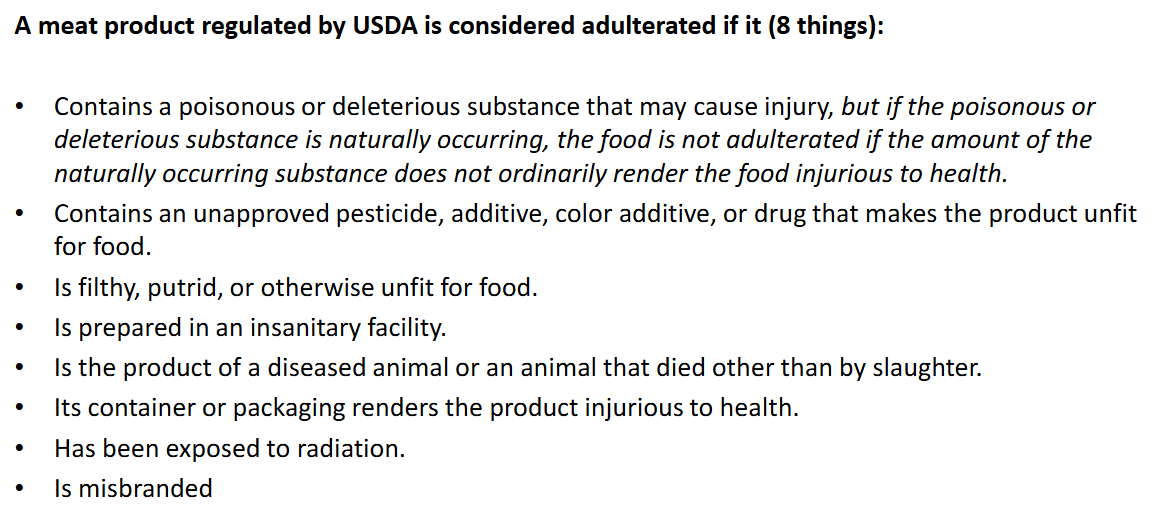
Adulterants
Overall: anything harmful, unapproved, unsanitary, died other than by slaughter, exposed to radiation, misbranded
Pathogens may be considered adulterants depending on the product
Ex: Listeria is an adulterant in cooked or RTE meat
Big six E coli serotypes are adulterants in raw ground beef
Salmonella is adulterant in breaded and stuffed raw chicken → to reduce salmonellosis cases
Meat spoilage organisms
Depends on product and packaging type:
Unmodified atmosphere: gram negatives → these guys are aerobic and can cause odors, slimes, quality defects
Vacuum packed: LAB → anaerobic conditions
Spoilage: Psychrotrophs which grow <10C or 50F
Meat processing
Raw meat sold fresh or frozen
Processing can involve curing, smoking, drying, fermentation, thermal
Curing (add salt, sugar, nitrites for preservation), smoking (cooking method to add flavor), drying (lower aw), and fermentation (lowers pH due to LAB growth all must control for:
Inactivation of pathogens on raw meat via temperature or pH
Inhibition of S. aureus toxin formation during processing
Decrease water activity if shelf-stability is desired
Thermal: make sure to check internal temps properly (in the center)
Alt to discontinuous checks: continuous or in line monitoring
Meat cooling
meat must be chilled rapidly or else pathogen growth can occur in temperature danger zone
For meat, C perfringens
Models like USDA’s ComBase can be used to estimate growth over time base on meat type, pH, and aw
Egg processing
Eggs in the US are washed, sanitized, and dried
– Decreases microbial counts, but also removes the cuticle
• Makes them more porous, refrigeration is required
– Other countries do not wash their eggs, cuticle is intact
• Salmonella vaccines may be given to chickens to decrease salmonella cases
• Egg refrigeration not required
Salmonella transmission to eggs
Internal contamination (vertical transmission)
- Contamination in the reproductive tract
- Directly into egg contents
- Before expulsion of the egg from the oviduct
External contamination (horizontal transmission)
- Contamination from the environment (feces)
- After expulsion of the egg from the oviduct
- Onto the outer surface of the eggshell
- Internalization through the shell
Salmonella Enteritidis is the serovar most associated with eggs
– Known for contamination via vertical transmission
– Other serovars contaminate eggs through horizontal transmission
• More commonly found in the egg white
– Salmonella grows faster in the yolk than in the white
– The albumen (egg white) has antimicrobial properties
• Estimated 1 in 10,000-20,000 eggs are contaminated
with Salmonella