OB - Exam 1: Lab Prework Information
 Call Kai
 Learn
Learn Practice Test
 Spaced Repetition
 Match
Match Flashcards
 Knowt Play
1/41

There's no tags or description
Looks like no tags are added yet.
Name | Mastery | Learn | Test | Matching | Spaced | Call with Kai | Chat |
|---|
No analytics yet
Send a link to your students to track their progress
42 Terms
Antepartum
Time between conception and onset of labor, usually used to describe the period during which a woman is pregnant, interchangeable with prenatal.
Intrapartum
Time from onset of labor until the birth of the infant and placenta.
Postpartum
Time from birth until the woman's body returns to an essentially prepregnant condition.
Gravida
Any pregnancy, regardless of duration, including present pregnancy.
Para
Birth after 20 weeks' gestation, regardless of whether the infant is born alive or dead.
Nulligravida
a woman who has never been pregnant
Primigravida
A woman who is pregnant for the first time
Multigravida
a woman who is in her second or any subsequent pregnancy
Nullipara
A woman who has not given birth at more than 20 week's gestation
Primipara
A woman who has had one birth at more than 20 weeks' gestation, regardless of where the infant is born dead or alive.
Multipara
A woman who has had two or more births at more than 20 weeks' gestation.
Gestation
The number of weeks since the first day of the last menstrual period.
Term
The normal duration of pregnancy (38-42 weeks gestation)
Preterm Labor
Labor that occurs after 20 weeks' but before the completion of 37 weeks gestation.
Postterm Labor
Labor that occurs after 42 weeks of gestation.
Abortion
A spontaneous or elective termination of pregnancy before the 20th week of gestation, based on the date of the last menstrual period. Spontaneous abortion is frequently called
Stillbirth
A fetus born dead after 20 weeks' gestation.
Gravida, Term, Preterm, Abortion, Living
What does GTPAL stand for?
G7, T4, P1, A1, L5
Fill out GPTAL for:
-A 30 year old female who is 25 weeks pregnant with twins, she has 5 living children. Four of the 5 children were born at 39 weeks gestation and one child was born at 27 weeks gestation. Two years ago she had a miscarriage at 10 weeks gestation.
G3, T2, P0, A0, L3
Fill out GTPAL
-A 27 year old is currently 16 weeks pregnant. She has 2 year-old twins that were born at 39 weeks gestation and a 5 year-old who was born at 40 weeks gestation. She had no history of miscarriage or abortion.
G3, T1, P0, A1, L1
Fill out this GTPAL
-A 26 year old is 26 weeks pregnant. She had a miscarriage at 10 weeks gestation five years ago. She has three year old who was born at 39 weeks.
G2, T0, P0, A1, L0
Fill out this GTPAL
-A 20 year old is 8 weeks pregnant. She had a miscarriage at 12 weeks gestation two years ago. She has no living children.
9/14
Calculate the estimated date of birth for
LMP of 12/7
5/6
Calculate the estimated date of birth for
LMP 08/30
8/13
Calculate the estimated date of birth for
LMP 11/6
10/30
Calculate the estimated date of birth for
LMP 1/24
Uterine Contraction Frequency
How often uterine contractions occur; the time that elapses from the beginning of one contraction to the beginning of the next in minutes
-Beginning to beginning of contractions
Uterine Contraction Duration
Count from beginning of the contraction to the end of the same contraction

Contraction Strength
The intensity with which uterine contractions occur to help push the fetus through the vaginal canal.
Cervical Dilation
Refers to the opening or widening of the cervix, to allow the passage of the baby from the uterus into the vaginal canal during birth.
-Measured in 0-10 cm
Cervical effacement
The thinning and shortening of the cervix that occurs in preparation for childbirth
-It is measured as a percentage with 0% indicating that a cervix is thick and long, and 100% indicating complete, thin and short.
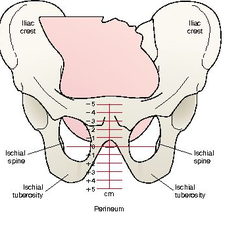
Station of Presenting part
Describes the positions of the baby's head in relation to the maternal pelvis during labor. Measured in centimeters above or below the ischial spine.
110 to 160 bpm
Normal fetal heart rate range
Variability
Fluctuation of the FHR during electronic fetal monitoring
-Assessed by observing the natural changes in the baseline fetal heart rate over time.
Acceleration
A temporary increase in the FHR.
-Generally considered positive and reassuring signs of fetal well being
Early deceleration
Pattern in FHR monitoring during labor
-Is characterized by a decrease in the fetal heart rate that mirrors the contractions during labor

Late Deceleration
Decrease in the FHR that occurs after the peak of a uterine contraction.
-Have delayed onset and reach their lowest points after the contraction has reached its peak.
Variable deceleration
Abrupt decreases in the FHR often coinciding with contractions

breasts, uterus, bladder, bowel, lochia, episiotomy, Homan's, edema, emotions, RhoGAM and rubella.
What does the acronym BUBBLE HEER stand for?
Apgar scale
a standard measurement system that looks for a variety of indications of good health in newborns
Appearance (color), pulse, grimace (reflex tone), activity (muscle tone), respirations
What does the APGAR scale contain?
7-10 is generally considered good.
What is considered a good Apgar score?