Hip Joint Overview and Structure
 Call Kai
 Learn
Learn Practice Test
 Spaced Repetition
 Match
Match Flashcards
 Knowt Play
1/77

There's no tags or description
Looks like no tags are added yet.
Name | Mastery | Learn | Test | Matching | Spaced | Call with Kai | Chat |
|---|
No analytics yet
Send a link to your students to track their progress
78 Terms
How many bones and what bones is/are the acetabulum made up of?
3: Ilium, Ischium, Pubis
What joint type(s) is the hip?
Triaxial ball and socket joint
What are the bones composing the hip joint?
Acetabulum (Pelvis) and Femoral head (Femur)
How many degrees of freedom does the hip joint have, what are they, and what type is it?
3 Degrees of Freedom: Flexion/Extension, Abduction/Adduction, Internal rotation/External rotation
Rotational (type vs Planer/translatory)
What is the primary role of the hip joint?
Stability: Support weight of Head + Arms + Trunk (HAT) in closed chain activities
What is the secondary role of the hip joint?
Mobility: Position the foot in space during open chain activities
Examples of Closed Chain Hip activities are…?
Climbing up stairs
Running and walking (WHEN FOOT IS IN CONTACT WITH THE GROUND)
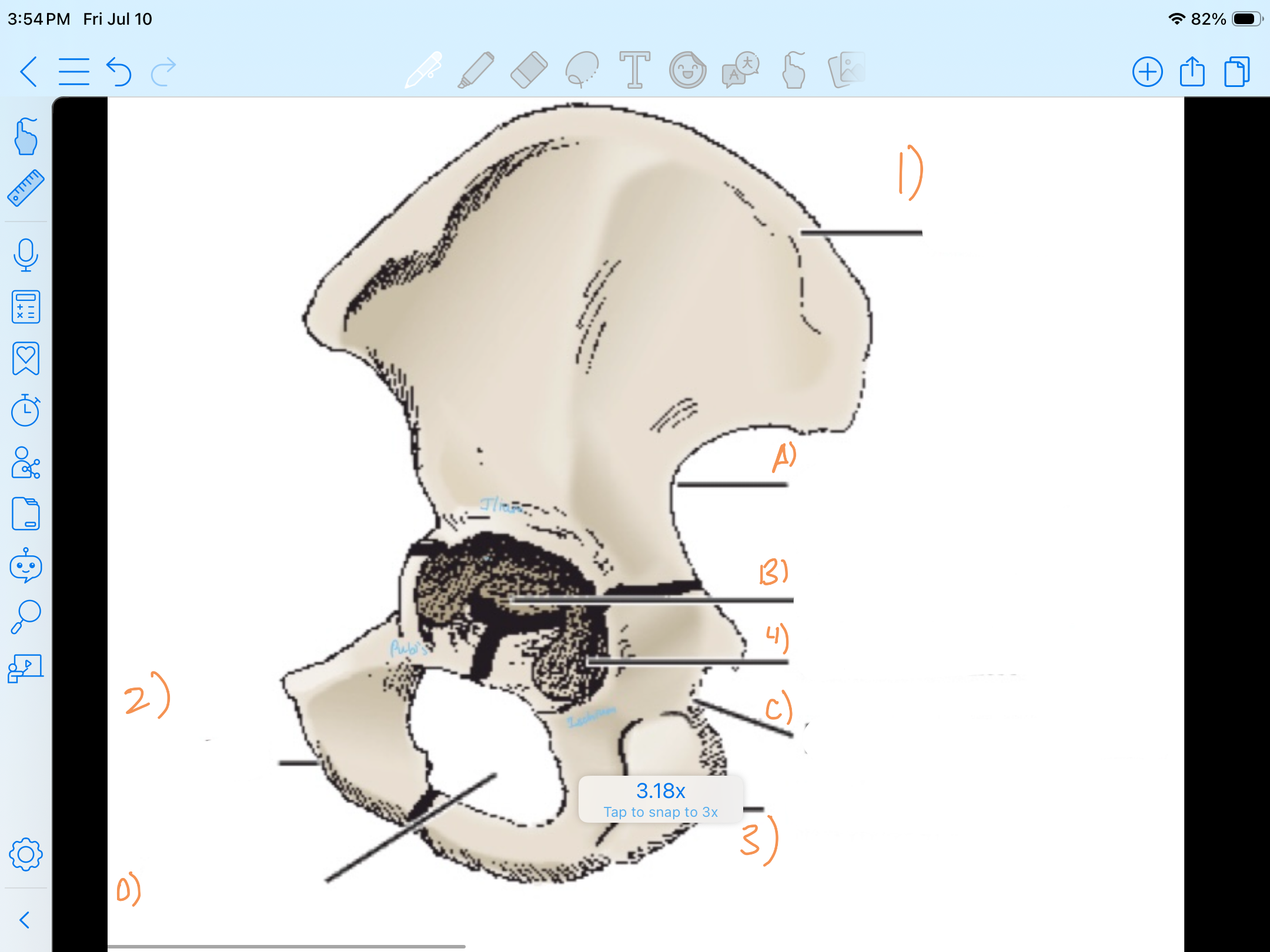
What is each part of the image and what bones is it apart of?
1) Ilium
2) Pubis
3) Ischium
4) Acetabulum
A) Greater Sciatic Notch
B) Acetabular fossa/socket
C) Lesser sciatic notch
D) Obturator foramen
What directions does the acetabulum face using anatomical nomenclature?
Laterally
Inferiorly
Anteriorly
What does acetabular anteversion tell us?
How forward/anterior facing the acetabulum bone is
What can excessive acetabular anteversion cause?
Instability — because it means less of the femoral head is covered by the bony projections
What does acetabular retroversion tell us?
How neutral or posterior/backwards facing the acetabulum is facing
what does excessive acetabular retroversion cause?
hip impingement and limited mobility — because more bony coverage thus leaving little room for muscle Attatchment, ligaments, vasculature, neural structures, and other connective tissues
What is acetabular anteversion?
Angle between the posterior lateral portion of the acetabulum and anterior lateral portion of the acetabulum, creates an angle with it being more forward facing and not neutral
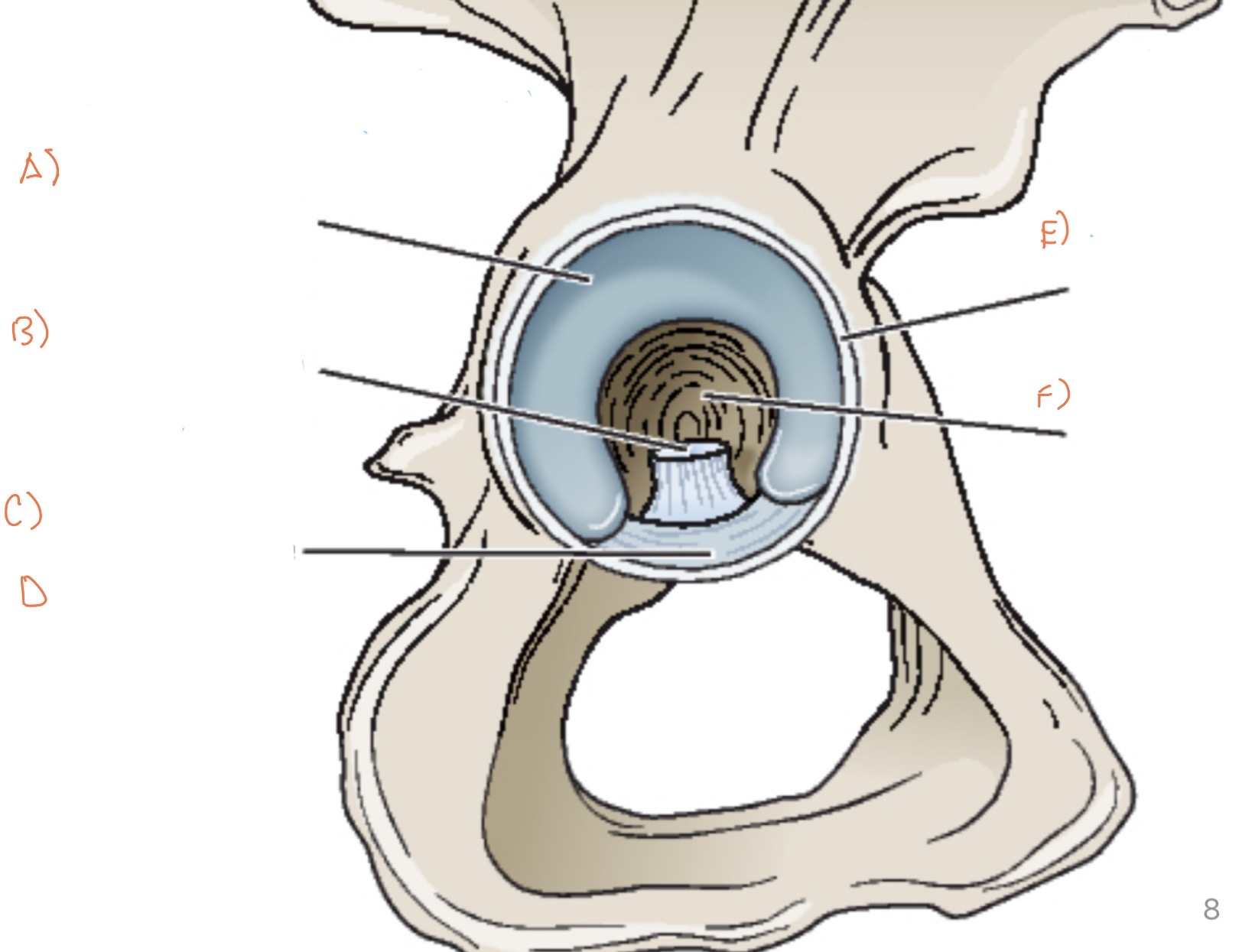
Label the parts in the image
A) Articulating surface
B) Ligamentum teres (cut)
C) Transverse acetabular ligament
D) Acetabular labrum
E) Acetabular fossa
What are the articulating portions of the acetabulum and femur?
Femoral head and articular surface of the acetabulum
What is the articulating surface composed of and what does it mean relating to its function?
Hyaline cartilage = Type II Collagen fibers = Compressive loads = 3 layers (shear, PGs and water, and compressive stress)
What is the acetabular labrum composed of and what does this mean for its function?
Fibrocartilage = Type 1 Collagen fibers (more than cartilage less than bone) = Tensile stress resistance (keeps femoral head and acetabulum together)
What is the acetabular fossa?
Deepest part of the acetabulum and does not do any weight bearing (femoral head does not actually touch here)
What is the function of the acetabular labrum?
Fibrocartilaginous tissue = tensile stress (keeps femur and acetabulum together) = seal “sucking” in like a magnet keeping the femoral head tightly against the acetabular socket
Increases surface area of acetabulum = stabilizes hip joint more
Proprioception through mechanoreceptors and nociceptors
Distributes weight bearing forces more
What normally happens with a hip labrum tear?
Damage to the articular/hyaline cartilage and eventual bone degradation (osteoarthritis) = hip pain
What do mechanoreceptors and nociceptors do? What is the main idea in relation to them and the hip joint?
Mechanoreceptors = touch sensors
Nociceptors = pain receptors
Main idea: Communicate with the CNS about positioning/location of the hip and if the hip is in a bad position move it through motor units (alpha motor neurons and muscles it innervates)
What is dysplasia?
Less coverage of the femur from the acetabulum (<16 degrees)
What’s coxa profounda?
Greater coverage of the femur — means Deep coxa (os coxa is a singular half of the fused pelvis) (>40 degrees covered)
What does dysplasia cause?
More mobility less stability — because less femoral head covered so bony limitation of movement is less
What does coxa profounda cause?
More stability and less mobility — because more bony coverage of the femoral head so the femur can not move as much
What is center angle?
Angle that measures how deep the acetabular socket/fossa actually is (tells if you have dysplasia aka shallow socket or coxa profounda aka deep socket)
How do we measure the center edge angle?
1) Draw a straight vertical line from the midpoint/axis of rotation of the femoral head following line of gravity
2) Draw a line connecting the midpoint of the femoral head to the lateral edge of the acetabulum (more outward portion not the medial portion)
Dysplasia = 16%, coxa profounda = >40%
Wh at is the shape of the femoral head?
2/3 sphere shape, a bit uneven so kind of egg kind of circle
Fovea capitis indent on the medial side of the head
What does the fovea capitis act as?
Acts as an attachment site for the Ligamentum Teres
Where does the Ligamentum Teres attach to and what does it do?
Attatches at the fovea capitis of the femoral head and acetabular notch
Provides more stability preventing excessive hip motion, free nerve endings are present allowing CNS sensation and proprioception
what direction(s) does the femoral head face?
Anteriorly, medially, and superiorly relative to the femoral shaft and femoral condyles
What is the angle of inclination?
Angle created between the axis through the femoral head and neck to the vertical/longitudinal axis of the femoral shaft
Differences show the shaft being more at an angle or perpendicular to the femoral head or being more in line/parallel to the femoral head (straight down)
What is the angle of torsion?
Angle that shows the difference in how anterior the femoral head is in respect to the posterior side of the femoral condyles
Transverse plane — axis goes on the posterior side of the femoral condyles in line with frontal plane kind of way (we look at transverse plane though), axis through the mid point of the femoral head, connect the 2 and theres your angle of torision
What does the angle of torsion tell us?
How much twisting/torsion is happening at the femur
If femoral condyles posterior side and head of femur are not at the same planar angle then that means there is twisting occurring since they are part of the same bone
What would cause an increased angle of torsion?
Femoral anteversion = femoral head and neck more anteriorly because of torsion at the proximal shaft (anterior direction)
With greater planar distance between the femoral head and neck in relation to the femoral condyles, the angle of torsion increases
What would cause a decreased angle of torsion?
Femoral retroversion = femoral head and neck move posteriorly/neutrally in line with the femoral condyles
This decreases angle of torsion
What is coxa valga?
Greater angle of inclination
The femoral head is parallel to the shaft of the femur
Given a greater angle of inclination (otherwise named as ___ ___) what does this mean for the femoral head coverage and what does that mean about the hip joint
Other name: Coxa valga
Femoral head coverage decreases, causing decreases in joint area
With coxa valga (which is what of the incline of the femoral head to shaft?) what happens to the moment arm of the glute med and why?
Decreases glute med moment arm, because the axis of rotation on the femoral head moves closer to the glute med attachment site decreasing moment arm distance of the glute med
Coxa valga: What happens to the force of the glute med and why?
Glute med force increases because its moment arm decreased from the femoral head moving closer to the glute med attachment site
Coxa valga: What happens to the joint stress and why?
Joint stress increases, because there is less area of the hip joint because the femoral head is less covered by the acetabulum with a greater angle of inclination,decreases glute meds moment arm increasing its force needed to produce torque, increasing joint stress
stress = force/area, increasing force and decreasing area causes overall increase
Coxa valga: What happens to bending moments and why?
Bending moment with a greater angle of inclination decreases because the force of the head arms and trunk will be closer to the shaft of the femur since the head will be more parallel to the shaft
What is coxa Vara?
Less angle of inclination
Head of femur either more perpendicular or lower than the femoral shaft proximal portion
Coxa vara: What happens to the femoral head coverage and what does it mean for its area of the hip joint?
Increases femoral head coverage therefore increasing joint area
Given a lesser angle of inclination (otherwise known as ___ ___) what happens to the glute med moment arm and why?
Glute med moment arm increases because e the axis of rotation of the femoral head of the hip joint moves further away from the atchment of the glute med thus moves further away from its line of pull increasing its moment arm distance
Coxa varus: Given information about its moment arm, what happens to glute meds internal force? This does what to its joint reaction force?
Internal force decreases because moment arm of glute med increases thus less force needs to be produced to produce torque
Joint reaction forces increase because less force is being produced thus more force is needed from the joint to compensate to balance out external torque to get static equilibrium
Lesser angle of inclination: What happens to joint stress why?
Joint stress decreases
Because:
1) Increased joint are because femoral head is more covered in the acetabular socket
2) Glute med’s moment arm increased since further distance from the line of pull of the glute med because axis of rotation moved further away from the muscle attachment
3) Force of glute med decreased because glute meds moment arm increased and T = F x Ea (? MA = < F)
Stress = force/area, over greater area = decreased stress
Coxa Varus: What happens to the bending moments and why?
Bending moment increases, because the axis of rotation is moving further away from the femoral shaft, increasing distance between the force of the head arm and trunk axis and the femoral shaft
What is femoral anteversion?
The femoral head is rotated or faces more anteriorly
What is femoral retroversion?
The femoral head is more posterior compared to normal (more in the same plane as the femoral condyles thus placing it more parallel to the greater trochanter)
what does femoral anterversion do to the moment arm of the gluteus medius and why?
Decreases its moment arm —- Because it places the greater trochanter more posteriorly moving it closer to the axis of rotation of the hip joint (femoral head)
Does the femoral anteversion cause more or less of the femoral head to be covered thus doing what to its area?
femoral anteversion causes less femoral head to be covered
Causing decreased area of the hip joint articulation
Femoral anteversion: Given the information about the glute med moment arm, does there need to be more or less force from the glute med? This does what to joint reaction forces?
More force because moment arm has decreased from
This decreases joint reaction force since more force will be present thus less compensation from joint reaction force needs to occur (going downwards onto the femoral head)
Femoral anteversion: How does this affect joint stress? Explain why
Increases joint stress
Because
1) moment arm of the glute med decreased since the attachment site of the glute med is now positioned closer to the axis of rotation of the joint (femoral head)
2) More force is needed from the glute med to produce torque (rotational moment force perpendicular to the external force load)
3) Decreased area of the femoral head (cause of anterior rotated femoral head) decreases surface area of the joint
4) Stress equals Force/Area, decreased denominator area and increased force leads to a bigger number thus more force per area (rip hip joint)
What is femoral retroversion?
Less or no anterior positioning (backward/posteiror positioning) of the femur (femur still goes superior and medial in relation to the shaft)
Femoral head is more in the coronal/frontal plane with the femoral condyles and shaft
How does femoral retroversion affect femoral head coverage? What does this mean about the area?
increases femoral head coverage by the acetabulum, thus increasing area of the hip joint
How does the glute med moment arm get affected by femoral retroversion?
Glute med moment arm increases because the axis of rotation of the hip joint on the femoral head gets further away from the attachment of the glute med on the greater trochanter, increasing the moment arm distance
Femoral retroversion: Given the information about the glute med moment arm, what does this mean about the force of the glute med?
Decreases, since torque = f x moment arm (effort arm in this case), the internal force can decrease since moment arm increased
Femoral retroversion: Given information about glute med, what does this mean about the joint stress and why?
Joint stress decreases
Because:
1) Increased femoral head coverage by the acetabulum = greater ara of the hip joint
Stress = Force/Area so increasing the denominator generally decreases stress already
2) Moment arm of glute med increases with the posterior rotation of the femur since axis of rotation is moving away from the muscle attachment = decreased force needed since T = F x Ea
Stress = Force/Area so decreased force over increases area = decreased force per area (aka stress)
Angle of torsion: What happens to uncompensated supine anteversion? How much area of exposure is there of the femoral head?
Femoral head stays very anterior direction
There is a ton of exposed area of the femoral head
Angle of torsion: What happens when the femoral anteversion leg and thigh medially rotates? What happens at the foot?
Toe-in occurs because no torsion is occurring, thus toe points inwards
The femur and the tibia rotate medially together
Angle of torsion: What happens to keep the toes facing forward instead of toeing in?
Lateral torsion of the tibia
Allows the femur to medially rotate while the tibia counteracts this rotation with its own torsion, keeping the foot facing forwards
What is the joint capsule composed of?
Hyaline cartilage = articular cartilage, synovial fluid, synovial membrane, fibrous layer, capsular ligaments, nerve endings, lymphocytes
Does the joint capsule do more stability or mobility of the hip joint and why?
Stability
Very stiff because tons of ligaments, labrum, articular cartilage
Where does the joint capsule attach between?
Proximally to edges of acetabulum (so covers the top of the acetabulum) To the intertrochanteric line (Does not cover the trochanters)
What does the joint capsule cover of the hip joint?
Acetabulum, acetabular socket entirely, neck and head of femur distally
what does intracapsular of the joint capsule mean? Name examples:
Intracapsular means it is inside the capsule
Ex. Labrum, articular/hyaline cartilage, synovial fluid
What does extracapsular of the hip joint mean and name examples
Outside the joint capsule, some ligaments ex. Ischiofemoral, iliofemoral
Where is the joint capsule of the hip thickest and why (3 reasons)
Anterior and superior parts of the hip joint
1) Acetabulum faces anteriorly so less bony coverage is happening there
2) Femur faces anteriorly so the head is less covered by bone again
3) COG is posterior to the axis of rotation of the femur
What does the pelvis want to do given that the COG is posterior to the axis of rotation of the hip joint?
posterior pelvic tilt (coccyx go down and ASIS go up)
What are the 3 ligaments of the joint capsule?
Pubofemoral, iliofemoral, ischiofemoral
Which ligaments of the hip joint are anterior?
Pubofemoral, iliofemoral
Which ligament is posterior (hip joint)?
Ischiofemoral
What do all 3 of the hip joint ligaments (extracapsular) prevent?
Hyperextension of the hip joint
What is the blood supply for the femoral head? Why does the femoral head need blood supply separately (exception to its bone blood supply)
Medial circumflex artery and vessels through the Ligamentum Teres
Because hyaline cartilage is avascular and joint capsules are not, however the head is right intracapsularly in the joint capsule
What does AVN stand for and mean?
Avascular necrosis = femoral head does NOT get enough blood supply thus damage can occur to it
What is the AVN applying to peds?
Leg-Calve-Perthes disease