3.5.3 Wage Determination
 Studied by 0 people
 Call with Kai
 Learn
Learn Practice Test
 Spaced Repetition
 Match
Match Flashcards
 Knowt Play
1/36

There's no tags or description
Looks like no tags are added yet.
Name | Mastery | Learn | Test | Matching | Spaced | Call with Kai |
|---|
No study sessions yet.
37 Terms
What factors influence wage rates differing within an occupation?
Wage rates differ within an occupation due to age, education, training, work experience, skill/talent/ability to perform tasks, sex and ethnic background
Which two factors influencing wages are illegal?
Sex and ethnic background, although average wages still suggest this may be an issue
How are wages determined in a perfectly competitive market?
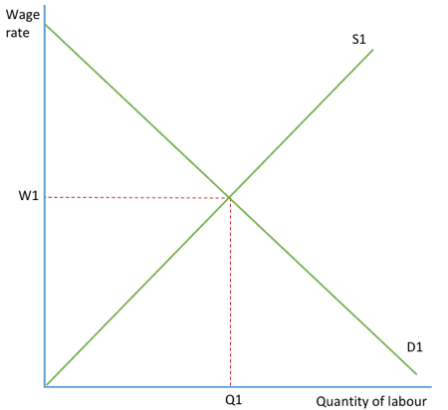
In a perfectly competitive labour market, we make the same assumptions as in a perfectly competitive product market. Therefore, wages are determined purely by demand and supply and all workers are paid the same. If workers were not paid the same, they would simply move somewhere else where the wage rate in the industry was higher
What is the diagram for wage determination in a perfectly competitive market?
How are wages set in an imperfectly competitive market?
However, in an imperfectly competitive market, wages will not always be set where demand equals supply.
Explain a monopsony in the labour market.
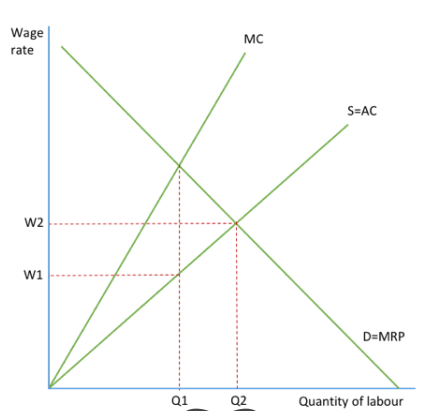
In a monopsony market, there is only one buyer of the labour. In this situation, businesses know that if they want to increase their labour force they will have to increase the wage they offer and, just like with monopsony product markets,an increase in the wage for one increases the wage for all.
What is the diagram for a monopsony in a labour market?
Explain the diagram for a monopsony in the labour market.
Therefore, the MC curve is above the supply curve (AC) of labour because it costs more to employ an additional worker than the average cost of labour. A firm will determine how many workers to employ where the cost of employing them is equal to the value of that worker to the company. They employ where MC=D at Q1 and at this output, they will pay their workers W1 (determined by the S curve). Compared to a perfectly competitive market (which would produce at W2Q2), they employ less people at a lower wage rate.
What is a monopoly in the labour market?
The existence of trade unions means they can operate as the only seller of labour. A trade union is an organisation with members who are usually workers or employees, which protects the rights and pay of workers through a process of collective bargaining
What are two ways trade unions could increase wages?
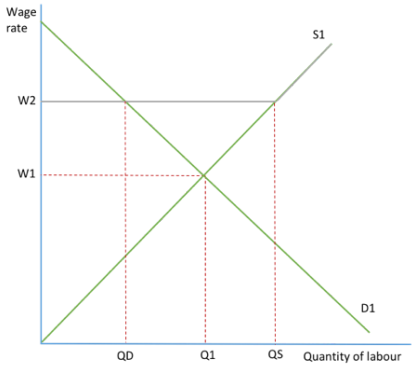
There are two ways they could increase wages. Firstly, they could set barriers of entry which would reduce supply. Teachers’ unions lobbied for a rule which means that all teachers must have degrees . Alternatively, they could set wages at a specific wage and ensure workers are not prepared to work for less, creating a kinked supply curve
Show the diagram for the kinked supply curve.
Why is the kinked supply curve this way? Explain it.
Alternatively, they could set wages at a specific wage and ensure workers are not prepared to work for less, creating a kinked supply curve as seen in the diagram (the grey line). Supply is perfectly elastic up to output of QS and if the company wanted to employ more than this, they would have to increase wages further. The firm will employ where supply is equal to demand, at QDW2. Both of these methods will lead to higher wages but cause a fall in employment from the perfectly competitive equilibrium of Q1W1.
What is the most recent way the government has been able to reduce the power of trade unions?
The Trade Union Act 2016 was the most recent act, and this included a clause saying that at least 50% of people must vote in the ballot; the most recent teachers union ballot only had 28% voting turnout.
What is a bilateral monopoly?
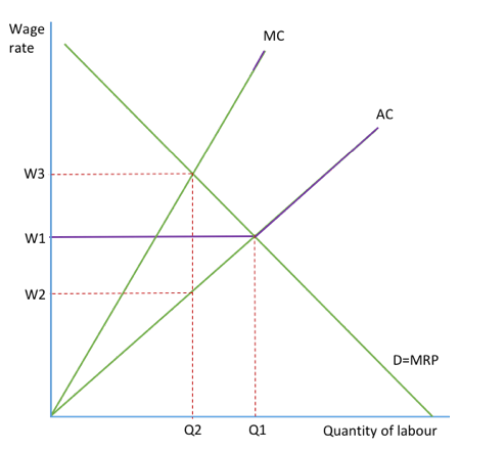
It is possible for there to be both monopoly and monopsony in a labour market, called a bilateral monopoly.
Explain how there is a bilateral monopoly in a labour market?
The firm is a monopsonist and wants to employ at Q2W2. However, the union may decide to set a minimum wage at W1 and ensure that there is no one willing to work below this price, creating a kinked supply curve. The new MC and AC curves are the purple curves. In this situation, there is a battle going on between the two parties. The wage that is set will depend on the relative bargaining strength of both . This is dependent on a number of factors, including the size of the union and the strength of the economy.
In a time of economic recession and unemployment the unions may have less bargaining power and wage is most likely to be down at W1. In times of full employment, they may have the power to influence and wages could be at W3 . This diagram highlights that Unions can have a positive impact on both wages and the number of people employed: they are able to increase wages to W3 without negatively impacting the number of workers. This increase in wages and employment is able to make the economy more efficient.
Show the diagram for a bilateral monopoly.
What are the 7 Labour Market issues?
Skill shortages
Young workers
Retirement
Wage inequality
Zero hour contracts
The ‘Gig economy’
Migration
How are skill shortages a problem in the labour market?
The UK suffers from geographical and occupational immobility, which means that even if there are enough engineers, there aren’t enough engineers in certain areas.
How are young workers a labour market issue?
Workers who join the workforce during recessions tend to receive lower lifetime earnings than those who enter the labour force in better times. Youth unemployment can be a particular issue; during hard times, firms are unlikely to employ new workers but are reluctant to let go of their current workers and so the young struggle to get a job.
How is retirement a labour market issue?
Rising life expectancy and an increase in the number of people reaching retirement age, as the ‘baby boomers’ reach retirement, has negative effects on the government budget. Pensioners now makeup over 50% of welfare spending. The retirement age will have to continue to rise and the government is trying to encourage people to save for their own pensions.
How is wage inequality an issue in the labour market?
Over time, those on the highest wages have seen their wages grow by a bigger percentage than those on the lowest wages. This is a contentious issue and raises questions over relative poverty and the level of redistribution required.
How are zero hour contracts a problem in the labour market?
There has been a rise in zero-hour contracts and this causes problems for employees who do not know how much they will earn a week and receive little notice of when they will be required to work.
How is the ‘gig economy an issue in the labour market?
Many more people are now self-employed and undertake short term contracts, working for companies such as Uber and Deliveroo. There are concerns over the rights of these workers and the unreliability of their pay each week.
How is migration an issue in the labour market?
Many people suggest that migration causes a fall in wages but it allows employers to recruit from a larger pool of workers and helps to fill skills shortages.
What political party introduced the national minimum wage and when?
Labour introduced the National Minimum Wage in April 1999 to raise people out of poverty and decent minimum standards in the workplace
When are the 4 methods of government intervention to solve labour market issues?
National Minimum wage
Maximum wages
Public sector wage setting
Tackling immobility
What are the 4 advantages of the national minimum wage?
The wage is able to reduce poverty as it mainly impacts the lowest wages and ensures that these people have enough to live on.
It can reduce male/female wage differentials as women are more likely to take up lower paid jobs (because they are vocational, offer more flexible hours etc.) and so a minimum wage is able to decrease the gaps between men and women.
Moreover, a minimum wage provides an incentive to work and prevents the ‘unemployment trap’, when benefits are higher than the wage people would otherwise receive.
It ensures everyone receives a fair wage, and is not exploited by being drastically underpaid
What are 4 disadvantages of the minimum wage?
The most notable negative consequence is the potential loss of jobs in the industry (or unemployment on a macro level).
Moreover, the minimum wage will raise costs for the companies and so may increase their prices, which is liking to lead to a fall in profit.
Another negative impact could be the wage spiral as individuals will try to protect wage differentials between them and the lowest price workers. An increase in the wage of the lowest paid will mean that others expect theirs to rise too. This will reduce profit and further reduce competitiveness.
There is no consideration of regional differences , and so this, alongside the fact many people on minimum wages are secondary earners, means the minimum wage may be ineffective at reducing poverty.
What does the impact of any minimum wage depend on?
where it is set, and whether this is above or below the current wage.
The level of job losses is dependent on the elasticity of supply and demand. If both are relatively elastic, there will be large job losses but if both are relatively inelastic, the losses will be small.
What is a maximum wage?
A maximum wage for chief executives or a maximum pay ratio compared to the lowest wage earners. The government can set maximum pay limits for public sector workers in order to keep public sector spending down.
What is the advantage of maximum wages?
It will help to reduce inequality.
What are the disadvantages of maximum wages?
Lead to excess demand within the industry, since people may not put themselves forward for the job if they don’t think the salary matches the stress and responsibilities or they know they could get higher wages abroad.
The UK may suffer from a loss of the best workers , which will reduce the quality of businesses and decrease competitiveness
The impact of this depends on the elasticities of supply and demand: inelastic means there will be little impact. It is argued that supply and demand for the highest paid workers, such as chief executives, is very inelastic since there is a small supply of chief executives and firms only need one chief executive so their cost is a very small part of total costs. This could mean maximum wages will have almost no effect on the market, other than causing a reduction in wages.
Explain public sector wage setting?
Since trade unions in the UK are weak, in the short run, the government can effectively make whatever wage decisions it decides in order to improve the budget.
What did public sector workers experience 2010-2015 and how did this impact the private and public sector?
Between 2010 and 2015, public sector workers experienced a pay freeze. This put downward pressure on private sector wages since few people were likely to leave the private sector for the public sector and private sector employers could use this as evidence to limit pay rises for their workers.
However, in the long run, if private sector workers receive pay rises and public sector workers don’t, people will move from the public sector to the private sector and this will force the government to increase public sector wages in order to expand supply.
What is the trend of public sector wages over the long run?
As a result, the wages of public and private sector workers tend to rise by the same percentage over a long period of time but in the short term they can rise by different rates.
What are the different ways the government can improve the geographical mobility of labour?
They could improve the supply of houses and reduce the price of properties making it easier for people to move. They could make renting cheaper to help people working in temporary jobs.
They could improve transport links which will allow people to work further away from where they live and if they do move, it will be easier for them to visit family and get to job interviews.
National advertising could be used so people know about jobs all over the country.
The government could introduce subsidies on houses, taxes etc. in areas where there are labour shortages to encourage people to move to the area and take up jobs.
How can the government tackle occupational immobility of labour?
Vocational training can be increased, particularly for younger students.
They could encourage further study, such as university or technical courses at college. They have been encouraging engineering degrees.
They could encourage greater spending on training within work.
Education could be targeted at improving skills shortages and helping with job applications, for example interview skills.