Chapter 2: The Chemistry of Life
 Call Kai
 Learn
Learn Practice Test
 Spaced Repetition
 Match
Match Flashcards
 Knowt Play
1/102

There's no tags or description
Looks like no tags are added yet.
Name | Mastery | Learn | Test | Matching | Spaced | Call with Kai | Chat |
|---|
No analytics yet
Send a link to your students to track their progress
103 Terms
What are Chemical elements?
Make up living and nonliving matter
Elements are in their simplest form and cannot be broken down
98.5% of your body’s mass is made up of?
Oxygen, Hydrogen, Carbon, Nitrogen, Calcium and Phosphorus
Which are called “major elements”
What are atoms?
Make up each element and are the smallest units of matter
Atoms consist of what?
Subatomic particles
Protons?
Found in the nucleus and have a positive charge (+)
Neutrons?
Found in the nucleus and have a neutral charge
Electrons?
Orbit around the nucleus, have a negative charge (-)
How many electrons move around the nucleus in the first shell?
Max of 2 electrons
Each shell fills to its max before another is added
How many electrons move around the nucleus in the second shell?
Max of 8 electrons
Each shell fills to its max before another is added
What are Isotopes?
Are atoms of the same element that differ in the number of neutrons
Which carbon isotopes are stable?
Carbon-12 and Carbon-13 are stable and do not decay overtime
Which carbon isotopes are unstable?
Carbon-14 is radioisotope; unstable, causing its nucleus to decay over time and release ionizing radiation then transforms to Nitrogen-14
What is an important tool in the medical field?
Iodine - 131
Has a biological half-life of 8 days
Used to detect thyroid cancer and treat hyperthyroidism
What are Ions?
Atoms with a positive or negative charge
These charges are created by atoms giving up or gaining electrons
Causes an unequal number of protons and electrons called ionization
What are anions?
Negatively charged ion; gains electron(s)
What is a cation?
Positively charged ion; loses electron(s)
What are electrolytes?
Minerals in your body that carry an electric charge when dissolved in water
What are molecules?
Formed by the combination of two or more atoms
What are Compounds?
Formed by the combination of two or more different atoms
The number of electrons that an element has can affect what?
Affect how it interacts with other elements
The goal is for the element to become stable
Either by the loss, gain or the sharing of electrons
What are Chemical bonds?
The forces that hold atoms together to form molecules or compounds
The formation of these bonds depends on an atoms valence shell - outermost shell
An atom is most stable and unlikely to do what?
Form bonds with another atom of it has 8 electrons in its valence shell
The elements that are most important for life do not what?
Do not have full valence shells
They form chemical bonds with other elements to fill their valence
shells with 8 electrons called the octet rule
What are Ionic bonds?
Formed by the attraction between positively and negatively charged ions
Sodium atom has how many electrons in its outer valence shell?
1 electron
Easier to give up one electron
This leaves 8 electrons in its second shell(outermost shell)
Forms a cation - positively charged ion
Chlorine atom has how many electrons in its valence shell?
7 electrons
Easier to accept one electron
This gives 8 electrons in its outermost shell
Forms an anion - negatively charged ion
Sodium and chloride become what?
Ionized(charged) by electron donation and are attracted to one another to form an ionic bond
Becomes → NaCl
Most ionic compounds are?
Solids and dissolve easily in water and form electrolytes
What are Covalent bonds?
Are formed by the sharing of electrons between two or more atoms
What are Non-polar covalent bonds?
Occur when electrons are shared equally between atoms
What are Polar covalent bonds?
Occur when electrons are shared unequally between atoms
What is electronegativity?
The power of an atom to attract electrons
How is water an example of a polar covalent bond?
Oxygen atom is more electronegative than hydrogen
Oxygen = partially negative
Hydrogen = partially positive
What are Hydrogen bonds?
A type of polar covalent bond between hydrogen atoms and another atom
Forms when a partially positive hydrogen attracts a partially negative atom nearby
Very weak atoms
What are Inorganic compounds?
Most lack carbon and are simple in structure water, salts, acids, and bases
Either ionic or covalent bonding
Explain water?
Most abundant inorganic compound in all living systems
Water is polar having partial negative oxygen and partial positive hydrogens
What is Solvent?
Dissolves another substance (solute)
Water dissolves ionized and polar substances
What is Hydrophilic?
(water loving) easily dissolve in water
Solutes with a charge (ions) or with polar covalent bonds
Ex. Suger and Salt
What is hydrophobic?
(water fearing) not soluble in water
Solutes with non-polar covalent bonds or uncharged
Ex. Fats and Oils
Water can do what?
Can absorb and release large amounts of heat with only slight changes in its own temperature
Has a high heat capacity due to hydrogen bonds
When water absorbs heat, it breaks hydrogen bonds and helps maintain body temperature
Water also has a high heat of what?
Vaporization
There is a high-energy requirement to change water from what?
Liquid to gas
What are Acids?
Substances that dissolve into hydrogen ions and anions in water
What are Bases?
Substances that dissolve into hydroxide ions and cations in water
What are Salts?
Substances that dissolve into cations and anions
Act as electrolytes by carrying electrical currents
Important in nerve and muscle tissue
What is an important balance in the body?
Acid-base balance
The more H+ increases solution acidity
The more OH- increases solution alkalinity
What is pH scale?
Used to express the acidity or alkalinity of a solution
Ranges from → 0 to 14
Based on the concentration of → H+
A pH of 7 is defined as being?
Neutral
Equal number of H+ and OH-
Acidic solution - pH?
Below 7
Solution with more → H+ than OH-
Basic solution - pH?
Above 7
Solution with more → OH- than H+
Blood pH must be maintained between?
7.35 and 7.45(slightly basic)
If pH gets above 7.45 what occurs?
Alkalosis occurs
If pH gets below 7.35 what occurs?
Acidosis occurs
What is Buffer?
Function to change strong acids and bases into weak acids an bases
Strong acids can damage many of our body’s systems
Buffers remove and add hydrogen ions(H+)
What are Chemical reactions?
Occur to either breakdown or form bonds between atoms
Reactants does what?
Starts substances
Products do what?
End substances
What are Synthesis reactions?
Occur when two or more atoms, ion, or molecules combine to form a new larger molecule
Referred to as anabolism
What are Decomposition reactions?
Occur when large molecules split into smaller atoms, ions, or molecules
Referred to as catabolism
What happens to energy when chemical reactions occur?
Absorbed or released
What is Catabolism?
Energy releasing decomposition reactions
Exergonic reactions?
Energy is released
What is Anabolism?
Energy storing synthesis reactions
Endergonic reactions?
Energy is absorbed
What are Organic compounds?
Contain carbon, most have hydrogen, and always contain covalent bonds
Large molecules with long carbon chains
What are Macromolecules?
Are made by a combination of small organic molecules (monomers) into large organic molecules (polymers)
Monomers bond together through dehydration synthesis
What is Dehydration synthesis?
Smaller molecules are joined to form larger molecules due to removal of water
Water molecule is formed as?
A product
What is Hydrolysis reaction?
Occurs when large molecules are broken down into smaller molecules due to the addition of water
Where are Carbon, Hydrogen and Oxygen found?
Found in a 1:2:1 ratio in all carbohydrates
Monosaccharides?
Carbohydrate → monomers
What are Disaccharides?
Molecules made up of two monosaccharides by dehydration synthesis
What are Polysaccharides?
Molecule contains tens or hundreds of monosaccharides by dehydration synthesis
Not soluble in water
Describe Carbohydrates?
Sugars; main/quick energy source; examples: glucose and glycogen
Describe Lipids?
Fats; energy storage and important in cell membranes; examples: triglycerides and phospholipids
Describe Proteins?
Made of amino acids; have structural/functional roles; enzymes and proteins
Describe Nucleic acids?
DNA and RNA; store/use genetic information
Describe Lipids?
Contain carbon, hydrogen, and oxygen but are insoluble in water and other polar solutes
Hydrophobic
Describe Fatty Acids?
Small monomer of large lipid molecules broken down to create energy
Contain a carboxyl group and a hydrocarbon
Describe Saturated fatty acids?
Hydrocarbon skeleton with only single covalent bonds
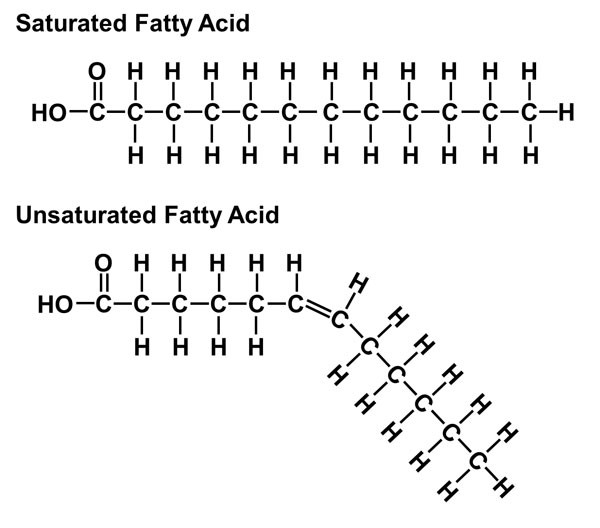
Describe Unsaturated fatty acids?
Hydrocarbon chain contains one or more double covalent bonds

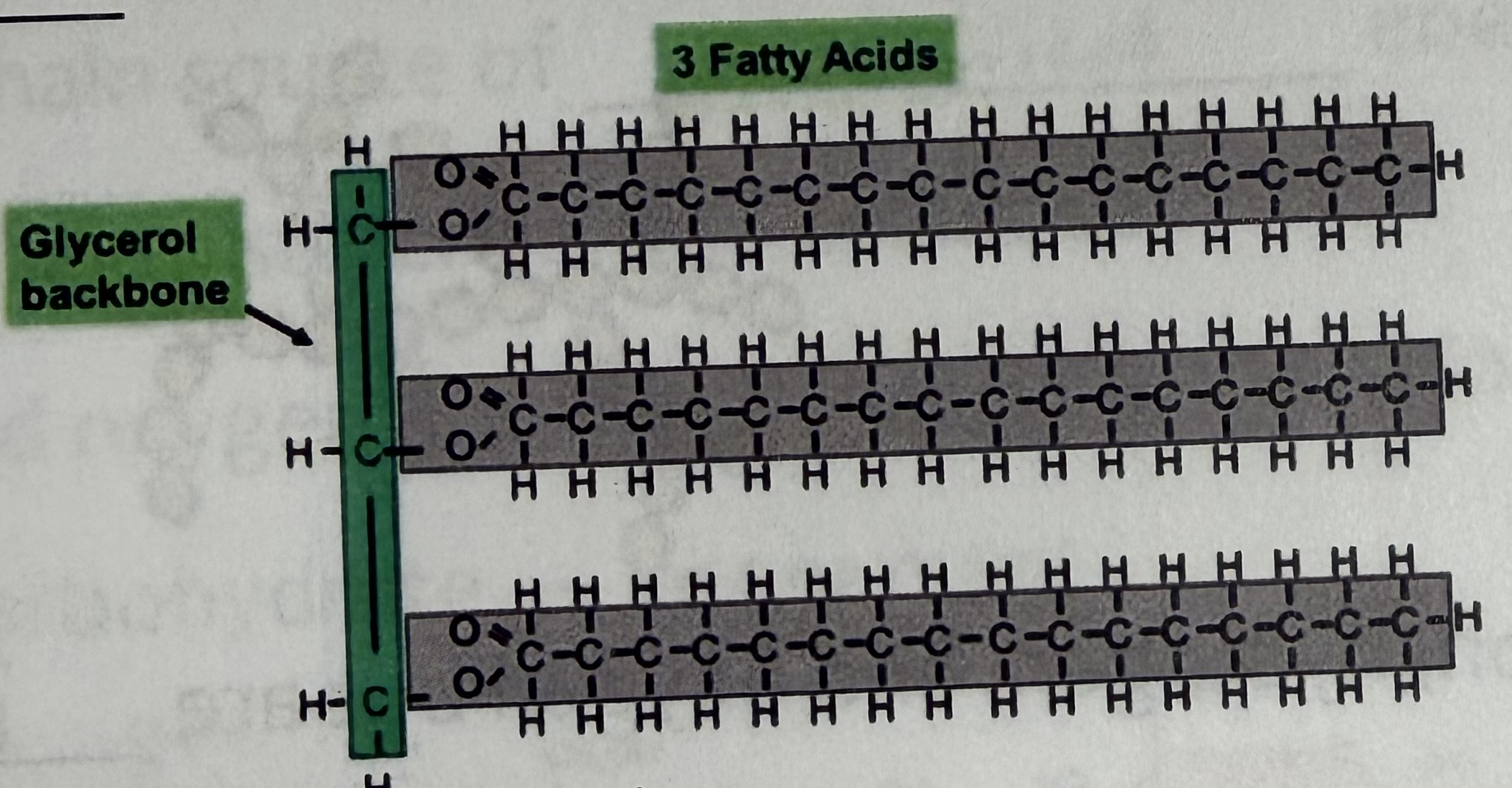
Describe Triglycerides?
Made up of a glycerol molecules and three fatty acids that combine through dehydration synthesis
Triglycerides exists in two states which are?
Solid or Liquid, depending on types of fatty acids
Saturated Fats?
Solid at room temperature(fats)
Unsaturated fats?
Liquid at room temperature(oils)
Lipids are our body’s what?
Long-term storage of energy in the form of adipose tissue(fat tissue)
Describe Phospholipids?
Similar to neutral fats except one fatty acid is replaced by a phosphate group
Structural foundation of the cell membrane
Fatty acid “tails” are?
Hydrophobic

Phosphate “head” is?
Hydrophilic

Describe Steroids?
Made up of a four-ring structure of carbon atoms
Called → sterols
Ex. cholesterol, estrogen, and testosterone
Describe Proteins?
Essential for body structure and function
Contain carbon, hydrogen, oxygen, and nitrogen
Describe Amino acids?
Monomer of proteins
Contain unique side chain that gives the amino acid a chemical identity
Proteins are made amino acids being covalently bonded to each other through a peptide bond
Describe Primary structure?
Linear sequence of amino acids linked by peptide bonds
Form a Polypeptide chain
Describe Secondary structure?
Neighboring amino acids twist and fold
Form alpha helix and beta pleated sheets
Describe Tertiary structure?
The final 3D shape of a protein and functional
Describe Quaternary structure?
Proteins with more than one polypeptide chain
Describe Denaturation?
Occurs in proteins that are exposed to too high of temperatures
Causes loss of function
Describe Catalysts(enzymes)?
A chemical compound that speeds up chemical reactions
Decreases the amount of energy needed to start the reaction
Our body’s most important catalysts are?
Enzymes
They allow atoms to collide and interact with one another
They do not breakdown or change during chemical reactions and can be reused
Describe Nucleic acids?
Contain carbon, hydrogen, oxygen, nitrogen, and phosphorous