Exercise 3 Simple Stains
 Call Kai
 Learn
Learn Practice Test
 Spaced Repetition
 Match
Match Flashcards
 Knowt Play
1/15

There's no tags or description
Looks like no tags are added yet.
Name | Mastery | Learn | Test | Matching | Spaced | Call with Kai | Chat |
|---|
No analytics yet
Send a link to your students to track their progress
16 Terms
What is the purpose of staining bacteria?
To make bacteria easier to see with a bright field microscope.
What information can a simple stain provide?
The relative size, basic shape, and arrangement of bacterial cells.
What is a simple stain?
A stain that uses one dye to stain the cells.
What are the two types of simple staining?
Positive staining and negative staining.
What is positive staining?
A staining method in which the dye binds to and colors the cells.
What happens to excess dye during positive staining?
Excess dye is washed away, leaving the background colorless.
What is negative staining?
A staining method in which the dye colors the background while the cells remain colorless.
What does a negative stain reveal?
The outline and true morphology of the cells.
Why can negative staining make bacterial morphology easier to see?
The cells are not distorted by heat-fixing.
What is a heat-fixed smear?
A thin film of bacterial cells that is air-dried and passed through a flame to permanently attach the cells to the slide.
Why are bacterial cells heat-fixed before positive staining?
To permanently attach the cells to the slide so they do not wash away.
Why must cells be heat-fixed for a positive stain?
To prevent the cells from floating away during staining.
Why should cells not be heat-fixed for a negative stain?
The cells must remain free to move and retain their true morphology.
What is the main difference between positive and negative staining?
Positive staining colors the cells, while negative staining colors the background.

What type of stain is this?
Positive stain
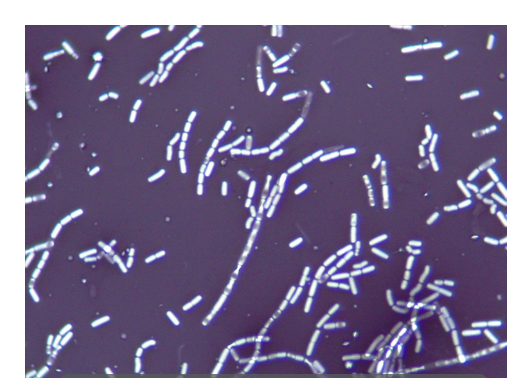
What type of stain is this?
Negative stain