41 Diseases and Disorders of the Equine Thorax
 Call Kai
 Learn
Learn Practice Test
 Spaced Repetition
 Match
Match Flashcards
 Knowt Play
1/52

There's no tags or description
Looks like no tags are added yet.
Name | Mastery | Learn | Test | Matching | Spaced | Call with Kai | Chat |
|---|
No analytics yet
Send a link to your students to track their progress
53 Terms
Penetrating wound
Shock, respiratory distress (nostril flaring, short quick breaths), hypoventilation (cyanotic membranes), weakness, and pain are all clinical signs for what thoracic problem?
To determine the extent of injury
What is the goal of diagnostic testing for penetrating thoracic wounds?
Radiographs: best for air
Ultrasound: best for fluid
What is the difference for evaluating penetrating thoracic wounds with radiographs versus ultrasound? Which is best for air? Fluid?
Thoracic auscultation
What is the best thing to do on your physical exam for thoracic trauma penetrating wound?
pH under 7.35, decrease HCO3 driver
What happens to pH, PaCO2, and HCO3 with metabolic acidosis?
pH over 7.45, increased HCO3 driver
What happens to pH, PaCO2, and HCO3 with metabolic alkalosis?
pH under 7.35, increased PCO2 driver
What happens to pH, PaCO2, and HCO3 with respiratory acidosis?
Over 7.45, decreased PCO2 driver
What happens to pH, PaCO2, and HCO3 with respiratory alkalosis?
b. lactic acidosis
d. diarrhea
f. renal failure
Select the things that commonly cause metabolic acidosis:
a. proximal GI obstruction
b. lactic acidosis
c. vomiting
d. diarrhea
e. hyperventilation
f. renal failure
a. proximal GI obstruction
c. vomiting
Select the things that commonly cause metabolic alkalosis:
a. proximal GI obstruction
b. lactic acidosis
c. vomiting
d. diarrhea
e. hyperventilation
f. renal failure
b. hypoventilation
note: like from collapsed lung
Select the things that commonly cause respiratory acidosis:
a. proximal GI obstruction
b. hypoventilation
c. vomiting
d. diarrhea
e. hyperventilation
f. renal failure
e. hyperventilation
note: like from pain
Select the things that commonly cause respiratory alkalosis:
a. proximal GI obstruction
b. hypoventilation
c. vomiting
d. diarrhea
e. hyperventilation
f. renal failure
Respiratory acidosis
A horse has the following blood gas:
pH 7.2
PCO2 65 mmHg
PaO2 40 mmHg
HCO3 25
BE -1
What is it?
CO2: 35-45 mmHg
HCO3: 22-26 mEq/L
What are the normal values for CO2 and HCO3
Do NOT pull the object out until you are ready to treat the pneumothorax, and when you DO pull it out = IMMEDIATELY pack to dec. air in chest
What is important to remember about penetrating wounds and what is causing it?
Ioban dressing
What is one of the best things used for wound dressing when addressing penetrating wounds in horses?
d. Metronidazole
Which of the following systemic antibiotics used in penetrating wound control is used for its ability to attack anaerobic bacteria?
a. penicillin
b. Naxcel
c. Gentamicin
d. Metronidazole
Jackson Pratt Drain
What is the closed suction drain used to treat penetrating wounds in horses?
DORSAL = removes air
VENTRAL = removes fluid
Why would you place a chest tube dorsally versus ventrally?
Heimlich valve
What is the name of the one way valve used to treat/drain penetrating wound trauma?
Jackson Pratt closed suction drain
What does the purple arrow indicate?
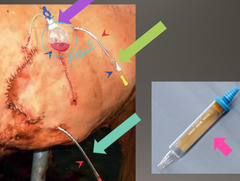
Dorsal chest tube for removing air
What does the light green/yellow arrow indicate?
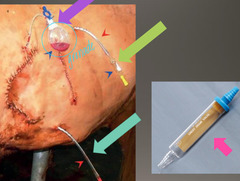
Ventral chest tube for removing fluid
What does the teal blue color arrow indicate?
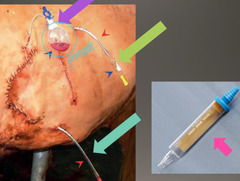
Heimlich one way valve
What does the large pink arrow indicate?
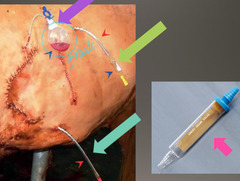
Penetrating chest wound into lung = guarded if septic pleuritis (50% die)
What is the prognosis like for an animal with a penetrating chest wound like this?
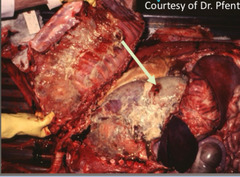
Because this commonly occurs from dystocia
Rib fractures are more common in foals than older horses. Why?
Rib fracture
What is happening here? Where the animal groans on palpation, has reluctance to move, and pain leading to "colic"?
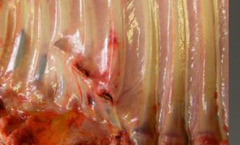
Rib fractures
You see this problem BEST on ultrasound (ie. better than radiographs)
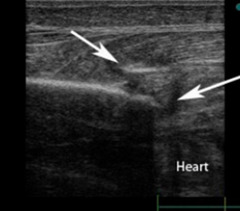
Surgical repair for displaced fractures near the heart, multiple fractures, or internal injuries
Besides pain control and restricted exercise, how can you manage rib fractures, particularly in foals?
Side B
note: if this were positive, this would be tension pneumothorax
Which one of these show the pneumothorax?
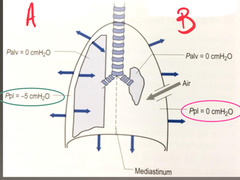
Pneumothorax
What is this horse at risk of?
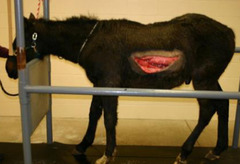
Pneumothorax
This is caused by air infiltrating through tissues to the thorax from outside structures in horses, or overall just disruption of the thoracic cavity
Pneumothorax = increased detail in dorsal lung field
A horse presents with increased respiratory effort, tachypnea, cyanotic mucous membranes, and distress. You see this on radiographs.
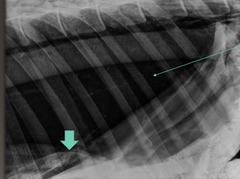
Pneumothorax
You can treat this problem by removing the excess air to allow the lungs to reinflate and with supplemental O2?
Re-expansion pulmonary edema
What do you have to be aware of when removing excess air to allow the lungs to reinflate when treating a pneumothorax?
DORSAL
When you treat pneumothorax with a teat cannula and a suction pump and indwelling chest tube with Heimlich valve, where should you do this, *dorsally or ventrally*
It is a good medium for microbes to grow
What additional issues does hemothorax cause?
Hemothorax = question mark is fluid NOT air
A horse presents with increased respiratory effort, pale mucous membranes, stiff movement, and hypovolemic shock. You see this on ultrasound. Thoughts?
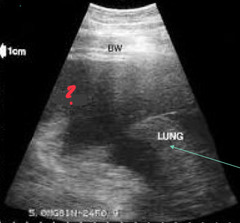
Ultrasound
What is the best diagnostic for hemothorax?
10%
What is the max % of bodyweight you can take from the donor when treating hemothorax via blood transfusion in a horse?
Axillary wounds
Wounds WHERE most commonly cause subcutaneous emphysema in horses?
Subcutaneous emphysema
What is happening in this horse that has a wound where air is sucked in but cannot leave?
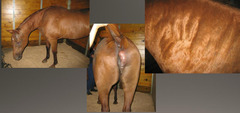
Pneumomediastinum or pneumothorax
THIS PICTURE = pneumomediastinum
What is subcutaneous emphysema a sequelae to?
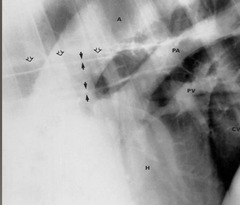
Excellent, air resorbs in 24-48 hours
What is prognosis like for subcutaneous emphysema in horses?
Diaphragmatic hernia
What is this?
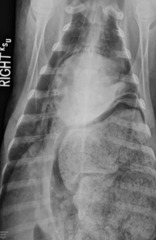
Thoracoscopy, thoracotomy and rib resection, and lung biopsy
What surgical procedures are typically done in the thorax in horses?
Thoracoscopy
Which surgical procedure of the thorax do you do in horses to: explore wounds, hernias, or neoplasia, place a drain, go guided pulmonary biopsy, and window pericardectomy?
Thoracoscopy
With this procedure, you make a portal between the ribs and purposefully create a unilateral pneumothorax because a collapsed lung allows for easy exploration (remove air when done)
Refractory pleuropneumonia ie. inspissated pus that isn't getting better
May also do lung abscess, chronic pleural effusion
What is the main indication you would use rib resection and thoracotomy for?
Rib resection and thoracotomy
What is this?
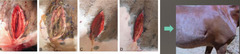
Rib resection and thoracotomy
For this procedure, you remove 20-25 cm piece of at least one rib, elevate the periosteum, and use OB wire to cut the bone, then suture it open
Lung biopsy
What procedure would you do for neoplasia and granuloma masses in the lungs in horses?
You need to seal the lung to prevent closed pneumothorax (like with ligature or staplers)
What do you need to remember about the lung with lung biopsy?