Anti-inflammatory drugs
 Call Kai
 Learn
Learn Practice Test
 Spaced Repetition
 Match
Match Flashcards
 Knowt Play
1/11

There's no tags or description
Looks like no tags are added yet.
Name | Mastery | Learn | Test | Matching | Spaced | Call with Kai | Chat |
|---|
No analytics yet
Send a link to your students to track their progress
12 Terms
Difference between the two drug classes?
Anti-inflammatory drugs reduce inflammation
Immunosuppressive drugs reduce the amount/action of T and B cells
What’s special about glucocorticoids?
They act as both anti-inflammatory and immunosuppressive drugs
COX-1 vs COX-2
COX-1 (constitutive) | COX-2 (inducible) | |
|---|---|---|
Where | Stomach, intestine, endothelium, kidney, platelets, is "always on" | Induced at inflammation sites (macrophages, synoviocytes) |
Produces | PGE2 (gastric protection), TXA2 (platelet aggregation), PGI2 (renal blood flow) | Inflammatory prostaglandins |
Physiological role | Housekeeping/protective | Drives inflammation |
Non-Steroidal Anti-Inflammatory Drugs (NSAIDs)
General mechanism: inhibits cyclooxygenase (COX) → block conversion of arachidonic acid into prostaglandins/thromboxane, resulting in anti-inflammatory, antipyretic, analgesic effects.
ASA & Ibuprofen are both NAISDs, but how are they different?
The general mechanism is the same and they are both npn-selective, but reversibility is different between the two.
Differences | ASA (aspirin) | Ibuprofen |
|---|---|---|
Reversibility | Irreversible; acetylates and permanently inactivates COX | Reversible competitive inhibition |
Selectivity | Non-selective (COX-1 + COX-2) | Non-selective (COX-1 + COX-2) |
Why does aspirin have such a long-lasting antiplatelet effect?
Platelets have no nucleus, so they can't synthesise new COX once ASA has acetylated it. The inhibition therefore lasts the entire lifespan of that platelet (~7–10 days).
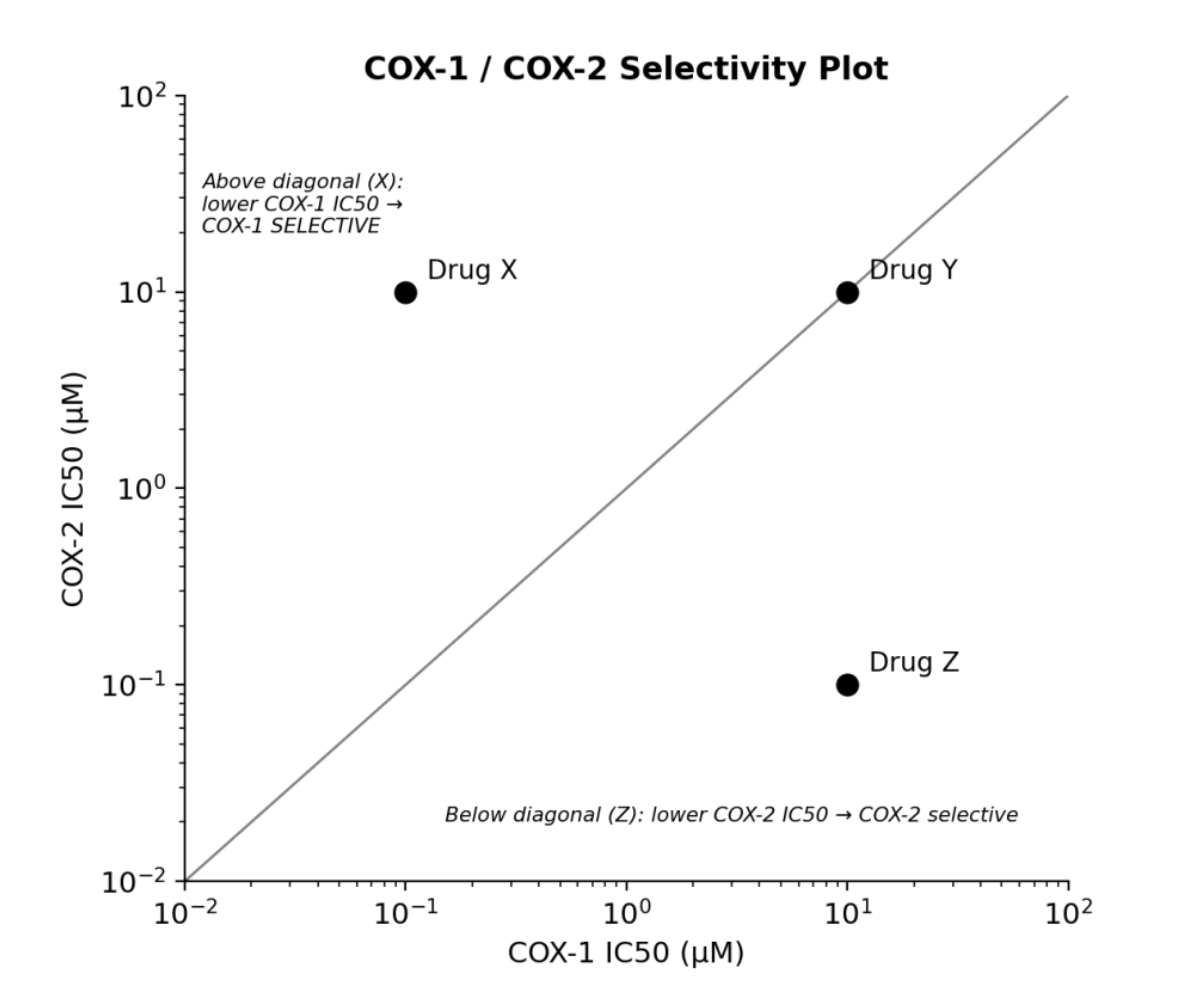
What conclusions can be drawn from the selectivity plot?
Drug X: above the diagonal → lower IC50 for COX-1 → COX-1 selective
Drug Z: below the diagonal → lower IC50 for COX-2 → COX-2 selective
Drug Y: on the diagonal → non-selective
Why have selective COX-2 inhibitors been developed?
COX-2 has a larger, more flexible binding pocket than COX-1, so drugs (e.g. celecoxib) can be shaped to fit COX-2 only, sparing COX-1. This protects stomach and platelets while still treating inflammation.
Adverse Effects of NSAIDs
Non-selective NSAIDs:
Inhibition of TXA2 reduces platelet aggregation, leading to bleeding risks
Inhibition of gastric prostaglandins (which normally protect the mucosa) can lead to GI damage
Selective COX-2 inhibitors:
Inhibition of PGI2 (antiplatelet, vasodilator) from endothelium without inhibiting platelet TXA2 shifts balance toward clotting
Increased risk of heart attack and stroke (black box warning for cardiac patients)
Advantage: less GI irritation than aspirin
Prednisolone - Glucocorticoid (transcriptional modulator)
Mechanism: Binds to intracellular (cytoplasmic) glucocorticoid receptor (GR) → receptor-ligand complex translocates to the nucleus and binds DNA → alters gene transcription to alter protein synthesis → altered cell function
Transcriptional effects
Trans-repression: ↓ inflammatory genes (cytokines, chemokines, adhesion molecules, COX-2)
Trans-expression: ↑ anti-inflammatory proteins, notably annexin 1, which inhibits phospholipase A2 → less arachidonic acid substrate available in the first place
How do glucocorticoids differ from NSAIDs?
NSAIDs directly inhibit the COX enzyme itself, and is therefore used for acute pain
Glucocorticoids inhibit transcription of the COX-2 gene, which is a step further upstream, and genomic/slow rather than direct/fast; this is why GCs aren't useful for acute relief
Adverse Effects of glucocorticoids
During treatment (supraphysiological doses): hyperglycemia, osteoporosis, myopathy, growth arrest, Cushing's features (moon face, buffalo hump, striae, hypertension, bruising, insomnia)
On withdrawal: flare of underlying disease, and acute adrenal insufficiency, because exogenous GC suppresses the HPA axis via negative feedback, so the adrenal cortex stops producing endogenous cortisol; abrupt stopping leaves the body without adequate cortisol.
This is why glucocorticoids must gradually be stopped rather than abruptly