cognition
 Call Kai
 Learn
Learn Practice Test
 Spaced Repetition
 Match
Match Flashcards
 Knowt Play
1/23

There's no tags or description
Looks like no tags are added yet.
Name | Mastery | Learn | Test | Matching | Spaced | Call with Kai | Chat |
|---|
No analytics yet
Send a link to your students to track their progress
24 Terms
genetics
80% influence of cognition
-attention & working memories have different genes that contribute
*dementia & schizophrenia have nonmodifiable genetic component (increases risk)
other risk factors: population, lifestyle, environmental factors, health conditions
hallmark of impaired cognition
-altered perception & thinking
general manifestations of altered cognition
-perception
-attention
-memory
-communication/ social cognition
-motor coordination
-execuative function
-intellectual/ learning
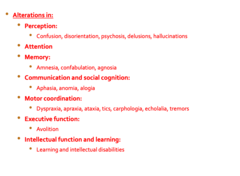
agnosia
inability to recognize objects through use of one or more senses
anomia
type of aphasia where individual not able to recall everyday objects
alogia
poverty of speech
dyspraxia
difficulty with acquisition of motor learning and coordination
Apraxia
alterations in speech due to motor function
carphologia
-lint picking behavior often seen in dementia
avolition
decrease in motivation or inability to initiate goal directed activity and may be in part related to executive dysfunction deficits
intellectual vs. learning disability
-learning= impacts individuals to process info (impacts learning in one area without affecting adaptive skills)
-intellectual= significant limitation in intellectual function begins around 18 (impact large adaptive skills)
delirium
-acute change in mental state causing confusion
-caused by medical conditions, trauma, substances use/ withdrawal
-reversible, linked to underlying cause
*polypharm!
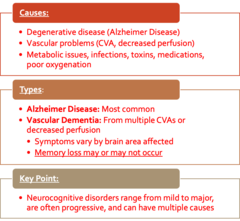
dementia
-loss of one or more brain functions due to degeneration of nervous system
**chronic progressive
causes of dementia
-degen disease, vascular problems, metabolic issues, infections, toxins, meds, oxygenation
**range from mild to moderate and have multiple causes
psychotic disorders
-loss of reality, usually requires medical evaluation
*psychosis can be caused by medical conditions & substances
psychosis
abnormal mental state that altered thought processes and perception in reality
positive symptoms of schizophrenia
-add to things that aren't there
-ex. delusions (false beliefs), hallucinations (false sensory experiences), disorganized speech
*2 or more symptoms last at least 6 months & interfere w ability to work/ maintain social relationships
-rule out physiological causes
negative symptoms of schizophrenia
-things that are taken away that should be there
-ex. anhedonia, flat affect, apathy, anergia, alogia (poverty of speech), avolation (lack of motivation)
6As
clang association
combine related or rhyming words together
*schizophrenia
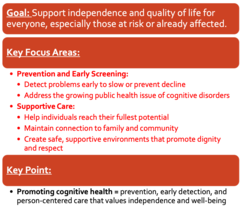
promoting cognitive health
-prevention, early detection and person centered care that values independence and well being
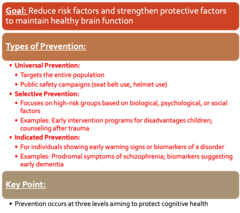
types of prevention
universal (entire populations)
selective (high risk groups)
indicated (showing warning signs of a disorder)
physical assessment
-can reveal clues to underlying cognitive syndromes (intellectual disabilities, schizophrenia)
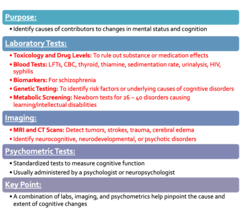
diagnostic tests
-labs, imaging and psychometrics help pinpoint cause and extent of cognitive changes
risks for altered cognition during development
-exposure to toxins
-maternal stress
-nutritional deficits
-illness