Study Guide Q (test 4)
 Call Kai
 Learn
Learn Practice Test
 Spaced Repetition
 Match
Match Flashcards
 Knowt Play
1/193

There's no tags or description
Looks like no tags are added yet.
Name | Mastery | Learn | Test | Matching | Spaced | Call with Kai | Chat |
|---|
No analytics yet
Send a link to your students to track their progress
194 Terms
Digestion begins in the
mouth
What is NOT a function of the digestive system?
production of ATP
During digestion, the major site of nutrient absorption is the
small intestine
What organ produces bile?
liver
What is the correct order of the major parts of the gastrointestinal tract?
mouth → esophagus → stomach → small intestine → large intestine
What are accessory organs of he GI tract?
Pancreas and Gallbaldder
What are the tunics that make up the GI wall?
Adventitia or serosa
Muscularis
Mucosa
Submucosa
The process of moving substances through the epithelial cells that line the GI tract into the blood or lymph is called?
absorption
T or F
The muscularis of the GI tract contains two layers of smooth muscles: the outer circular layer and the inner longitudinal layer
false
What are the major functions of the muscularis layer of the GI tract?
Peristalsis and Mixing
What are the serous membranes of the GI tract?
parietal peritoneum and visceral peritoneum
Btwn the parietal and visceral peritoneum is the thin?
peritoneal cavity
What are the names of the individual mesenteries associated with specific GI organs?
mesocolon
greater omentum
falciform ligament
What are the general receptors found in the GI tract?
chemoreceptors and mechanoreceptors
T or F
Sensory input from both mechanoreceptors and chemoreceptors is relayed to the CNS in response to stimulation. Autonomic motor output is then relayed through cranial nerves to organs of the GI tract. These are referred to as the short reflexes
false
The muscularis mucosae is a thin layer of smooth muscle immediately deep (external) to the
lamina propria of the mucosa
Most GI tract organs are lined with a ___________ epithelium
simple columnar
The mucosa of the esophagus is lined with ____________ squamous epithelium
nonkeratinized stratified
Within the abdomen, organs that are completely surrounded by visceral peritoneum are called _______________ organs
intraperitoneal
The greater omentum extends inferiorly like an apron from the ___________ of the stomach and covers most of the abdominal organs
greater curvature
Which of the following might stimulate the cephalic phase of gastric secretion?
the though of food
T or F
Gastric secretion is increased in all three phases (cephalic, gastric, intestinal)
false
Gastric secretion during the intestinal phase is inhibited by the presence of
lipids or low pH
Which phase (s) of gastric secretion is (are) regulated by the medulla oblongata?
all 3 phases are regulated by the medulla oblongata
Function of the stomach include?
chemical and mechanical digestion
Which region of the stomach is continuous with the esophagus?
cardiac region
Which cell of the gastric glands produces pepsinogen?
chief cell
Secretin is released from the duodenum in response to
hydrochloric acid in chyme
What enzyme is produced by the stomach?
pepsin
T or F
Gastrin functions to increase the production of HCl in the stomach
true
In the parietal cells, the enzyme carbonic anhydrase causes a reaction btwn?
CO2 + H2O
Hydrochloric acid is formed when H+ ions and Cl- ions join in the?
duct of the gastric gland
The ion exchange protein in the plasma membrane of parietal cells changes ____________ ions going out for __________ ions coming in
bicarbonate
chloride
T or F
The first step in the formation of hydrochloric acid is the active transport of carbon dioxide into the parietal cells
false
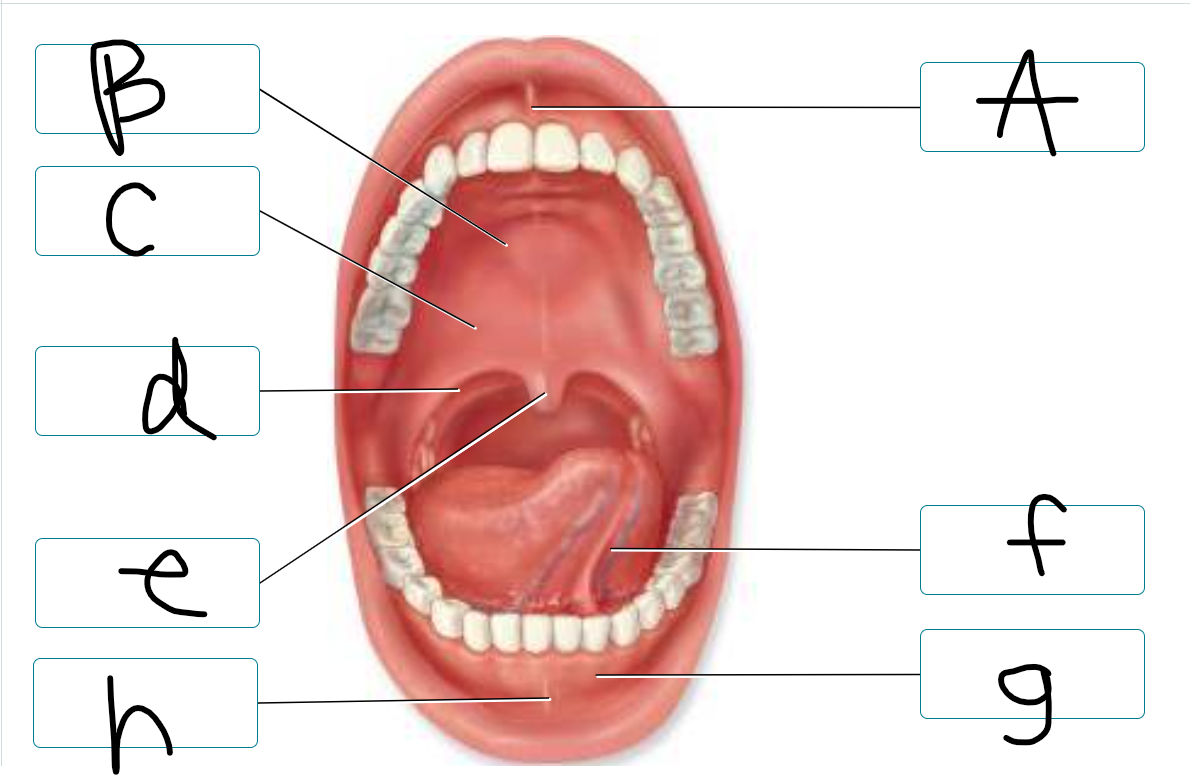
label oral cavity
a) superior labial frenulum
b) hard palate
c) soft palate
d) palatoglossal arch
e)uvula
f) lingual frenulum
g) gingivae
h) inferior labial frenulum
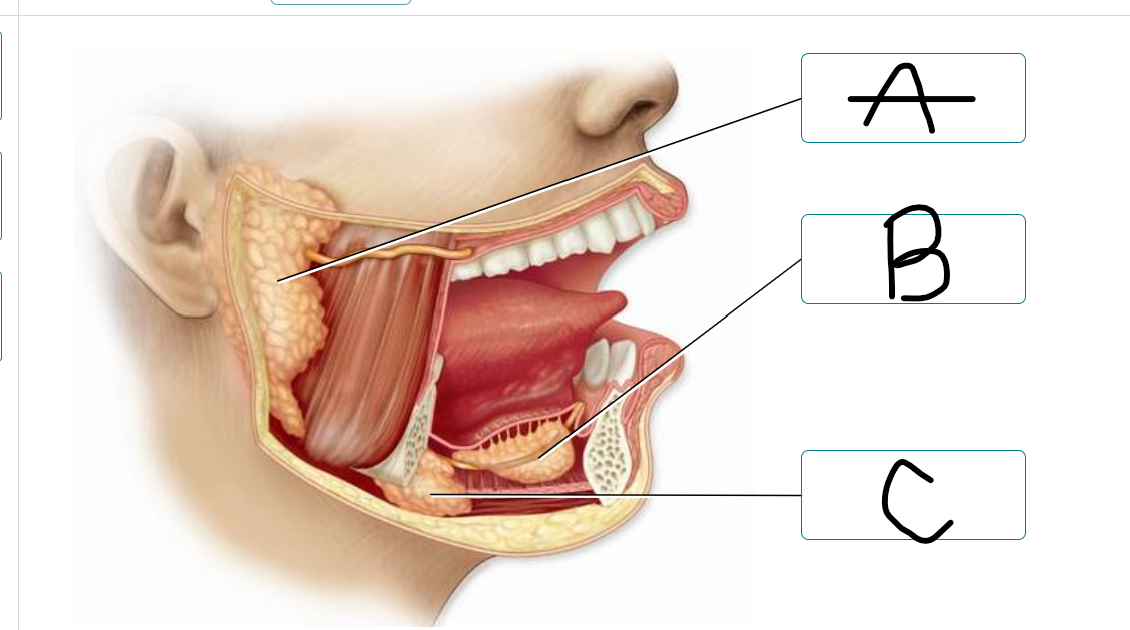
label salivary glands
a) parotid salivary gland
b)sublingual salivary gland
c) submandibular salivary gland
Bolus passes from the pharynx to esophagus
resembles what swallowing phase?
Pharyngeal phase
Bolus passes from esophagus to stomach
resembles what swallowing phase?
esophageal phase
chewing forms bolus
resembles what swallowing phase?
voluntary phase
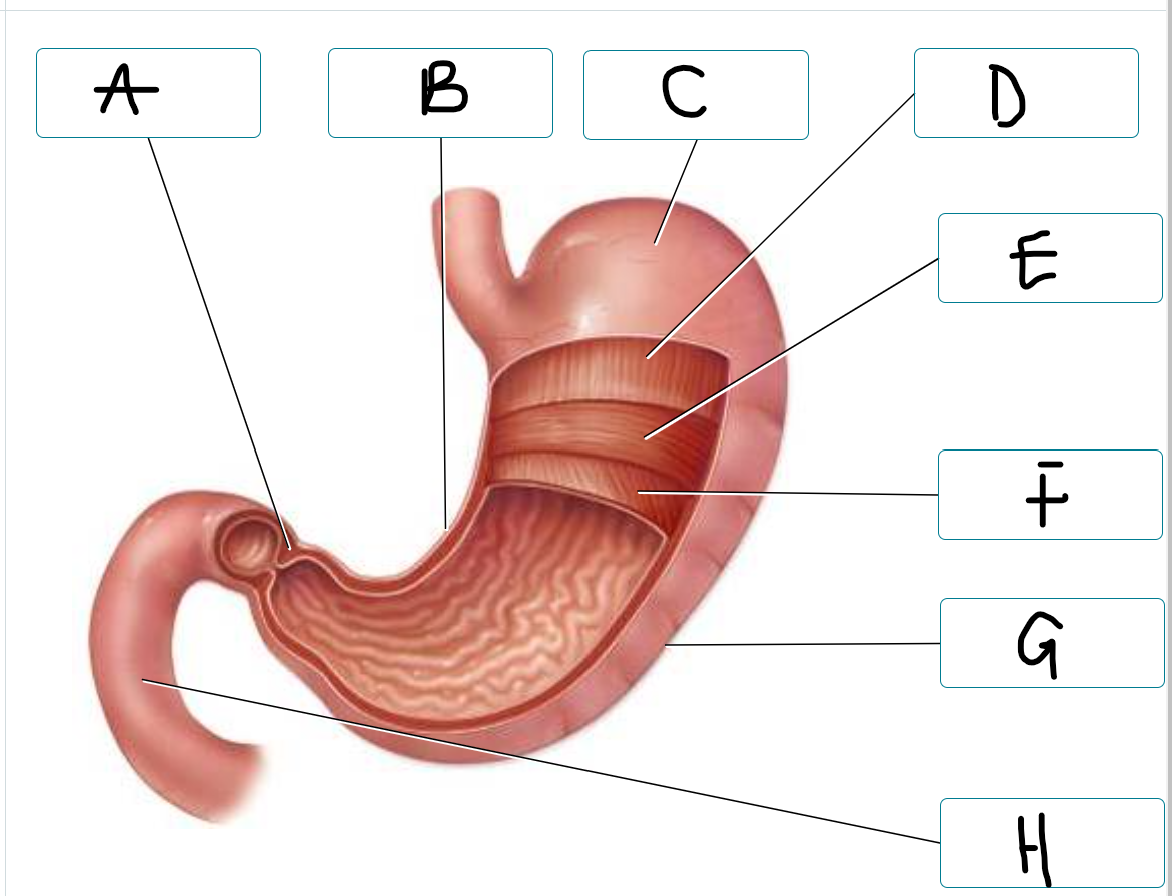
label stomach structures
a) pyloric sphincter
b) lesser curvature
c) fundus
d) longitudinal layer
e) circular layer
f) oblique layer
g) greater curvature
h) duodenum
The stomach is lined by
simple columnar epithelium
T or F
The esophagus extend from the nasopharynx to the stomach
false
T or F
The esophagus is about 25 meters long
false
T or F
The esophagus lies anterior to the treache
false
T or F
The muscularis of the esophagus is different from other parts of the digestive tract because the superior part of the esophagus consists of skeletal muscle
true
T or F
The esophagus contains both an upper and lower esophageal sphincter that regulated the movement of materials into and out of the esophagus
true
T or F
The esophagus contains numerous mucous glands that produce a thick, lubricating mucus that coats the inner surface of the esophagus
true
What events of swallowing are associated with the Pharyngeal phase?
1. initiated by stimulation of tactile receptors in the oropharynx
2. begins with elevation of the soft palate
3. the upper esophageal sphincter relaxes
What events of swallowing are associated with the Esophageal phase?
1. peristalsis moves food bolus onward
2. the lower esophageal sphincter relaxes
What events of swallowing are associated with Voluntary phase?
1. food bolus forced into the oropharynx
2. food bolus pushed by tongue against the hard palate
T or F
The epithelial lining of the oral cavity has a transitional epithelium
false
T or F
Mastication is the process of chemically reducing food bulk into smaller particles to facilitate swallowing
false
G-cells of the gastric glands in the stomach produce a hormone called __________ that stimulates stomach secretion and motility
gastrin
The intestinal phase of digestion involved both the intestinal reflexs and the release of 2 primary hormones __________ and secretin
CCK
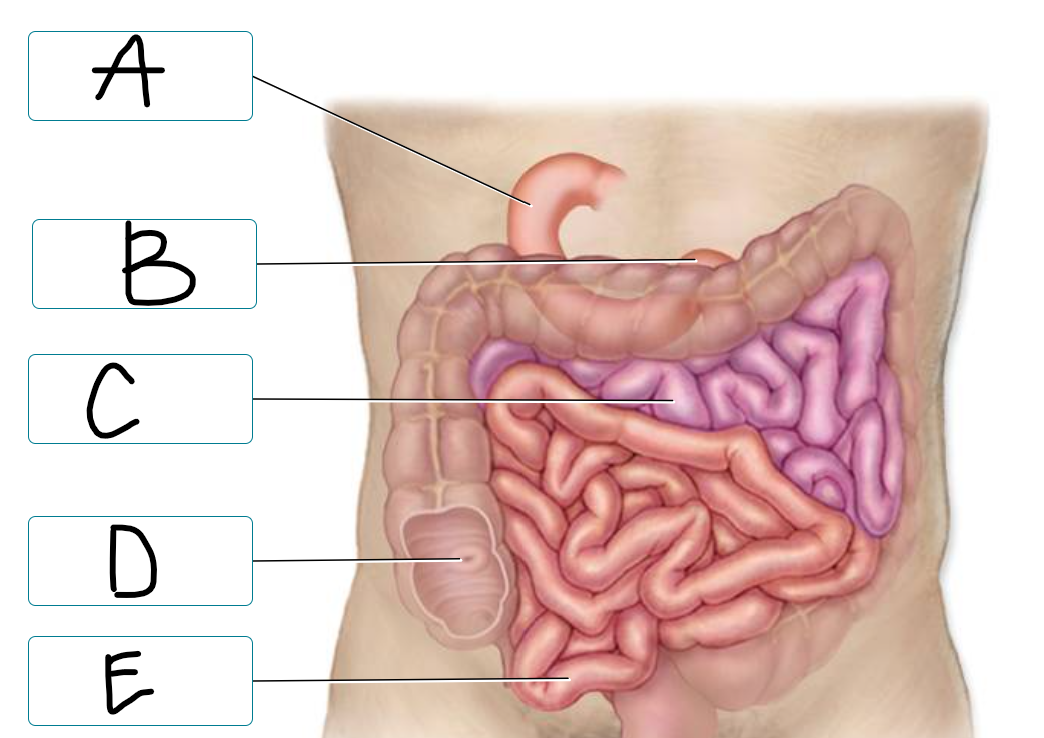
label regions/structures of small intestine
a) duodenum
b) duodenojejunal flexure
c) jejunum
d) ileocecal valve
e) ileum
_____________ performs most chemical digestion and absorption
Jejunum
_______________ receives bile and pancreatic juice
Duodenum
______________ controls entry of material into large intestine
Ileum
Ranking the small intestine features from largest to smallest
circular folds, villi, microvilli
1. circular folds
2. villi
3. microvilli
_____________ is a hormone released from the small intestine primary in response to fatty chyme in the intestinal lumen
CCK
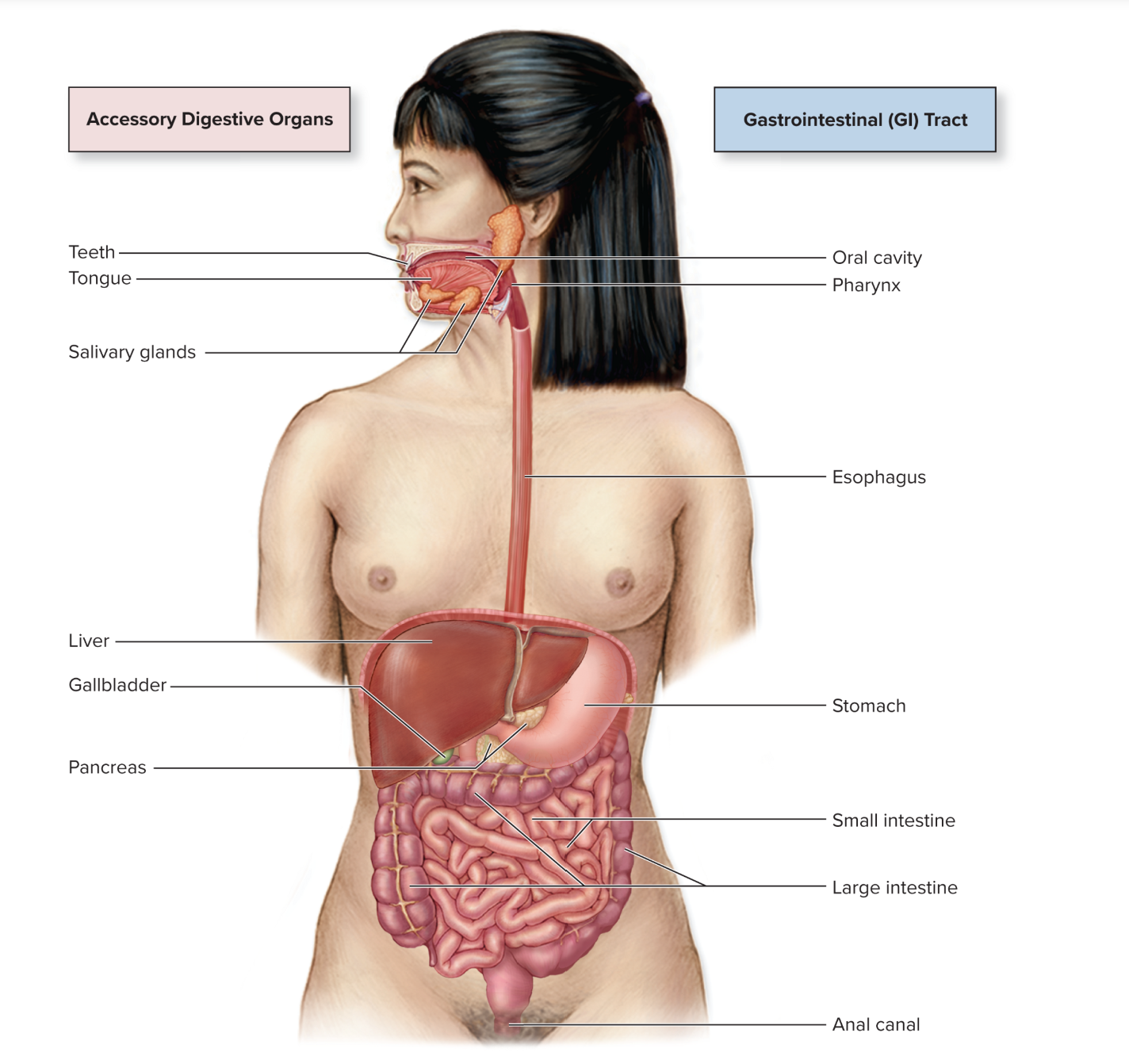
What is the GI tract?
continuous tube that includes
oral cavity, pharynx, esophagus, stomach, small intestine, large intestine, and ends at the anus
What are two alternative names for the GI tract?
digestive tract or alimentary canal
Why are the contents in the lumen of the GI tract no considered part of the body?
until they are absorbed
What are accessory digestive organs?
teeth, tongue, salivary glands, liver, gallbladder, pancreas
What are the 6 general functions of the digestive system?
Ingestion, Motility, Secretion, Digestion, Absorption, elimination
What occurs in Ingestion?
is the introduction of solid and liquid nutrients into the oral cavity. It is the first step in the process of digesting and absorbing nutrients
What occurs in Motility?
voluntary muscular contractions (by skeletal muscle)
involuntary muscular contractions (by smooth muscle) for mixing/moving materials through the GI tract.
What occurs in Secretion?
is the process of producing and releasing substances that facilitate both digestion and the movement of contents within the GI tract.
What occurs in Digestion?
1. Mechanical digestion is the breaking of ingested material into smaller pieces without changing its chemical structure.
2. Chemical digestion involves the activity of specific enzymes to break down complex molecules into smaller molecules so that they can be absorbed.
What occurs in Absorption?
involves membrane transport of digested molecules, electrolytes, vitamins, and water across the epithelial lining of the GI tract into the blood or lymph. Absorption occurs primarily within the small intestine.
What occurs in Elimination?
is the expulsion of indigestible components through the anal canal.
What are the four tunica of the GI tract wall?
mucosa
submucosa
muscularis
adventitia (serosa)
What is the innermost tunic?
mucosa
What type of epithelium is found in most of the GI tract: stomach, small intestine, large intestine?
simple columnar epithelium
What type of epithelium is found in portions that must withstand abrasion: esophagus, anal canal?
nonkeratinized stratified squamous epithelium
What underlies the epithelial layer?
What tissue composes it?
lamina propria
areolar CT
What is the deepest layer of the mucosa?
What tissue composes it?
Muscularis
thin layer or smooth muscle
What do the autonomic nerves in the submucosa form?
submucosal nerve plexus or Meissner Plexus
What are Peyer patches?
larger aggregates of lymphatic nodules in the submucosa
What tissue composes muscularis tunic?
smooth muscle tissue
What are the two layers of the muscularis tunic?
inner circular layer and outer longitudinal layer
What do the autonomic nerves of the muscularis form?
myenteric nerve plexus or Auerbach nerves
What is the function of the muscularis?
motility
What is segmentation?
backward and forward mixing that blends secretions with ingested material within GI tract
but does not result in directional movement of lumen contents
What is peristalsis?
sequential contraction of the muscularis within the GI tract wall that moves like a wave
one-way movement
What is a sphincter?
rings of smooth muscle that are between regions of the GI that relax and contract
What is the function of a sphincter?
1. control the movements of materials into the next section of the GI tract
2. prevent backflow
What organs located in which regions have a serosa or adventitia?
Only GI structures that are intraperitoneal organs have serosa as their outermost tunic
What are some exceptions to the typical pattern of the GI tract wall?
esophagus: nonkeratinized stratified squamous in its mucosa to protect lining
Stomach: 3 layers of smooth muscle in the muscularized to help with mechanical digestion of swallowed food
What two systems regulate the digestive system?
nervous and endocrine
What is the ENS?
An array of both sensory neurons and motor neurons, which extends from the esophagus to the anus.
Located within the submucosal plexus and the myenteric plexus of the gastrointestinal (GI) tract wall.
Innervates the smooth muscle and glands of the GI tract and mediates the complex coordinated reflexes for the mixing and propulsion of materials through the GI tract.
Which division promotes GI activity?
parasympathetic
What is the impact of the parasympathetic on motility/sphincters?
stimulates GI motility and relaxes GI tract sphincters
Which division opposes GI tract activity?
Sympathetic
What is sympathetic impact on motility/sphincters/blood vessels?
inhibits GI tract motility
contracts GI tract sphincters
vasoconstricts blood vessels within GI tract wall
What type of receptors are involved in GI reflexes?
Baroreceptors and chemoreceptors
detect stretch of the GI tract wall
Baroreceptors
monitor the chemical content of the material within the lumen, including the presence of protein and acid
chemoreceptors
What term describes reflexes that only involve the ENS?
short reflex
What term describes reflexes that involves the CNS?
long reflex