3.14-3.39 Inheritance
 Call Kai
 Learn
Learn Practice Test
 Spaced Repetition
 Match
Match Flashcards
 Knowt Play
1/56

There's no tags or description
Looks like no tags are added yet.
Name | Mastery | Learn | Test | Matching | Spaced | Call with Kai | Chat |
|---|
No analytics yet
Send a link to your students to track their progress
57 Terms
What is a genome?
The entirety of an organism’s DNA is known as its genome
What is an allele?
Different versions of the same type of gene resulting in different versions for a particular trait
What is a dominant allele?
If one copy of this type of allele present its phenotype will always be expressed
What is a recessive allele?
Needs two copies of this type of allele to be present its phenotype to be expressed
What is a phenotype?
Physical expression of genotype resutling in a physical characteristic
What is a genotype?
The combination of alleles for a gene that an organism possesses
What is a homozygous recessive?
When two alleles for a gene are identical
What is a heterozygous?
When two alleles for a gene are different
What is a gene?
A section of a molecule of DNA
What is the name for the square we use to calculate inheritance probabilities?
Punnet squares
What does each gene within the genome code for?
Each gene codes for a particular sequence of amino acids
What do sequences of amino acids form?
They form different types of proteins
Fill in the gap: genes control our [ ] as they code for proteins that play important roles in what our cells do
Characteristics
Name four types of protein in the body:
Structural proteins (e.g. collagen in skin)
Enzymes
Hormones
Antibodies

In the nucleus of a cell, the DNA double helix supercoils to form structures called…?
Chromosomes
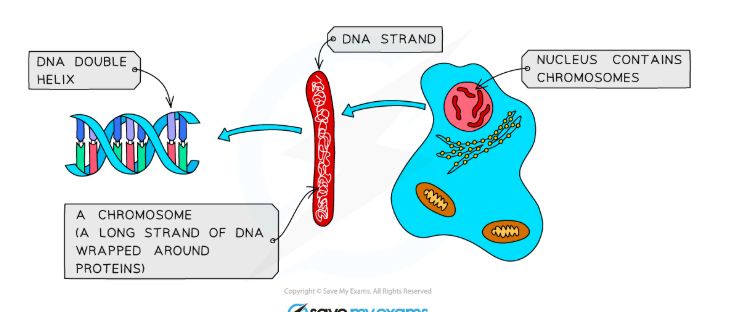
When are chromosomes only visible?
Chromosomes are only visible during cell division
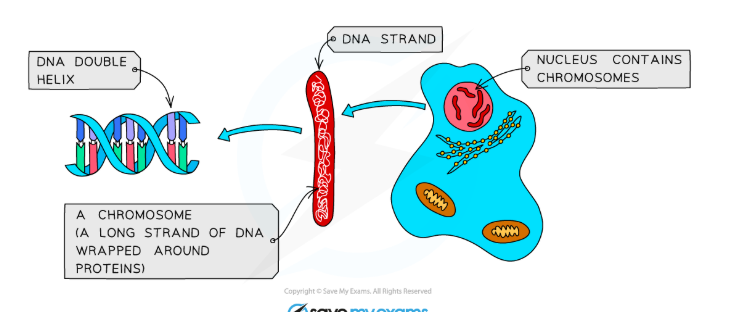
How many pairs of chromosomes do ordinary human bdy cells contain?
23 pairs (i.e. 46 chromosomes in total)
How is a diploid number often shown?
2n
One chromosome from a pair is inherited from each parent. What is each chromosome pair called?
Each chromosome pair is called a homologous pair
How many pairs of chromosomes do dogs have?
39 pairs
How many pairs of chromosomes do rice plants have?
12 pairs
What is the full name of DNA? [Spell it twice].
Deoxyribonucleic acid. Deoxyribonucleic acid.
What is DNA and what is it made up of?
DNA is a polymer made up of two strands coiled around to make a double helix

What are the strands formed from?
A sugar phosphate backbone with bases

What 4 bases are in a sugar phosphate backbone?
Adenine (A)
Thymine (T)
Guanine (G)
Cytosine (C)


How are the 4 bases bonded together?
Through complementary base pairing. Adenine pairs with Thymine, Guanine pairs with Cytosine.

What two processes rely on these base-pairing rules?
Cell division and protein synthesis
What is the full name of RNA?
Ribonucleic acid
What is RNA and what is it made up of?
RNA is a polynucleotide as it is made up of many nucleotides linked together in a long chain

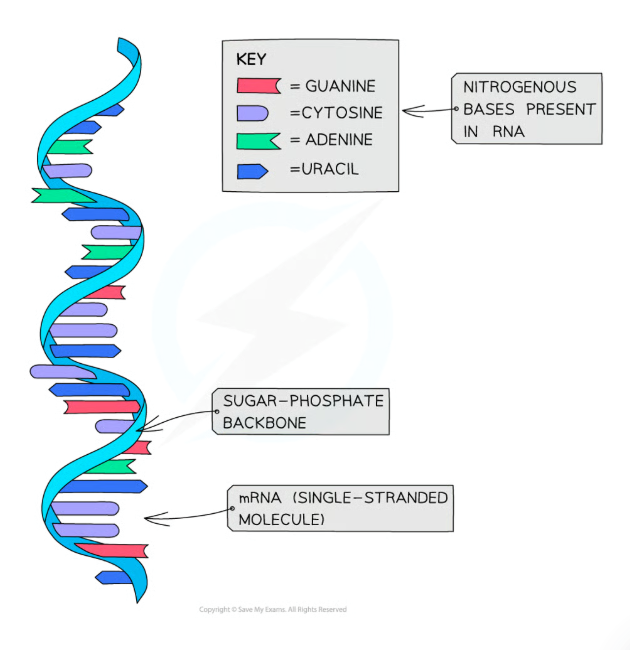
What do RNA nucleotides never contain and what do they have instead?
They never contain the nitrogenous base thymine (T), instead they have uracil (U)
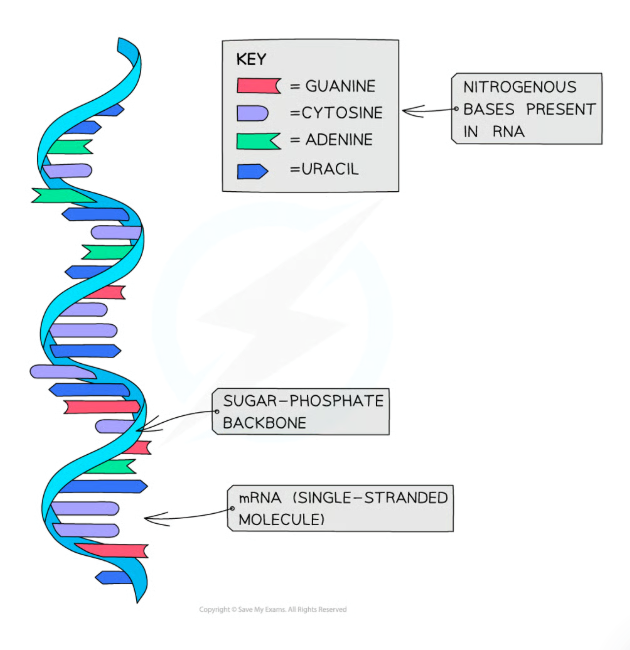
RNA molecules are [ ] made up of [ ] [ ]
RNA molecules are only made up of one polynucleotide
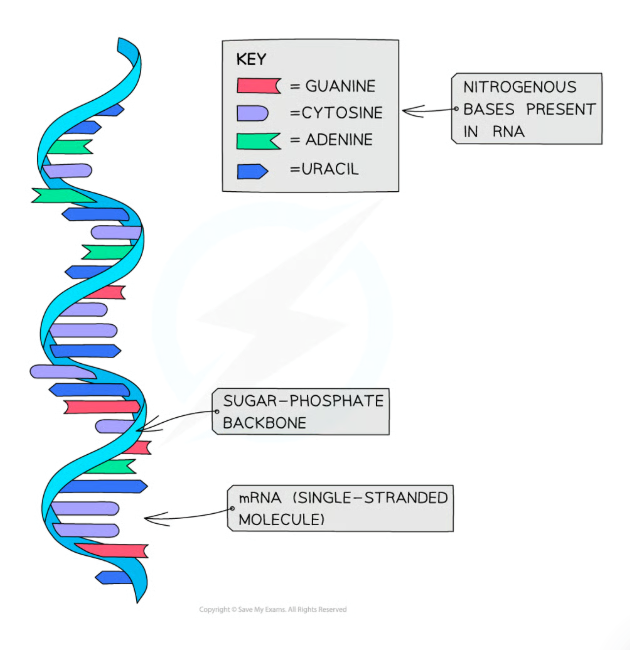
Name 3 specific types of RNA molecule:
Messenger RNA (mRNA)
Transfer RNA (tRNA)
Ribosomal RNA (rRNA)
What does mRNA do?
mRNA is the transcript copy of a gene that encodes a specific polypeptide
What is tRNA involved in?
tRNA is involved in protein synthesis
What does rRNA form part of?
rRNA forms part of a ribosome
What are the two main differences between RNA and DNA?
RNA is single-stranded
RNA contains uracil instead of thymine
What two stages is the process of turning a gene into a specific sequence of amino acids split into?
Transcription and translation
What is transcription?
The process where a section of DNA is transcribed to produce a complementary single strand of mRNA
What is translation?
The process where an mRNA molecule is decoded at a ribosome to produce a chain of amino acids
What is transcription located in the cell? Name the specific part.
Nucleus
What happens first in transcription in DNA?
Part of the DNA molecule unwinds as H bonds between complementary base pairs break
What is the exposed DNA strand used during transcription?
The template strand
What is the role of free mRNA nucleotides in transcription?
They bind to complementary nucleotides on the exposed DNA template strand and join together to form mRNA
How does mRNA exit the nucleus?
Through a pore in the nuclear envelope
What is the relationship between mRNA product and original DNA gene?
The single stranded mRNA is a complementary copy of the DNA code from the template strand
Where in the cell does translation take place?
In the cytoplasm, specifically, on a ribosome
What does mRNA attach to during translation?
A ribosome in the cytoplasm
What is tRNA?
A transfer RNA which carries a specific amino acid to the ribosome matching its anticodon to mRNA
What is a codon?
A triplet of consecutive bases on an mRNA strand that codes for a specific amino acid
What is an anticodon?
A triplet of unpaired bases at one end of a tRNA molecule complementary to an mRNA codon
What is the relationship between an anticodon and an amino acid?
Each specific anticodon on tRNA corresponds to one specific amino acid carried at its other end
What is the name of the bond formed between adjacent amino acids?
Peptide bond
What signal terminates translation?
A ‘stop’ codon on the mRNA molecule
What does the amino acid chain do finally for modification?
The amino acid chain folds and is modified to form a functional protein molecule
What is the primary function of H bonds in DNA during transcription?
They break to allow the two strands of DNA to separate and expose the template strand
What is the difference between the output of transcription and the output of translation?
Transcription produces an mRNA molecule, whereas translation produces an amino acid chain (a protein)
What are the sequence of events during translation?
1. mRNA attaches to [ ]
[ ] [ ] pair with [ ] [ ]
[ ] bonds form between [ ] acids
stops at ‘stop’ [ ]
1. mRNA attaches to ribosome
tRNA anticodons pair with mRNA codons
peptide bonds form between amino acids
stops at ‘stop’ codon