Modules 7 & 8
 Call Kai
 Learn
Learn Practice Test
 Spaced Repetition
 Match
Match Flashcards
 Knowt Play
1/42

There's no tags or description
Looks like no tags are added yet.
Name | Mastery | Learn | Test | Matching | Spaced | Call with Kai | Chat |
|---|
No analytics yet
Send a link to your students to track their progress
43 Terms
Why are traditional networks hard to manage, in the view this lesson presents? A. The diversity of devices (routers, switches, middleboxes) and the proprietary, vendor-specific control software running on each makes consistent network-wide policy hard to express and verify. B. Modern devices are too slow at line rate, so operators must continually replace hardware to keep up. C. IPv6 transition fundamentally broke the management plane that worked under IPv4. D. Open-source software dominates the data plane and lacks the maturity of vendor-shipped systems.
A. The diversity of devices (routers, switches, middleboxes) and the proprietary, vendor-specific control software running on each makes consistent network-wide policy hard to express and verify. Why: Vendor heterogeneity + proprietary control SW => inconsistent policy. Each box runs its own CLI, control software, and configuration model; expressing 'route X via path P everywhere, enforce Y everywhere' becomes a per-device puzzle rather than a global statement.
In traditional networks, the control logic and the packet-forwarding logic are tightly integrated inside the same physical box. True or False?
True. Why: Same box = same CPU runs both planes. In traditional routers, the route processor and forwarding ASICs sit inside one physical chassis; the conceptual split exists but they're not separable.
The history of SDN is often described in three phases. Which list is correct in chronological order? A. ARPANET; ATM; MPLS — these are the three precursors of modern SDN. B. Active networks; control/data plane separation; OpenFlow and network operating systems. C. Active networks; MPLS; P4 hardware programmability. D. OpenFlow; ONOS; SD-WAN deployment in enterprises.
B. Active networks; control/data plane separation; OpenFlow and network operating systems. Why: Active networks -> control/data separation -> OpenFlow + NOSes. Active networks (1990s) explored programmable packets; the early 2000s formalized control-plane decoupling (4D, RCP); OpenFlow + NOX/ONIX/ONOS made it deployable.
The conceptual separation of the control plane from the data plane PREDATES OpenFlow by several years, even though OpenFlow is what made the separation practical. True or False?
True. Why: Separation idea predates OpenFlow by years. RCP (2005) and the 4D project argued for centralised control before OpenFlow (2008) shipped a concrete southbound API that made it practical.
The lesson argues that separating control and data planes enables several benefits at once. Which one is BEST captured by 'a logically centralized view of the network'? A. Forwarding decisions are pushed up to the end hosts directly, while the switches are no longer responsible for making forwarding choices. B. Each device runs its own routing algorithm independently, exactly as in traditional networks, but with cleaner code. C. The controller has the whole topology in one place, so it can compute consistent policies (routing, security, traffic engineering) across many devices. D. The data plane gains write access to the global routing table for every other AS.
C. The controller has the whole topology in one place, so it can compute consistent policies (routing, security, traffic engineering) across many devices. Why: Centralized view => consistent global policy. The controller sees the entire topology and computes coherent forwarding/security/TE decisions; per-device protocols can only converge to consistency, not guarantee it.
In a traditional network, changing a routing or security policy across many devices requires logging into each device's CLI and applying per-device commands. In SDN, the same change is expressed once at the controller. Beyond saving keystrokes, which OPERATIONAL property does this centralization enable that the traditional CLI workflow makes hard? A. Routers no longer need a control plane — the SDN controller forwards every packet itself, removing the need for operator oversight. B. Hardware-level encryption is automatically enforced on every flow without any operator action or configuration. C. The data plane no longer needs forwarding logic; the controller is consulted over the network for each packet before the packet is forwarded. D. Network configuration becomes centralized, software-managed state — so changes can be version-controlled (e.g., Git), code-reviewed, tested in CI, and rolled back like any other software artifact.
D. Network configuration becomes centralized, software-managed state — so changes can be version-controlled (e.g., Git), code-reviewed, tested in CI, and rolled back like any other software artifact. Why: Centralized config = code-managed state => Git, code review, CI, rollback. Per-device CLIs scatter config across boxes with no native version control or atomic rollback; once the controller holds the network's intent as software-defined state, every change flows through the same pipelines (PR, test, deploy, revert) that software teams already use — eliminating a major class of operational risk.
Consider an SDN network, where does the routing computation occur? A. On a logically centralized controller that distributes forwarding tables to the network elements. B. Inside each switch, identically to the traditional approach but with newer firmware. C. On end hosts that originate the traffic and intermediate switches/routers as Layer-1 repeaters. D. SDN networks include IXP route servers which are configured to perform routing.
A. On a logically centralized controller that distributes forwarding tables to the network elements. Why: Routing computed on centralized controller. The controller runs algorithms on the global view and pushes resulting forwarding rules down to the switches via the southbound API.
Consider an SDN run network where the SDN controller runs in a remote data center which is not co-located with the routers. Which architectural design/property of SDN run networks enables this operation? A. The data plane includes a built-in tunnel to the operator's headquarters for any remote management traffic. B. The control plane is implemented in software and is physically decoupled from the data plane — it can run anywhere reachable over a control channel. C. Routers run the full controller code locally and send commands to themselves via loopback. D. OpenFlow requires the controller to be co-located, but operators may pre-stage forwarding rules from afar.
B. The control plane is implemented in software and is physically decoupled from the data plane — it can run anywhere reachable over a control channel. Why: Control plane is SW + physically decoupled => runs anywhere reachable. Because the control channel is just network traffic, the controller can sit in a different rack, data center, or even cloud — wherever the operator wants.
In traditional (non-SDN) networks, separating data plane and control plane CONCEPTUALLY already existed — but they ran inside the same physical box, on the same CPU. True or False?
True. Why: Conceptual separation existed, but co-located on same CPU. Even traditional routers distinguish 'compute routes' from 'forward packets'; SDN's contribution is making the separation physical and programmable.
In the SDN-architecture figure, the 'infrastructure layer' (the SDN-controlled switches) is responsible for which function? A. Acting as the northbound REST API that operator tools talk to. B. Computing forwarding rules based on operator policy directly within the switch CPU. C. Hosting the network-control applications that operators write for the controller. D. Forwarding traffic according to the rules computed and installed by the SDN control plane above.
D. Forwarding traffic according to the rules computed and installed by the SDN control plane above. Why: Infrastructure layer = switches that execute installed rules. The data-plane elements (OpenFlow switches, P4 targets) accept rules from the controller and forward at line rate; they don't compute routes themselves.
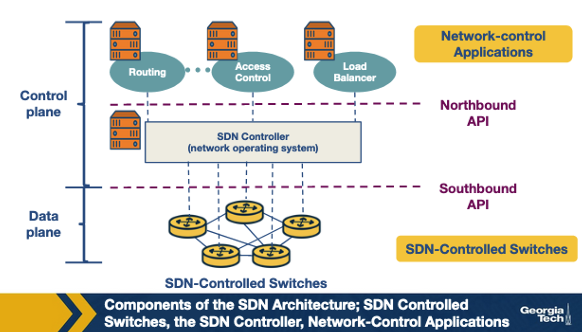
Which SDN interface connects the CONTROLLER to the network-control applications above (e.g., a REST API)? A. Southbound interface (e.g., OpenFlow). B. Northbound interface. C. Mininet topology interface. D. OpenFlow flow-table priority field.
B. Northbound interface. Why: Northbound = controller
Which SDN interface connects the CONTROLLER to the switches it programs (e.g., OpenFlow)? A. East-west interface. B. Northbound interface. C. Southbound interface. D. Management plane interface.
C. Southbound interface. Why: Southbound = controller
In the SDN architecture, the controller is responsible for COMPUTING forwarding decisions; the switches are responsible for EXECUTING those forwarding decisions at line rate. True or False?
True. Why: Controller computes; switches execute. Cleanly split responsibility: route decisions and policy live in software at the controller; per-packet enforcement at line rate happens on the switches.
Modern SDN controllers are typically DISTRIBUTED across multiple instances. Select the primary motivation. A. Eliminating the southbound API entirely, since distributed controllers talk to switches via gossip. B. Reducing latency below 1 nanosecond per control message. C. Allowing controllers to be written in many different programming languages. D. Fault tolerance and scalability — a single instance is a single point of failure and may not handle the load of a large network.
D. Fault tolerance and scalability — a single instance is a single point of failure and may not handle the load of a large network. Why: Distributed controllers = fault tolerance + scale. A single controller is a SPOF and a bottleneck; distributing to multiple instances tolerates failures and shares load across a large network.
Logical centralization of the control plane does NOT require physical centralization — a distributed control platform can still present a single logical view to applications. True or False?
True. Why: Logical != physical centralization. The control platform can be distributed (for HA and scale) yet still present applications with a single logical view of the network through shared state.
Consider the differences between traditional networks and SDN run networks. Which architectural change one of the most fundamental that SDN introduces? A. Separating the control logic from the data plane and placing the logic in a logically centralized controller. B. Replacing IP with a new Layer-3 protocol designed specifically for software-defined switches. C. Eliminating the data plane entirely so the controller forwards every packet itself. D. Forcing every switch to run BGP as its intra-AS routing protocol.
A. Separating the control logic from the data plane and placing the logic in a logically centralized controller. Why: Separation of control logic + centralized controller. The defining architectural shift: control reasoning moves out of each box and into a logical controller that programs the data plane via a southbound API.
SDN does not eliminate the data plane — the data plane is still where packets are actually forwarded at line rate. SDN only moves the CONTROL logic out of the device. True or False?
True. Why: SDN doesn't kill the data plane — it moves CONTROL. Packets still get forwarded at line rate by the switch ASICs; what's been factored out is the route-computation logic, not the forwarding itself.
How does SDN benefit middlebox-like services in practice? A. Every middlebox in the data plane is physically replaced by a local copy of the SDN controller, so each box independently recomputes the global forwarding policy. B. A single common control platform can express firewall, NAT, load-balancing, and other policies without each one being a separate proprietary middlebox. C. Operators stop using firewalls, NAT, and load balancers entirely once they deploy SDN. D. Middleboxes still exist but no longer participate in the data path at all.
B. A single common control platform can express firewall, NAT, load-balancing, and other policies without each one being a separate proprietary middlebox. Why: One control platform expresses many policies (firewall, NAT, LB). Instead of buying a separate proprietary middlebox per function, SDN apps express those policies on top of a common controller and switch fabric.
The lesson presents SDN by contrasting it with conventional networks built from proprietary middleboxes. Which of the following are genuine advantages of the SDN approach as described in the lesson? (select all that apply) A. A common control platform can express firewall, NAT, and load-balancing policies as applications, instead of a separate proprietary middlebox for each function. B. Deploying SDN removes the need for firewalls, NAT, and load balancers. C. Every network application works from the same global view of the network, keeping policy decisions consistent and letting control-plane modules be reused. D. A network function's logic can run from anywhere in the network, rather than being pinned to a fixed physical location the way middleboxes were. E. Each switch hosts its own copy of the controller and recomputes the global forwarding policy on its own. F. Independent applications, such as routing and load balancing, can be combined and integrated more smoothly. G. The control and data planes stay bundled inside each device, now running on faster hardware. H. Decoupling the control plane from the data plane lets new features and protocols roll out without upgrading firmware on every device.
A, C, D, F, H. A. A common control platform can express firewall, NAT, and load-balancing policies as applications, instead of a separate proprietary middlebox for each function. C. Every network application works from the same global view of the network, keeping policy decisions consistent and letting control-plane modules be reused. D. A network function's logic can run from anywhere in the network, rather than being pinned to a fixed physical location the way middleboxes were. F. Independent applications, such as routing and load balancing, can be combined and integrated more smoothly. H. Decoupling the control plane from the data plane lets new features and protocols roll out without upgrading firmware on every device. Why: A / C / D / F are the four advantages the "SDN Advantages" page names — shared abstractions, consistent global network view, location-independent placement, and simpler integration. H is the core motivation benefit: decoupling the planes ends the per-device, ~10-year rollout cycle. B is the classic trap — those functions aren't removed; they become applications on the controller. E is wrong — control is logically centralized (a controller, physically distributed in practice), not replicated per switch. G is wrong — SDN's whole premise is decoupling the control and data planes, not keeping them bundled.
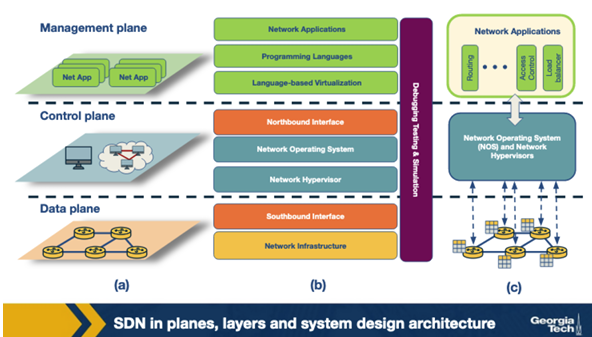
The figure shows three different ways to view the SDN landscape. Which set names the three views correctly? A. The OSI seven-layer model, the TCP/IP four-layer model, and the legacy ATM cell-switching reference model. B. Physical layout, IP addressing, and routing tables. C. BGP topology, DNS hierarchy, and TLS handshake. D. A plane-oriented view, a layers view (infrastructure/control/application), and a system-design perspective.
D. A plane-oriented view, a layers view (infrastructure/control/application), and a system-design perspective. Why: Three views: plane-oriented, layered, system-design. The lesson decomposes the SDN landscape from three angles — control/data planes, infra/control/application layers, and the broader system-design considerations.
In the OpenFlow-derived SDN data plane, each flow-table entry has three parts. Which set is correct? A. A source MAC address, a destination MAC address, and a VLAN tag used as the entry's match key. B. A matching rule, actions to execute on matching packets, and counters for statistics. C. A timeout, a priority, and an encryption key. D. A parser, a deparser, and a control program.
B. A matching rule, actions to execute on matching packets, and counters for statistics. Why: Match + actions + counters. An OpenFlow flow entry is (matching rule, action list, counters) — counters give per-flow stats, actions specify forward/drop/modify, and the rule defines the header pattern.
A single OpenFlow device can have multiple flow tables forming a processing PIPELINE, with each table either matching a packet or passing it onward. True or False?
True. Why: Multi-table pipelines forward through stages. Modern OpenFlow exposes multiple flow tables; each stage matches/acts and can pass packets to the next table — enabling clean separation of L2/L3/ACL logic.
OpenFlow defines three categories of information that forwarding devices send to the controller. Which is NOT one of them? A. Packet messages (PacketIn — when a device does not know what to do with a flow). B. Event-based messages (e.g., link/port state change). C. Flow statistics (counters per flow). D. BGP update messages exchanged between border routers.
D. BGP update messages exchanged between border routers. Why: BGP UPDATE is NOT one of OpenFlow's three info sources. OpenFlow's switch-to-controller messages are PacketIn (unknown flow), events (link/port up/down), and statistics (per-flow counters).
Which statement BEST characterizes OpenFlow's role in the SDN architecture, as described in the module? A. OpenFlow is a southbound API/protocol used by the controller to program the data plane — it is the interface between the control and data planes. B. OpenFlow is a full control plane that runs locally on each switch and replaces the external controller, computing all routing decisions on the switch itself. C. OpenFlow is a forwarding fabric used in place of Ethernet at the data plane. D. OpenFlow is a management-plane SNMP replacement for legacy network monitoring.
A. OpenFlow is a southbound API/protocol used by the controller to program the data plane — it is the interface between the control and data planes. Why: OpenFlow = southbound protocol (controller
Consider an SDN application that wants to continuously monitor link utilization for QoS adjustments. Which of OpenFlow's three info sources fits BEST, and why? A. PacketIn — every monitored packet must be sent up to the controller so utilization can be measured. B. Flow statistics — they continuously expose per-flow byte/packet counters that the controller can read on demand without per-packet involvement. C. Event-based messages — link utilization is computed only when a link goes up or down. D. BGP UPDATE messages — utilization is encoded in BGP UPDATE counters by convention.
B. Flow statistics — they continuously expose per-flow byte/packet counters that the controller can read on demand without per-packet involvement. Why: Flow statistics => per-flow counters, polled on demand. PacketIn would generate too much controller traffic for utilization monitoring; statistics let the controller read byte/packet counts without touching every packet.
Consider a scenario where a packet arrives at an OpenFlow switch and no flow-table entry matches it. Which of these BEHAVIORS is consistent with what the lesson describes? A. The switch must always forward to the controller; dropping on miss is never permitted by the spec. B. The switch must always drop the packet immediately, with no exception. C. Either dropping the packet OR encapsulating it and forwarding to the controller — both are valid outcomes depending on configured actions. D. The switch must broadcast the packet on every port to discover routes.
C. Either dropping the packet OR encapsulating it and forwarding to the controller — both are valid outcomes depending on configured actions. Why: Miss policy: drop OR PacketIn to controller (per config). The action on a table-miss is configurable; common defaults send the packet to the controller (slow-path discovery) or just drop it.
A centralized SDN controller architecture has what main characteristic, as described in the module? A. It uses BGP as the southbound API by default. B. Multiple controllers vote on every packet to decide each forwarding rule democratically, and a majority quorum must agree before any rule is installed. C. It eliminates the southbound interface by pushing all logic into switch hardware. D. A single entity manages all forwarding devices — simple in design, but a single point of failure and potentially a scaling bottleneck.
D. A single entity manages all forwarding devices — simple in design, but a single point of failure and potentially a scaling bottleneck. Why: Centralized = one entity manages everything (simple but SPOF). Easiest architecture to reason about, but the single controller is a single point of failure and a scaling ceiling.
Which two properties are emphasized for DISTRIBUTED SDN controllers? A. Weak consistency semantics across instances and fault tolerance. B. Strict serializability and zero-copy I/O. C. Hardware encryption and BGP federation. D. VLAN tagging and MPLS labeling support.
A. Weak consistency semantics across instances and fault tolerance. Why: Distributed controllers => weak consistency + fault tolerance. Spreading control across instances trades strict global consistency for availability and load distribution; the controller designer picks the consistency model.
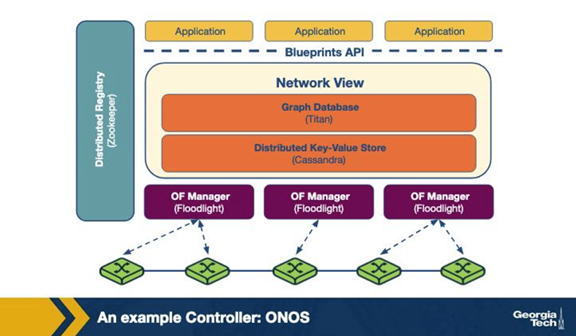
In the ONOS figure, how is each switch associated with controller instances? A. Each switch connects to exactly one ONOS instance and cannot fail over without manual operator intervention. B. Each switch connects to multiple ONOS instances; one acts as master, and on master failure a consensus election picks a new master. C. Each switch is its own controller; ONOS is only a telemetry collector for the operator. D. Switches connect to all instances simultaneously and any instance can write rules at will.
B. Each switch connects to multiple ONOS instances; one acts as master, and on master failure a consensus election picks a new master. Why: ONOS: each switch has multiple instances + ONE master (consensus). One master writes at a time; remaining instances stand by and elect a new master if the current one fails.
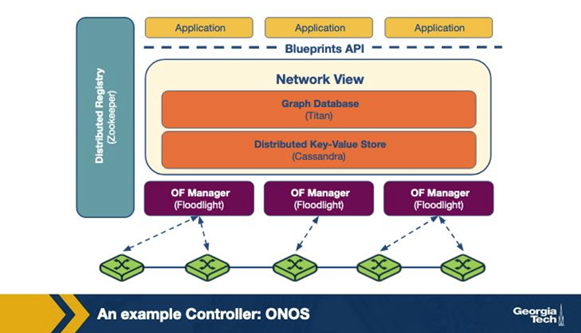
Scenario from the ONOS figure: an ONOS instance crashes while serving as master for several switches. What happens next? A. Switches automatically promote themselves to local-controller mode and re-converge with the wider AS later. B. All switches whose master died are stranded until the operator restarts the dead instance manually. C. The remaining connected instances run a consensus election (e.g., via ZooKeeper) and pick a new master for each affected switch. D. ONOS hands master responsibilities to the IXP's route server temporarily for those switches.
C. The remaining connected instances run a consensus election (e.g., via ZooKeeper) and pick a new master for each affected switch. Why: Consensus election (ZooKeeper-style) picks new master per orphaned switch. When a master dies, the surviving instances run a Paxos/Raft-style election; affected switches gain a new master without operator intervention.
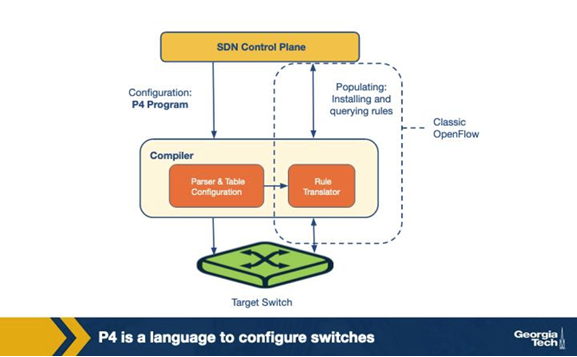
What does the figure motivate that OpenFlow alone does NOT enable? A. Authentication of every packet at the network layer. B. Switching at line rate — the claim that OpenFlow switches cannot forward fast enough without P4 accelerating each match+action stage in hardware. C. Persistent connections between controllers and switches. D. Programmability of the switch itself — defining the parser and the set of match+action stages, not just filling in rules in a fixed pipeline.
D. Programmability of the switch itself — defining the parser and the set of match+action stages, not just filling in rules in a fixed pipeline. Why: P4 programs the SWITCH ITSELF (parser + pipeline). OpenFlow only fills in rules in a fixed pipeline; P4 lets you DEFINE the pipeline — what headers exist, in what order they're parsed, what stages run.
How does the module describe the relationship between P4 and OpenFlow? A. P4 configures the switch programmatically (parser + match+action tables); OpenFlow populates rules into a fixed-function pipeline — they are complementary. B. P4 is a replacement for all southbound APIs that eliminates the need for any controller, because each switch compiles and runs its own control logic independently. C. P4 is a control-plane routing protocol like BGP layered on top of OpenFlow. D. OpenFlow compiles down to P4 bytecode and runs only on legacy hardware.
A. P4 configures the switch programmatically (parser + match+action tables); OpenFlow populates rules into a fixed-function pipeline — they are complementary. Why: P4 (configure programmable pipeline) + OpenFlow (populate rules) are complementary. They live at different layers: P4 defines the data-plane program; OpenFlow (or its successors) installs runtime entries into the resulting tables.
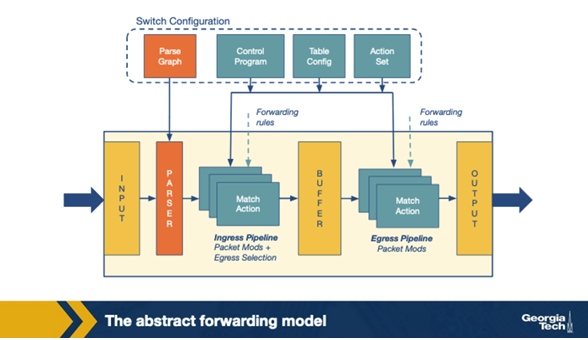
The figure separates two classes of operations in P4. Which pair is correct? A. Compile and Link, like a general-purpose language toolchain that builds an executable before loading it onto the switch. B. configure (program parser and order of match+action stages) and populate (add/delete entries in those tables). C. Encrypt and Decrypt, for line-rate IPsec. D. Advertise and Withdraw, like BGP UPDATE messages.
B. configure (program parser and order of match+action stages) and populate (add/delete entries in those tables). Why: Two ops in P4: CONFIGURE (program) + POPULATE (entries). Configure changes the parser/pipeline definition; populate fills entries into already-defined match+action tables.
Which set of P4's design properties is identified by the lesson? A. Encryption, signing, and key rotation. B. Reliability, integrity, and confidentiality — the three security guarantees that P4 enforces in the data plane by signing and encrypting each packet at line rate. C. Reconfigurability (the switch can be reprogrammed), protocol independence (no fixed parser), and target independence (one program runs on different hardware targets). D. Compression, deduplication, and rate-limiting.
C. Reconfigurability (the switch can be reprogrammed), protocol independence (no fixed parser), and target independence (one program runs on different hardware targets). Why: P4 design properties: reconfigurable + protocol-independent + target-independent. The switch can be reprogrammed at runtime, the parser isn't tied to fixed protocols, and the same program compiles to multiple hardware targets.
P4 lets the same control program describe how a switch parses packets AND how it processes them through match+action tables. True or False?
True. Why: P4 = parse + process in one program. The language describes both how to parse arriving packets (extracting headers) AND how match+action tables operate on those headers.
What is the role of SDN applications in the SDN architecture? A. They are the network-control programs that operators write on top of the northbound API to express policies (routing, security, traffic engineering, etc.). B. They are simply the data-plane match+action tables under a new name, compiled directly into switch silicon with no northbound API or controller involvement. C. They run inside the switches' silicon and have no controller involvement. D. They are end-user mobile apps that download bandwidth from the controller.
A. They are the network-control programs that operators write on top of the northbound API to express policies (routing, security, traffic engineering, etc.). Why: SDN apps = network-control programs on northbound API. Routing, security, TE, monitoring — all expressed as programs that read controller state and install policy through the controller's northbound API.
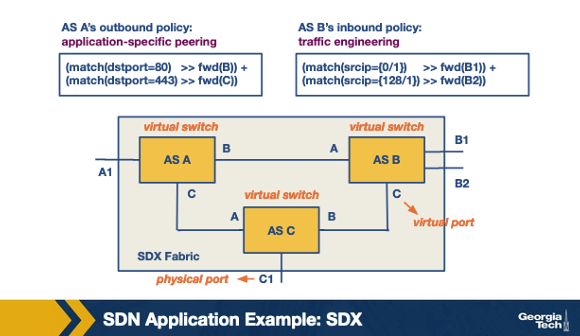
In the SDX architecture figure, each AS sees the illusion of its own virtual SDN switch connecting it to every other participant. Why is this abstraction useful? A. It eliminates BGP entirely from the Internet because each AS's virtual SDN switch replaces AS-level routing, so participants no longer exchange any route advertisements at the exchange point. B. Each AS can define its own forwarding policies (inbound and outbound) as if it were the sole participant; the SDX merges all participants' policies into a single physical-switch policy. C. Every AS sees the same policy as every other, removing per-AS customization. D. All participants share a single anycast IP for every advertised service.
B. Each AS can define its own forwarding policies (inbound and outbound) as if it were the sole participant; the SDX merges all participants' policies into a single physical-switch policy. Why: SDX virtual-switch abstraction: each AS writes policies as if alone. The SDX hides composition complexity: each participant reasons locally about its own policy, and the SDX merges all participants' policies into a coherent shared switch.
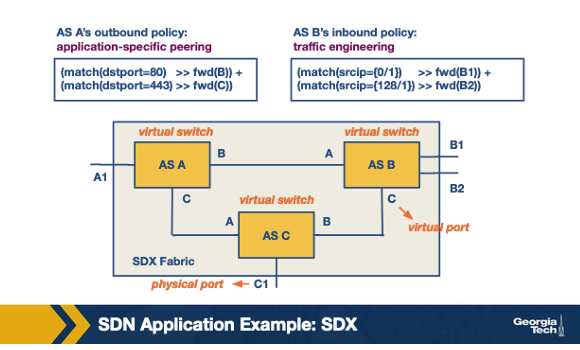
Consider this Pyretic policy from the SDX section: (match(dstport=80) >> fwd(B)) + (match(dstport=443) >> fwd(C)). A packet arrives with destination port 22 (SSH). What does the parallel operator '+' do? A. The packet is forwarded to B because B is listed first. B. The packet is forwarded to BOTH B and C in parallel, since '+' duplicates every arriving packet to all listed forwarding actions. C. The packet is dropped — '+' returns the combined output of all sub-policies, and neither sub-policy matches port 22. D. The packet is sent to the controller via PacketIn for resolution.
C. The packet is dropped — '+' returns the combined output of all sub-policies, and neither sub-policy matches port 22. Why: Pyretic '+' = parallel composition; no sub-policy matches => drop. The parallel operator combines outputs of multiple policies on the same packet; if no sub-policy matches, the combined output is empty so the packet is dropped.
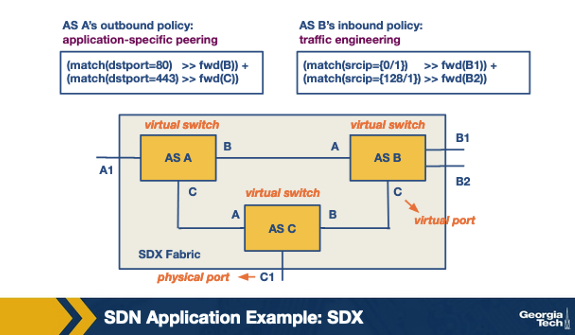
Scenario: an SDX participant AS A writes the policy 'match(dstport=80) >> fwd(B) + match(srcAS=AS_X) >> fwd(C)'. Another participant AS D writes 'match(dstport=80) >> fwd(E)'. How does the SDX combine these conflicting outbound policies for port 80? A. SDX rejects both policies and forces the participants to use traditional BGP for port-80 traffic. B. The SDX drops every port-80 packet because A and D conflict on the destination port, and the exchange refuses to install two policies that match the same field until the participants manually resolve the collision through BGP. C. Only the first-installed policy wins; A or D loses depending on installation order. D. The SDX merges all participants' policies into one physical-switch policy, respecting per-participant ownership of each sub-policy — A's port-80 rule directs A's outbound flows, D's port-80 rule directs D's outbound flows.
D. The SDX merges all participants' policies into one physical-switch policy, respecting per-participant ownership of each sub-policy — A's port-80 rule directs A's outbound flows, D's port-80 rule directs D's outbound flows. Why: SDX composes per-participant policies into one master policy (per-participant ownership). Each participant's rules apply to its own traffic; the SDX's policy compiler merges them into a single switch policy while respecting ownership of sub-policies.
SDX combines per-participant policies into ONE master policy installed on the shared switching fabric, while still letting each participant reason about its own policy locally. True or False?
True. Why: SDX merges participants' policies; each still reasons locally. The participant writes its policy as if alone; SDX handles composition and conflict resolution into the underlying physical switch fabric.
What is the main motivation for SDN-based wide-area traffic delivery (e.g., across a backbone)? A. Operators can centrally plan traffic engineering — directing flows across multiple backbone paths based on global utilization and policy — instead of relying on per-router heuristics. B. Wide-area links are too slow for distributed routing protocols to converge, so SDN is needed because only a central controller can run BGP fast enough across a long-haul backbone. C. SDN enables every backbone link to run at higher line rate than non-SDN equivalents. D. Wide-area SDN replaces BGP entirely on the public Internet.
A. Operators can centrally plan traffic engineering — directing flows across multiple backbone paths based on global utilization and policy — instead of relying on per-router heuristics. Why: Central TE planner uses global utilization view. Traditional networks rely on per-router heuristics (OSPF weights); central TE can solve the whole-network optimization (LP) using a fresh global view of link loads.
Scenario: an SDN traffic-engineering app sees that ONE backbone link is at 95% utilization while a parallel link is at 30%. What can it do that's HARDER in traditional networks? A. Install new OSPF link weights at every router simultaneously by physically replacing the line cards, which lets a traditional network shift load faster than any SDN controller could. B. Programmatically install rules to shift some flows to the under-utilized link based on a global view — without waiting for slow distributed routing protocols to react. C. Run BGP on every backbone router twice as fast. D. Pre-program every host on the network with a load-aware sender.
B. Programmatically install rules to shift some flows to the under-utilized link based on a global view — without waiting for slow distributed routing protocols to react. Why: Programmatically shift flows to under-utilized links — distributed protocols can't react fast enough. Centralized TE installs new flow rules immediately; OSPF/ISIS would have to re-converge through their own timers and bandwidth.
Wide-area SDN deployments (e.g., Google's B4) demonstrated that centralized traffic engineering can sustain much HIGHER link utilization than traditional shortest-path routing. True or False?
True. Why: B4 demonstrated 90%+ link utilization via centralized TE. Google's WAN runs near full utilization by centrally planning flows across multiple paths — far above the 30-40% typical of shortest-path WANs.