Kaylas Blind Insertion Airway review Lab quiz 2
 Call Kai
 Learn
Learn Practice Test
 Spaced Repetition
 Match
Match Flashcards
 Knowt Play
1/29

There's no tags or description
Looks like no tags are added yet.
Name | Mastery | Learn | Test | Matching | Spaced | Call with Kai | Chat |
|---|
No analytics yet
Send a link to your students to track their progress
30 Terms
what year did blind insertion airways become prominent in EMS
80’s
what is the goal of blind insertion airways
bridge the gap between respiratory arrest and airway management when endotracheal intubation is not possible
what do blind inserrtion airways do for the patient
provide quick access, easy to secure patients airways and ventilate their lungs
What are the benefits of blind insertion airways
indirect route to the trachea / lungs
protects the airway
improves ventilation
limits gastric distension
connection for end tidal CO2 monitor
Emergency airways in case of failed endotracheal intubation
In procedure of blind insertion airways how do you confirm correct placement
check make sure chest wall rise is symmetrical, auscultation of equal breath sounds over the chest and lack of epigastric sounds : noises, clicks, gurgles
what is the procedure for blind insertion airway
open oxygen tank, fill oxygen in bag valve, insert tube
confirm its appropriately placed in the patient by looking for symmetrical chest rise, auscultation of equal breath sounds and lack of gurgling with bag valve mask ventilation and capnography if available.
secure devide
document the time, provider, provider level and success of the procedure
complete all airway confirmation fields cehst rise, bilateral equal breath sounds, absense of epigastric sounds or end tidal Co2 readings
reassess placement of tube frequently especially after patient moves
what are the complications of blind insertion airways
initial misplacemnt
dislodgement : was in correct place but then moved
Patient will die if misplacement is unrecognized. they can also have trauma to the airway like bleeding or swelling
Airway anatomy: Nasopharynx, Oropharynx, Larynopharynx. What parts are in each section
Nasopharynx: hard palate, soft palate
Oropharynx: tonsil, tongue
Laryngopharynx: epiglottis, vocal cords

look at this
General procedures for blind insertion airways
uPrepare equipment (including suction)
uBody substance isolation including mask, eye shield
uPre-oxygenate patient
uPosition head
uOpen airway with jaw lift
uPass device
uInflate cuff and immediately disconnect syringe
uVerify correct tube placement by at least 2 methods
uSecure tube with a commercially prepared device
uReassess placement after any patient lifting/moving
what are the different blind insertion airway devices for EMTs
King LTD or LTSD : MGregror uses it , i gel: lee fire department uses it , Air Q
what is the equipment used for blind insertion airways
Suction device with FR suction catheter, BVM, O2,EtCO2 if available
what is the insertion procedure
uPlace the patient in a supine position
uVentilate via BVM and pre-oxygenate the patient with 100% oxygen prior to device insertion
what do you need to verify during blind insertion airways
uDuring ventilation observe end-tidal CO2 monitor and pulse oximetry to confirm adequate ventilation, oxygenation


Gel airways
have rapid, easy insertion, their is not inflatiion or syringes required
can be prone to unseating because they dont have baloons in place to keep the pressure secreated
take a little more riske using an I gel tube than a King tube
what are the mutliple methods to verify airway placement
equal chest rise
bilateral lung auscultation
Negative auscultation of ABD
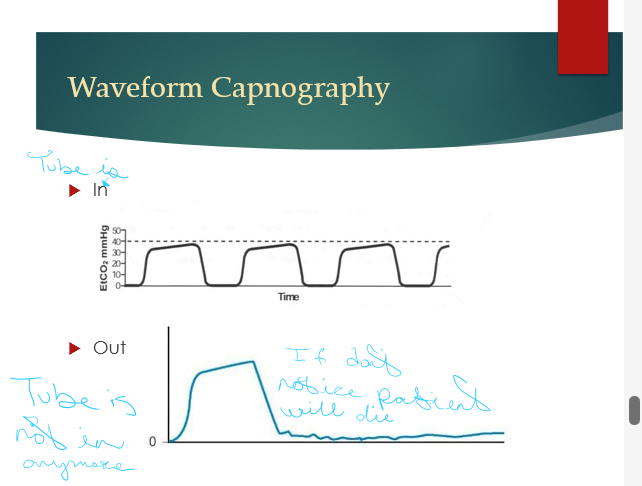
ETCO2 wave form
what is a gold standard for verifying airway confirmation
capnography
true or false: do not ventilate stomach if you have good capnography wave form
true
what is capnography
its a continuous, non invasive measurement and graphical display of CO2 in exhaled breath


airway displacement
uEven if secured properly at the lips, tube movement up to 2 cm can occur at distal end
u
uThis is enough to displace your tube!
u
uUse continuous EtCO2 monitoring
u
uReassess tube placement after any significant movement of patient
uPt. to stretcher, loading / unloading stretcher from ambulance, etc.
Ventilation rates are how many breaths per minute depending on pt. age
10-12
how many ml is tidal volume
400-500ml
dont squeeze entire bag : 1500 mL : can over inflate the lungs
why do you want smaller tidal volumes when ventilating patient
Due to better access to lungs and 100% supplemental oxygen
watch chest rise don’t over inflate
excessive tidal volumes lead to increased intrathoracic pressure and decreased blood flow
Do not let go of BVM and let it drag on the tube you will traumatically extubate the patient
Keys to Success
uPreparation of equipment
uHave everything ready, including EtCO2, suction, tube tamer
u
uPosition yourself and patient
u
uAssess, Re-assess, Re-re-assess
u
uPRACTICE, PRACTICE, PRACTICE!