AP Bio Unit 1 Exam Review
 Call Kai
 Learn
Learn Practice Test
 Spaced Repetition
 Match
Match Flashcards
 Knowt Play
1/103

There's no tags or description
Looks like no tags are added yet.
Name | Mastery | Learn | Test | Matching | Spaced | Call with Kai | Chat |
|---|
No analytics yet
Send a link to your students to track their progress
104 Terms
Covalent Bonds
Two or more atoms share electrons (nonmetals)
Nonpolar Covalent
Electrons equally shared
Polar Covalent
Electrons NOT equally shared
Ionic Bonds
Transfer of electrons from one atom to another forming ions
Ionic bonds are between_____
oppositely charged atoms (usually metal and nonmetal)
Cation v. Anion
Cat - pos
An. - neg
Hydrogen Bonds
partially positive hydrogen atom in one polar covalent molecule will be attracted to an electronegative atom in another polar covalent molecule
NH2
Amino Group (N-Terminus)
Position needed for a peptide bond to form:
Amino group must be next to the carboxyl group of another amino acid
What codes for proteins?
DNA
Elements in proteins
CHON (S)
monomers of proteins
amino acids
polymers of proteins
polypeptide chains
How are polypeptide chains different from proteins?
Polypeptides are chains of amino acids BEFORE they are folded into proteins
What differs between each amino acid?
Variable side chain (R)
nonpolar amino acids are
hydrophobic
polar amino acids are
hydrophilic
charged/ionic amino acids are
hydrophilic
what determines the shape and function of the protein?
The interaction between side chains
carbs monomers
monosaccharide
elements of carbs
CHO
carbs polymer
polysaccharide
lipids elements
CHO
Lipids monomers
Glycerol & Fatty Acids
Polymer of lipids
NO TRUE POLYMER
elements of nucleic acids
CHONP
monomer of nucleic acids
nucleotide
polymer of nucleic acids
polynucleotide (DNA & RNA)
Function of proteins
antibody
enzyme
messenger
structural
transport/storage
Primary protein structure
Linear chain of amino acids dictates secondary and tertiary forms
primary protein structure is determined via____
genes
Secondary protein structure
coils and folds due to hydrogen bonding within the polypeptide backbone
Beta pleated sheet (secondary)
hydrogen bonds between polypeptide chains lying side by side

Alpha helix (secondary)
Hydrogen bonding between every 4th AA

Tertiary protein structure
3D folding due to interactions between side chains of AAs
tertiary structure is reinforced by_____
hydrophobic interactions, hydrogen bonds, ionic interactions and disulfide bridges of the side chains
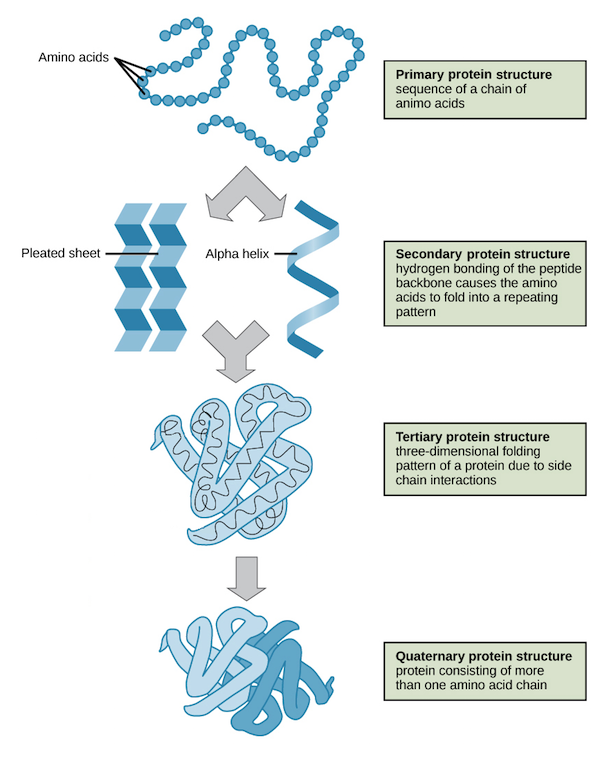
Quaternary protein structure
Association of two or more polypeptides
True or false: Quarternary protein structure is found in every protein
FALSE: only some proteins have this level
Amino group
N-Terminus

Carboxyl group
C-Terminus
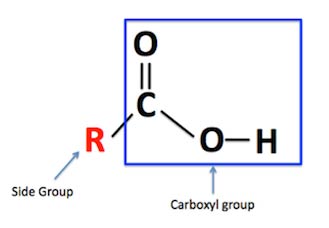
Peptide bonds are formed through______
Dehydration synthesis
HCO2
Carboxyl group (Proteins)
Base pairing is possible because of ______
Hydrogen Bonds
Cat-Gato
Cytosine bonds to Guanine
Tree-Arbol
Thymine bonds to Adenine
The more hydrogen bonds in the base pair, the ______ it is
Stronger
Deoxyribose
No oxygen under the second carbon sugar
Bond that holds nucleotides together
Posphodiester linkages
In RNA, what does adenine bond to?
Uracil
what links adjacent nucleotides
phosphate groups
Sequences of bases along DNA or mRNA dictates ______
primary structure of protein which then dictates 3D structure
DNA has ____ polynucleotides
2 (double helix)
Antiparallelism in DNA
5’ end and opposite side is 3’ end
Pyrimidines
one ring with 6 atoms (4 carbon & 2 Nitrogen)
Purines
2 rings
a phosphate group added to the ___ carbon of the sugar to form a nucleotide
5’
3 parts of nucleotide
Nitrogenous base
Five carbon sugar (pentose)
phosphate group (each monomer only has one phosphate group in polynucleotides)
Do lipids have polymers?
NO TRUE POLYMER OF LIPIDS
Types of lipids
Fats
Phospholipids
Steroids
Cholesterol
Fats are composed of_____
Glycerol and fatty acids
Glycerol
alcohol (hydroxyl groups)
Fatty acids
carbon chains (carboxyl group at one end)
___fatty acids join to a glycerol via ____
ester linkage (bond between hydroxyl and carboxyl group)
Saturated fatty acid have____
single bonds between carbons in the carbon chain (more hydrogen)
Unsaturated fatty acid
One or more DOUBLE bonds (fatty tails form kinks)
why are some unsaturated fatty acids more liquid @ room temp than others?
They have more DOUBLE bonds
Phospholipids
two fatty acids attached to a glycerol and a phosphate

Steriods have ___ fused rings
4 (unique groups attached to the ring determine the type)
Cholesterol provides
structural stability to ANIMAL cell membranes