PSYC 230 Exam 1
 Call Kai
 Learn
Learn Practice Test
 Spaced Repetition
 Match
Match Flashcards
 Knowt Play
1/201

There's no tags or description
Looks like no tags are added yet.
Name | Mastery | Learn | Test | Matching | Spaced | Call with Kai | Chat |
|---|
No analytics yet
Send a link to your students to track their progress
202 Terms
Early 1800s Cognitive Psychology
mind cannot study itself
1868 - Donders’s Pioneering Experiment
Simple reaction time (RT): how long it takes to respond to a simulus
Choice RT: how long does it take to make a decision?
Choice RT - Simple RT = one tenth of a second
1879 - Wundt’s introspection
describe sensations, first psyc lab
used it as a structured experimental method to study basic elements of conscious experience (observers exposed to stimuli and asked to report immediate mental reactions)
1885 - Ebbinghaus’s Time Course of Forgetting
Learn: DAX, QEH, LUH, ZIF
Delay
Learn again
savings = original learning time - relearning time after delay
plotted savings curve
forgetting occurs rapidly for first 2 days and then levels off
Behaviorism
Early 1900s - Watson, Skinner
can only study psychology through observable behavior
Watson’s classical conditioning
Little Albert Experiment - infant shown various objects and initially showed no fear. eventually researchers paired rat with a loud noise, resulting in infant to be scared of rat even without noise
Early 1900s - Skinner
interested in determining the relationship between stimulus and response (operant conditioning) —> rat learned to press lever to either get food or get rid of electrical shock
1948 - Tolman’s Cognitive Map
behaviorism —> cognitive revolution
trained rats to find find food in a four-armed maze
Group 1: always turned right for reward
Group 2: reward always at location B
Group 2 found reward fastest meaning spatial map developed
1959 - Chomsky
Argued that children do not only learn language through imitation and reinforcement. Language is innate and hardwired into brain from birth.
1967 - Neisser’s first cognitive psychology textbook
focus on vision, hearing and holding information in mind for brief amounts of time
Information Processing Approach
1954: Introduction of the digital computer
transition to the mind being described as processing information through a sequence of stages
changed the framing of research questions and answers
stimulus response —> stages of information processing
Broadbent’s filter of attention
human brain filters out unattended sensory information based on basic physical characteristics before semantic processing occurs
early selection model - filter eliminates unattended information at the beginning of process
Atkinson and Shiffrin’s three-stage model of memory
sensory memory (less than 1 second)
short-term memory (a few seconds, limited capacity)
long-term memory (long duration, infinite capacity
1972 - Tulving
long term memory is not a single unified system but rather divided into separate subsystems (episodic and semantic)
Axon terminal buttons
primary output structures
Dendrites
primary input structures, receive signals
cell body
metabolic center of neuron
Neural circuit
group of interconnected neurons
Receptors
specialized neurons that respond to environmental stimuli (light, touch, physical signals)
Action potentials
electrical signals that transmit neural information down a neuron’s axon, initiating at the axon hillock
allow for communication between neurons
~1 millisecond
cause the release of neurotransmitters at the synapse
all or none principle - all action potentials are of the same strength
How is information transmitted
chemical signals (neurotransmitters)
electrical signals (nerve impulse/action potential)
Different brain areas
Single Cell Recording
recording the activity (firing) of a single neuron by inserting a microelectrode
Pros: minimizes confounding variables
Cons: invasive
Electroencephalogram (EEG)
recording the brain’s electrical activity through electrodes on the scalp
good at recording info as it occurs
not good at interpreting where info occurs
challenging for people with thick hair (can’t apply electrodes to scalp)
Event related potentials (ERP)
EEG applied to specific events/stimuli of interest
Magnetic Resonance Imaging (MRI)
used to examine brain structure
MRI scanner creates strong magnetic field
relies on the magnetic properties of hydrogen atoms in brain matter
magnet causes them to orient one way
radiofrequency current is delivered causing them to spin and then snap back to their orientation
causes a release of energy that is measured by the scanner and can be used to produce the image
fMRI
used to examine brain function
relies on the magnetic properties of hemoglobin, a molecule in the blood that carries oxygen
BOLD signal
BOLD signal
blood oxygen level dependent signal
indirect measure of neural activity
measures amount of deoxygenated hemoglobin in various areas
more deoxygenated hemoglobin = more oxygen consumption by that area of the brain = more neural activity
Why is not everyone eligible for an MRI scan?
dental and oral devices
pumps and shunts
cardiovascular devices
cosmetics and accessories (mascara, metallic hair dye)
Neuropsychology
studying people with brain damage (lesions)
Double dissociation
disadvantage: case study based; difficult to generalize
Double dissociation
patient 1 with damage to region A
can do task x
cannot do task y
patient 2 with damage to region B
cannot do task x
can do task y
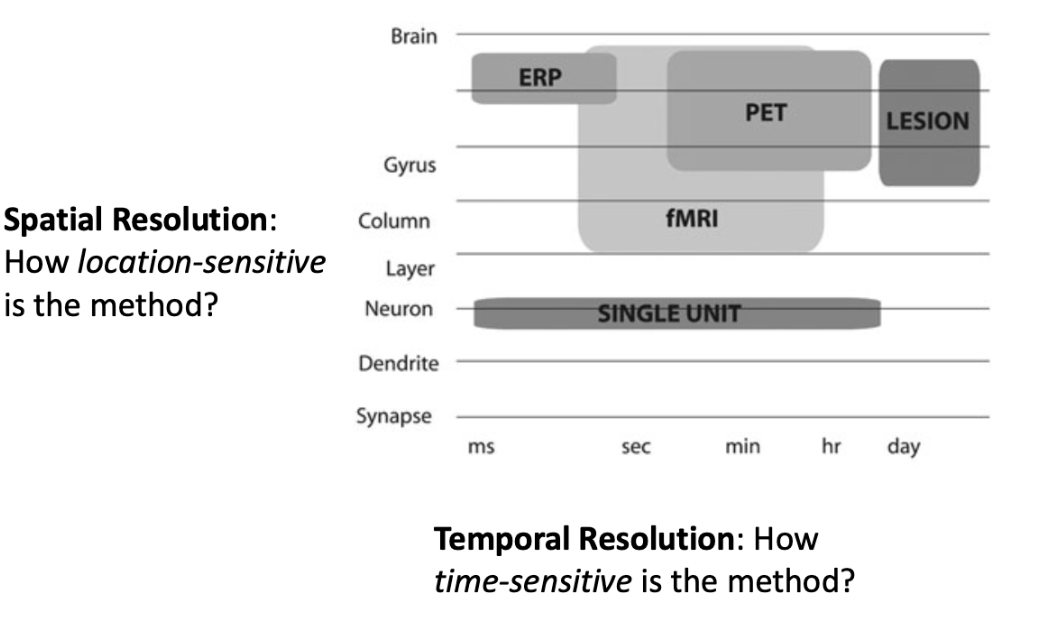
Temporal and spatial resolution in each method
Hubel and Wiesel
some neurons respond to specific stimulus features such as orientation, movement, and length
Blakemore and Cooper
experience dependent plasticity: structure of the brain is changed by experience
receptive field - place where you need to be to observe neural activity
specific region of sensory space or input data that can elicit a response from a given neuron
Specificity coding
representation of a specific stimulus by the firing of neurons that respond only to that stimulus
Population coding
representation of a stimulus by the pattern of firing of many neurons
Sparse coding
representation of a stimulus by the pattern of firing in small groups of neurons
Studying neurons in monkeys temporal lobes
demonstrates population coding (not 1:1 neuron to stimulus organization) where each stimulus activates a distributed pattern across many neurons and each neuron responds to multiple different stimuli
Broca’s area
area in frontal lobe associated with langugae production
broca’s aphasia: slow, labored, ungrammatical speech
fully intact comprehension
Wernicke’s area
area in temporal lobe associated with language comprehension
wernicke’s aphasia: difficulty understanding language; fluent/grammatical speech that is incoherent
intact production of fluent speech (even if incoherent)
Prosopagnosia
damage to lower right temporal lobe (FFA)
inability to recognize faces
Frontal Lobe
receives signals from all senses
thinking/decision making
problem solving
Somatosensory cortex
parietal lobe; touch, pressure, pain
Fusiform face area
inferior (underside) temporal lobe
localized area for faces
Parahippocampal place area
medial (middle) temporal lobe
localized area for places
extrastriate body area
lateral (outer) temporal lobe
localized area for body parts
Huth et al. Movie Clip Experiment
duplicates were played to eliminate fMRI noise so that brain activity could be averaged.
human brain maps language and meaning continuously across the entire cerebral cortex —> brain also organizes information by meaning where region of brain lights up for similar concepts grouped together
Memory Localized vs Distributed Function
Short term memories vs long term memories
Episodic memory vs semantic memory
Language Localized vs Distributed Function
multiple language pathways
not just broca’s/wernicke’s areas
Looking at a face Localized vs Distributed Function
emotional expression; attention/gaze direciton; attractiveness; familiarity
Neural network
interconnected areas of the brain that communicate with one another
Structural connectivity
“wiring” of the brain
which brain regions are structurally connected via axons
Functional connectivity
which brain regions are involved in the same cognitive processes?
extent to which the neural activity in two brain regions is correlated
Visual network
vision; visual perception
Somato-motor network
movement and touch
Dorsal attention network
attention to visual stimuli and spatial locations
Executive control network
higher-level cognitive tasks involved in working memory and directing attention during tasks
Salience network
attending to survival-relevant events in the environment
Default mode network
mind wandering, and cognitive activity related to personal life-story, social functions, and monitoring internal emotional states
Sensory Receptor Cells
cells that begin the transmission of information about external stimuli up to the brain via nerve signals
Vision Perception
receptors; photoreceptors (rods and cones)
stimulus: light waves
location: back of retina
Hearing Perception
receptors: hair cells (inner and outer)
stimulus: vibration
location: organ of Corti (inner ear)
other hair cells in other parts of the inner ear contribute to balance
Taste Perception
receptors: taste receptors with microvilli
stimulus: chemicals
location: taste buds on tongue
Smell Perception
receptors: olfactory receptors with cilia
stimulus: odorants
location: roof of nasal cavity
Touch Perception
receptors: mechanoreceptors
stimulus: physical change (touch, pressure, vibration)
location: skin
skin also has thermoreceptors (temperature) and nociceptors (pain)
Nature of Perception
often rapid and effortless
can utilize perceptual rules about the environment (gravity, continuation)
not always effortless
sometimes there is initial uncertainty about what we are perceiving
perception can change with additional information
can involve a reasoning process
Inverse projection problem
a particular shape on the retina can be created by an object at various orientations and/or distances
reliance on finer detail/characteristics for similarly shaped objects
Viewpoint invariance
ability to recognize objects from different viewpoints
How can we form all these perceptions?
mix of current sensory experience and prior knowledge
Bottom up processing
processing that is driven by information received by the receptors
starts with stimulus itself
Top down processing
processing that is driven by a person’s knowledge or expectations
starts with prior knowledge/expectation
Speech Segmentation
ability to tell when one word in someone’s speech ends and the next one begins
top down processing allows for knowledge of language to affect perception
Statistical learning
learning the probabilities that one sound will follow another in a language
pretty baby (pre and ty more likely to be in same word than ty and ba)
Saffran et al. - infant language study
infants demonstrated top down processing via statistical learning
bi was always followed by da which was always followed by ku —> bidaku easily perceived as a word
Helmholtz’s Theory of Unconscious Inference
likelihood principle
occurs by unconscious inference
perception as problem solving
Likelihood principle
we perceive the object that is most likely to have caused the pattern of stimuli we have received
occurs by unconscious inference
unconscious inference
unconscious assumptions, or inferences, we make about the environment
Perception as problem solving
problem is solved through applying one’s knowledge of the environment to infer what the object might be
perception occurs rapidly and unconsciously — seems instantaneous
Gestalt Principles of Perceptual Organization
wanted to understand the intrinsic principles governing perception
goal to explain the way elements are grouped together to create larger objects/concepts (proposed a set of principles of perceptual organizations)
structuralism (whole is a sum of its parts) —> Gestalt (whole is different than the sum of its patrts)
experience can influence perception but is not the key driver, minor compared to intrinsic “built in” principles
Apparent movement
illusion of movement when stimuli in different locations are flashed back-to-back
Principle of Good Continuation
points that follow a straight or smoothly curving line are seen as belonging together, and the lines are seen as following the smoothest path
objects that are overlapped by other objects are perceived as continuing behind the overlapping object
Law of Pragnanz
law of good figure/simplicity
every stimulus pattern is seen in such a way that the resulting structure is as simple as possible
Principle of similarity
similar things appear to be grouped together
tend to group objects with similar properties (e.g. color, shape, texture)
Law of Proximity
objects that are positioned close to one another are often seen not as separate parts, but rather as one coherent whole
Law of common fate
leads us to group together objects that move in the same direction
Principle of common region
elements that are within the same region of space are grouped together
Oblique effect
vertical and horizontals are more easily perceived than other orientations (slanted)
Life-from-above assumption
unconscious mental shortcut where human brain assumes illumination comes from overhead
Interposition
when one object partially covers another, the covered object comes out from the other side
Scene schema
a person’s knowledge about what is likely to be contained in a particular scene
ex) fastest to perceive bread in a kitchen
Bayesian Inference
probability of an outcome is determined by
the prior probability: initial belief about the probability of an outcome
the likelihood: extent to which available evidence is consistent with the outcome
ex) perceiving page on textbook —> use prior knowledge that books are rectangular and use bottom up processing stimuli to arrive to conclusion
Gestalt vs other approaches
Gestalt: perception is influenced by intrinsic organizational laws and principles (innate)
bottom up approach
Helmholtz’s likelihood principle, regularities in the environment, bayesian inference: perception is influenced by our prior knowledge
top down approach
possible that we could have learned gestalt principles from experience
Faces vs Greebles
fMRI study looking at activation in FFA
greeble novices vs greeble experts
greebles - beings that have same basic configuration but differ in shapes/sizes of their parts
found that FFA is not exclusively wired for human faces (can be trained to recognize greebles)
Dorsal pathway
where pathway
parietal lobe
action pathway (execute physical movements based on what you say)
Ventral pathway
what pathway
temporal lobe
lateral occipital cortex (LOC)
perception pathway
Ungerleider and Mishkin (1982)
lesioned monkeys’ brains
object discimination task - pick the correct shape, requires intact temporal lobe
landmark discimination task - pick the food well closer to the cylinder, requires intact parietal lobe
Milner and Goodale
patient DF
damage to lateral occipital complex and temporal lobe
could not match postcard orientation (what pathway was impaired)
could mail postcard (where pathway was intact)
could not name or copy object
could draw from memory
Visual agnosia
inability to recognize objects from visual perception alone (but eyes work)
Selective attention
attending to one thing while ignoring others