Phonics and Word Identification
 Call Kai
 Learn
Learn Practice Test
 Spaced Repetition
 Match
Match Flashcards
 Knowt Play
1/55

There's no tags or description
Looks like no tags are added yet.
Name | Mastery | Learn | Test | Matching | Spaced | Call with Kai | Chat |
|---|
No analytics yet
Send a link to your students to track their progress
56 Terms
Semantic Encoding
processing information by associating it with a story or meaning
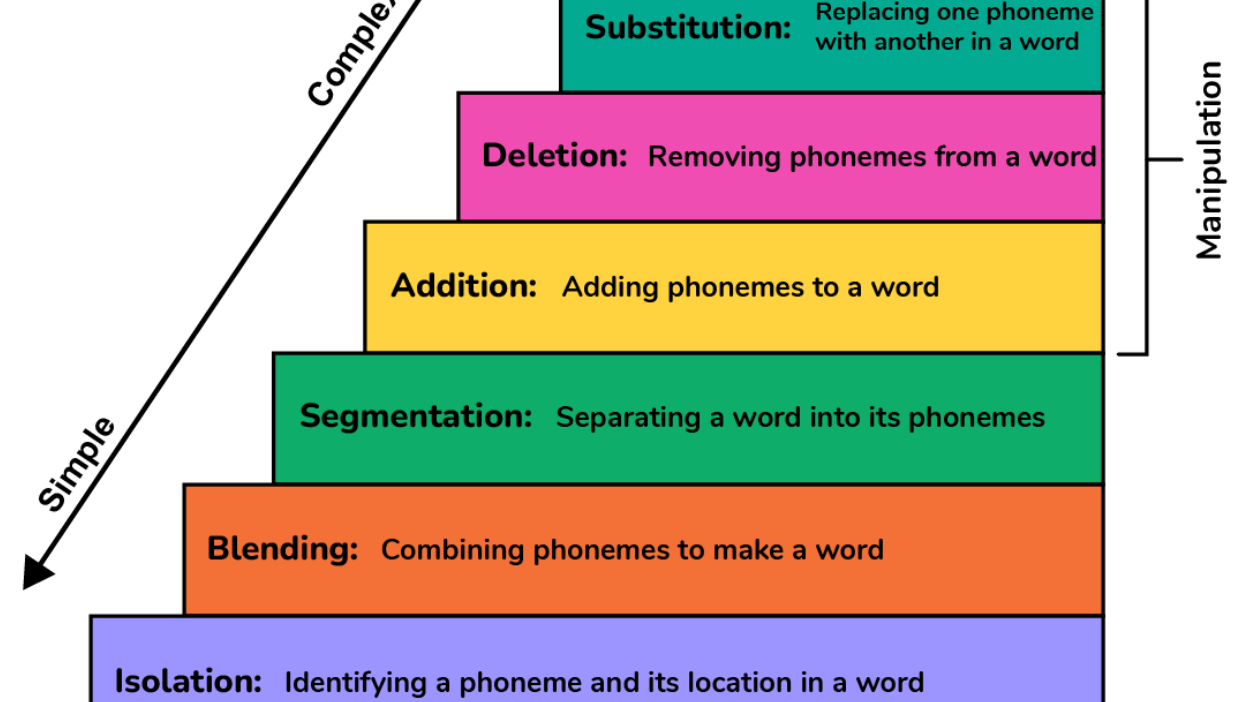
Phoneme Blending
the ability to blend two sounds to make a word
Example
Blend together these sounds to make a word: /b/ /a/ /t/ to form bat.
Closed Syllable
syllable that ends in a consonant; vowel has its short sound
Example
hot, help, dog,
Transitional Spelling
use some conventional spelling but still misspell many irregular words
Word Families
a group of words with a shared ending letter group/sound
Example
back, black, stack, shack, quack, lack, tack
Language Transfer
process that occurs when students who are learning a new language transfer knowledge from L1 to L2
Example
Students use what they know about sentence structure in their native language to help them understand sentence structure in the language they are acquiring.
Multisensory Instruction
engages learners with different modalities
Example
hands-on activities, movement, auditory learning
Phonics
the teaching of how phonemes connect to symbols
Prefix
a letter or letters at the beginning of a root word that changes its meaning
Example
re, de, un
Cognates
also called true cognates; words in two languages that share a similar meaning, spelling, and pronunciation
Example
family-familia; computer-computadora; bicycle-bicicleta
Reading Fluency
ability to read with appropriate speed, accuracy, and prosody
R-Controlled Vowel
a vowel followed by the letter r where the "r" that doesn't make its normal short or long sound
Example
In the word, "tiger," the letter e is an r-controlled vowel, as its pronunciation changes because it is followed by an r.
Etymology
the study of the origin and history of words
Suffix
letter or letters at the end of a root word that changes its meaning
Example
s, es, ed, ing, ly, er, or, ion, tion, able, and ible
Inflectional Affix
an affix that changes the form of the root or base word
Example
The inflectional affix, "ed" changes a verb to the past tense.
Inflection Suffix
also known as "inflectional ending", suffixes that change the meaning of a word by determining tense or quantity: -s, -es, -ing, -ed.
Example
run / running
Phoneme Segmentation
the ability to break down a word into separate sounds, as they say and count each sound
Example
How many sounds are there in the word bug? /b/ /u/ /g/? There are three.
Heart Words Approach
students learn to decode the regular parts while memorizing the irregular; supports decoding skills and reduces rote memorization
Vowel-Consonant-E Syllable
has a silent "e" and makes the vowel before it long; this syllable is usually found at the end of a word
Example
name, mice, cake, compete
Contraction (Semantics)
a shortened version of a word or group of words; the removed letters are replaced with apostrophes
Example
do not becomes don't
Encoding
using individual sounds to spell a word
Example
To encode, a student must represent the sounds of a word with letters. For example, the word cat would be encoded as /c/, /a/ and /t/.
High-Frequency Word
a word that appears often in grade-level text; can be decodable or irregular
Example
Words like "and", "the", "as" and "it" are high-frequency words.
Orthography
the standards present in a language's conventions
Example
spelling, capitalization, punctuation, emphasis
Vowel Team Syllable
syllable that has 2-4 vowels that make a short, long, or unique vowel sound
Example
south, enough
Decodable Word
words that follow regular phonics patterns and can be read by applying letter-sound correspondence rules
Example
For a third grader, words like "family" and "afternoon" are decodable.
Morpheme
a combination of sounds that has meaning in speech or writing and cannot be divided into smaller grammatical parts; this includes prefixes and suffixes
Example
write, cat, laugh, box
Reading Comprehension
the ability to read a text and understand its meaning
Example
Jessie read the book and was able to explain to me why the character lied in Chapter 3.
Phoneme
the smallest individual sounds in a word
Example
The word “bit” has three phonemes – b – i – t.
Word Analysis
breaking down words into morphemes, or the smallest units of meaning
Example
Word analysis can be useful as a decoding tool and can help to determine word meaning.
Phonemic Awareness / Sound Awareness
the ability to hear, identify, and re-create individual sounds in spoken words
Example
A student can hear that /b/ makes first sound in the word blue.
Conventional Spelling
know and use basic spelling rules and spell most words correctly
Diphthong
one vowel sound made by the combination of two vowel sounds
Example
the "ou" in south; the "au" in taught; the "oy" in oyster
Consonant Blend
two or more consonants that blend together when decoded, but each retains its own sound
Example
In the word "blue," the letters b and l form the consonant blend, bl.
Stop Consonant Sound
letters with sounds that cannot be stretched without changing the sound
Example
/t/ is an example of a stop sound, as it cannot be stretched out.
Grapheme
a written letter or a combination of letters that represents a single sound
Example
"ph" makes a "f" sound
Explicit Teaching
the process of teaching by communicating clear expectations and giving specific feedback to students
Precommunicative Spelling
use scribble shapes and sometimes letter-like shapes for spelling words but are unable to make the forms
Automaticity
the ability to read words effortlessly
Environmental Print
the print students encounter in their everyday surroundings
Example
signs, logos, labels
Fry Word List
the 100 most frequently occurring words in the English language
Open Syllable
ends in a vowel; the vowel has its long sound
Example
vacant, brutal, agent
Semiphonetic Spelling
some letter awareness, but unable to use all letters in the word
Example
"Play" is spelled p-a
Final Stable Syllable
consonant + -le syllable occurs at the end of a word.
If the consonant + -le syllable is found next to an open syllable, then the vowel in the open syllable stays long.
If the consonant + -le is next to a closed syllable, the vowel in the closed syllable stays short.
Example
bugle, candle, bubble, circle, and trample
Phonics / Graphophonemic Principle
using the relationship between symbols (letters and words) and sounds of a language to read and write
Continuous Consonant Sound
letters with sounds that can be lengthened or stretched
Example
/s/ is an example of a continuous sound, as it can be held out indefinitely!
Consonant Digraph
two consonants that make a single consonant sound when together in a word
Example
In the word "wish," the letters s and h form the consonant digraph, sh.
Word Web
a form of scaffolding which helps students to understand and retain new words and concepts
Example
During reading, as students encounter each word, they write down around the word different words or phrases that will help them remember the meaning.
Phonetic Spelling
spell the way they hear the word pronounced
Example
"Made" is spelled m-a-d.
Homophones
words that are pronounced the same as another word but have a different meaning and may be spelled differently
Example
carat, carrot, caret: to, too, two
R-Controlled Syllable
syllable that contains a vowel followed by the letter r; the r controls the vowel and changes the way the vowel is pronounced
Example
car, guitar, mother, and manor
Commonly Confused Words
words that have similar meanings, spellings, or pronunciations, leading to confusion during literacy development
Example
new vs. knew; affect vs. effect
Vowel Digraph
two vowels that make a single vowel sound when together in a word, also known as "vowel teams"
Example
the "ai" in paint; the "ee" in need; the "oa" in boat
Multisyllabic Words
words having several syllables or parts into a word can be separated for interpretation
Example
water, tomato, macaroni
Morphological Awareness
an understanding of how words can be broken down into smaller units of meaning, such as roots, prefixes, and suffixes
Example
Morphological awareness plays a key role in learning to read and identify vocabulary in English.
Decoding
in reading out loud, being able to sound out words by breaking them into simple forms; in reading for comprehension, the understanding of how to read each letter or letter pattern in a word to determine the word's meaning
Syllable
a unit of pronunciation that contains one vowel sound with or without consonant sounds
Example
The word motorcycle has four syllables - mo / tor / cy / cle