1 - Fundamental Concepts
 Call Kai
 Learn
Learn Practice Test
 Spaced Repetition
 Match
Match Flashcards
 Knowt Play
1/103

There's no tags or description
Looks like no tags are added yet.
Name | Mastery | Learn | Test | Matching | Spaced | Call with Kai | Chat |
|---|
No analytics yet
Send a link to your students to track their progress
104 Terms
c. Microbiology
[Introduction]
The study of microorganisms
a. Parasitology
b. Public Health
c. Microbiology
d. Immunology
c. Microorganisms
[Introduction]
Very small organisms that can't be seen by the naked eye
a. Parasites
b. Fungi
c. Microorganisms
d. Protozoa
b. Parasitology
[Introduction]
Study of parasites
a. Microbiology
b. Parasitology
c. Immunology
d. Public Health
a. True
[Introduction]
Majority of the PARASITES can be seen by naked eye
a. True
b. False
c. Intimate contact
[Introduction]
Parasites acquire nutrients via _____
a. Photosynthesis
b. Osmosis
c. Intimate contact
d. Diffusion
d. Public Health
[Introduction]
The art and science of preventing disease, promoting health and prolonging health via community effort
a. Parasitology
b. Microbiology
c. Epidemiology
d. Public Health
c. Public health
[Introduction]
CHECK IN ACT:
As a concept, it is defined as “what we as a society do to assure the conditions in which people can be healthy”
a. Microbiology
b. Parasitology
c. Public health
d. Hygiene
d. Hygiene
[Introduction]
Practice that maintains health and prevents spread of diseases
a. Microbiology
b. Parasitology
c. Public Health
d. Hygiene
b. Robert Hooke
[Fundamental Concepts - History]
Scientist credited for cell theory
a. Anton van Leeuwenhoek
b. Robert Hooke
c. Francesco Redi
d. John Needham
c. Anton van Leeuwenhoek
[Fundamental Concepts - History]
First person to visualize a living specimen (his sperm cell) under microscope
a. Robert Hooke
b. Lazzaro Spallanzani
c. Anton van Leeuwenhoek
d. Francesco Redi
d. Anton van Leeuwenhoek
[Fundamental Concepts - History]
Credited for the concept of "animalcules"
a. Robert Hooke
b. John Needham
c. Francesco Redi
d. Anton van Leeuwenhoek
c. Spontaneous generation
[Fundamental Concepts - History]
Theory stating that living cells came from nothing
a. Cell theory
b. Germ theory
c. Spontaneous generation
d. Biogenesis
d. John Needham
[Fundamental Concepts - History]
Proponent of spontaneous generation
a. Francesco Redi
b. Lazzaro Spallanzani
c. Robert Hooke
d. John Needham
Francesco Redi
Lazzaro Spallanzani
[Fundamental Concepts - History]
Opponent of spontaneous generation [2]
b. Biogenesis theory
[Fundamental Concepts - History]
Living cells would arise from pre-existing cells
a. Spontaneous generation
b. Biogenesis theory
c. Cell theory
d. Germ theory
c. Rudolf Virchow
[Fundamental Concepts - History]
Scientist credited with the statement "living cells came from pre-existing cells"
a. Louis Pasteur
b. Jon Tyndall
c. Rudolf Virchow
d. Robert Hooke
d. Louis Pasteur
[Fundamental Concepts - History]
Scientist credited for the "Swan neck/Goose Neck Flask"
a. Rudolf Virchow
b. Jon Tyndall
c. Anton van Leeuwenhoek
d. Louis Pasteur
c. Pasteurization
[Fundamental Concepts - History]
Process developed by Louis Pasteur that uses heat to kill organisms
a. Sterilization
b. Tyndallization
c. Pasteurization
d. Fermentation
c. 63°C × 30 min
[Fundamental Concepts - History]
Temperature and time for home pasteurization
a. 72°C × 15 min
b. 140°C × 4 sec
c. 63°C × 30 min
d. 100°C × 10 min
b. 72°C × 15 min
[Fundamental Concepts - History]
Temperature and time for high temp-short time pasteurization
a. 63°C × 30 min
b. 72°C × 15 min
c. 140°C × 4 sec
d. 100°C × 10 min
d. 140°C × 4 sec
[Fundamental Concepts - History]
Temperature and time for ultra high temp pasteurization
a. 63°C × 30 min
b. 72°C × 15 min
c. 100°C × 10 min
d. 140°C × 4 sec
Mycobacterium bovis
Salmonella spp.
Streptococcus spp.
📌Mnemonic: “MSS”
[Fundamental Concepts - History]
BEQ: Examples of milk-borne pathogens [3]
c. Fermentation
[Fundamental Concepts - History]
BEQ: Anaerobic process where sugar is converted to simpler substances
a. Pasteurization
b. Tyndallization
c. Fermentation
d. Sterilization
Homoactic Fermentation
Heterolactic Fermentation
[Fundamental Concepts - History]
BEQ: Types of Fermentation [2]
b. 2 lactic acid only
[Fundamental Concepts - History]
BEQ: Products of homoactic fermentation
a. Lactic acid, CO₂, and ethanol
b. 2 lactic acid only
c. CO₂ and ethanol only
d. Lactic acid and CO₂
Lactic acid
CO₂
Ethanol
[Fundamental Concepts - History]
BEQ: Products of heterolactic fermentation
a. 2 lactic acid only
b. Lactic acid and CO₂ only
c. Lactic acid, CO₂, and ethanol
d. CO₂ and ethanol only
c. Jon Tyndall
[Fundamental Concepts - History]
Scientist credited for Tyndallization
a. Louis Pasteur
b. Rudolf Virchow
c. Jon Tyndall
d. Robert Hooke
b. Intermittent/fractional sterilization
[Fundamental Concepts - History]
BEQ: Tyndallization is also known as
a. Pasteurization
b. Intermittent/fractional sterilization
c. Ultra high temp sterilization
d. Autoclaving
c. Paul Ehrlich
[Fundamental Concepts - History]
Father of antimicrobial chemotherapy
a. Robert Koch
b. Alexander Fleming
c. Paul Ehrlich
d. Louis Pasteur
Compound 606
Arsphenamine
[Fundamental Concepts - History]
Salvarsan is also known as _______ [2]
a. Salvarsan
[Fundamental Concepts - History]
_________
Is historically recognized as the first "magic bullet"
Used for Treponema pallidum
a. Salvarsan
b. Paracetamol
c. Cisplatin
d. Allopurinol
d. Treponema pallidum
[Fundamental Concepts - History]
Causative agent of syphilis
a. Mycobacterium tuberculosis
b. Salmonella typhi
c. Staphylococcus aureus
d. Treponema pallidum
d. Alexander Fleming
[Fundamental Concepts - History]
Scientist credited for the discovery of penicillin
a. Florey and Chain
b. Robert Koch
c. Paul Ehrlich
d. Alexander Fleming
b. Florey and Chain
[Fundamental Concepts - History]
Scientists credited for the isolation of penicillin
a. Paul Ehrlich and Robert Koch
b. Florey and Chain
c. Alexander Fleming and Louis Pasteur
d. Jon Tyndall and Rudolf Virchow
c. Robert Koch
[Fundamental Concepts - History]
Scientist who identified Bacillus anthracis as the causative agent of anthrax
a. Alexander Fleming
b. Paul Ehrlich
c. Robert Koch
d. Louis Pasteur
a. Bacillus anthracis
[Fundamental Concepts - History]
Causative agent of anthrax.
a. Bacillus anthracis
b. Clostridium botulinum
c. Yersinia pestis
d. Vibrio cholerae
d. Robert Koch
[Fundamental Concepts - History]
BEQ: Scientist who developed the pure culture technique
a. Louis Pasteur
b. Alexander Fleming
c. Paul Ehrlich
d. Robert Koch
The microorganism must be found in abundance in all organisms suffering from the disease, but not in healthy organisms.
The microorganism must be isolated from a diseased organism and grown in pure culture
The cultured microorganism should cause disease when introduced into a healthy organism.
The microorganism must be re-isolated from the inoculated, diseased experimental host and identified as being identical to the original specific causative agent.
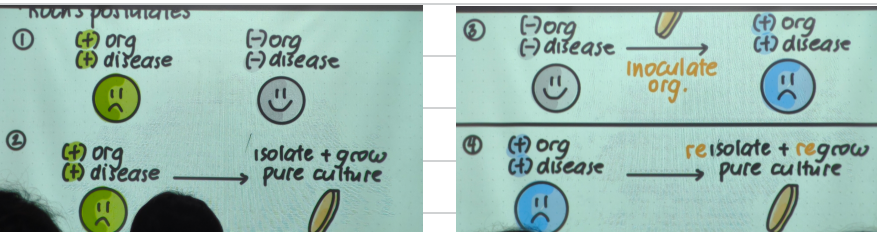
[Fundamental Concepts - History]
Koch's postulates [4]
Normal Flora
Typhoid Mary
Mycobacterium leprae
[Fundamental Concepts - History]
Exceptions for Koch's postulates [3]
b. Viridans streptococcus
[Fundamental Concepts - History]
Normal flora of the mouth/oral cavity
a. Staphylococcus epidermis
b. Viridans streptococcus
c. Bacteroides
d. Lactobacillus spp.
c. Staphylococcus epidermis
[Fundamental Concepts - History]
Normal flora of the skin
a. Viridans streptococcus
b. Bifidobacterium
c. Staphylococcus epidermis
d. Lactobacillus spp.
Bacteroides
Bifidobacterium
E. coli
Lactobacillus spp.
📌Mnemonic: “BELL”
[Fundamental Concepts - History]
Normal flora of the colon [4]
d. Lactobacillus spp.
[Fundamental Concepts - History]
Normal flora of the urethra
a. Viridans streptococcus
b. Staphylococcus epidermis
c. Bacteroides
d. Lactobacillus spp.
c. Carrier
[Fundamental Concepts - History]
Has organism but no disease
a. Infected host
b. Immune host
c. Carrier
d. Reservoir
c. Salmonella typhi
[Fundamental Concepts - History]
Typhoid Mary was a carrier of _______
a. Treponema pallidum
b. Mycobacterium tuberculosis
c. Salmonella typhi
d. Streptococcus pyogenes
Salmenollosis
Typhoid fever
[Fundamental Concepts - History]
Salmonella typhi is the causative agent of _______ [2]
Armadillo
Mouse foot pad
[Fundamental Concepts - History]
BEQ: Mycobacterium leprae requires ______ [2] animal models for study
a. Mice and rats
b. Rabbits and guinea pigs
c. Armadillo and mouse foot pad
d. Monkeys and hamsters
d. Mycobacterium leprae
[Fundamental Concepts - History]
Causative agent of leprosy (Hansen's disease)
a. Mycobacterium tuberculosis
b. Salmonella typhi
c. Treponema pallidum
d. Mycobacterium leprae
d. Hansen's disease
[Fundamental Concepts - History]
Leprosy is also known as:
a. Hansen's disease
b. Weil's disease
c. Lyme disease
d. Hansen's disease
b. Mitochondria
[Fundamental Concepts - Organisms]
BEQ: Site of the electron transport chain (ETC)
a. Nucleus
b. Mitochondria
c. Ribosome
d. Golgi apparatus
c. Dinoflagellates
[Fundamental Concepts - Organisms]
Responsible for red tide
a. Algae
b. Protists
c. Dinoflagellates
d. Methanogens
b. Prokaryote
[Fundamental Concepts - Organisms]
No true nucleus
a. Eukaryote
b. Prokaryote
b. Prokaryote
[Fundamental Concepts - Organisms]
True nucleus
a. Eukaryote
b. Prokaryote
b. Prokaryote
[Fundamental Concepts - Organisms]
Circular DNA
a. Eukaryote
b. Prokaryote
a. Eukaryote
[Fundamental Concepts - Organisms]
Linear DNA
a. Eukaryote
b. Prokaryote
b. Prokaryote
[Fundamental Concepts - Organisms]
1 chromosome
a. Eukaryote
b. Prokaryote
a. Eukaryote
[Fundamental Concepts - Organisms]
Multiple chromosome
a. Eukaryote
b. Prokaryote
b. Prokaryote
[Fundamental Concepts - Organisms]
No membrane-bound organelles
a. Eukaryote
b. Prokaryote
a. Eukaryote
[Fundamental Concepts - Organisms]
Have membrane-bound organelles
a. Eukaryote
b. Prokaryote
b. Prokaryote
[Fundamental Concepts - Organisms]
Ribosome 70S (subunits 30S and 50S)
a. Eukaryote
b. Prokaryote
a. Eukaryote
[Fundamental Concepts - Organisms]
Ribosomes 80S (subunits 40S and 60S)
a. Eukaryote
b. Prokaryote
b. Prokaryote
[Fundamental Concepts - Organisms]
Binary fission
a. Eukaryote
b. Prokaryote
a. Eukaryote
[Fundamental Concepts - Organisms]
Mitosis
a. Eukaryote
b. Prokaryote
b. Prokaryote
[Fundamental Concepts - Organisms]
Smaller average size
a. Eukaryote
b. Prokaryote
a. Eukaryote
[Fundamental Concepts - Organisms]
Larger average size
a. Eukaryote
b. Prokaryote
Eubacteria
Archaebacteria
Methanogens
[Fundamental Concepts - Organisms]
Examples of Prokaryote [3]
Fungi
Algae
Plants
Protists
Dinoflagellates
[Fundamental Concepts - Organisms]
Examples of Eukaryote [5]
d. Peptidoglycan
[Fundamental Concepts - Organisms]
Cell wall of bacteria
a. Chitin
b. Cholesterol
c. Cellulose
d. Peptidoglycan
c. Chitin
[Fundamental Concepts - Organisms]
Cell wall of fungi
a. Peptidoglycan
b. Cholesterol
c. Chitin
d. Cellulose
c. No cell wall
[Fundamental Concepts - Organisms]
Cell wall of humans
a. Peptidoglycan
b. Chitin
c. No cell wall
d. Cellulose
d. No cell membrane component
[Fundamental Concepts - Organisms]
Cell membrane of bacteria
a. Ergosterol
b. Cholesterol
c. Chitin
d. No cell membrane component
c. Ergosterol
[Fundamental Concepts - Organisms]
Cell membrane of fungi
a. Cholesterol
b. Peptidoglycan
c. Ergosterol
d. Chitin
d. Cholesterol
[Fundamental Concepts - Organisms]
Cell membrane of humans
a. Ergosterol
b. Chitin
c. Peptidoglycan
d. Cholesterol
Lag phase
Log phase
Stationary phase
Declined phase
Stages of Microbial Growth [4]
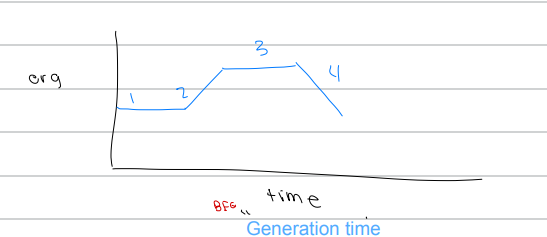
b. Generation time
[Fundamental Concepts - Microbial Growth]
Time it takes for population to double
a. Lag time
b. Generation time
c. Stationary time
d. Decline time
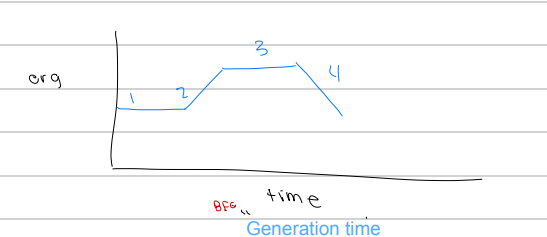
c. Lag phase
[Fundamental Concepts - Microbial Growth]
Stage of microbial growth characterized by (+) metabolism and (-) reproduction
a. Log phase
b. Stationary phase
c. Lag phase
d. Decline phase
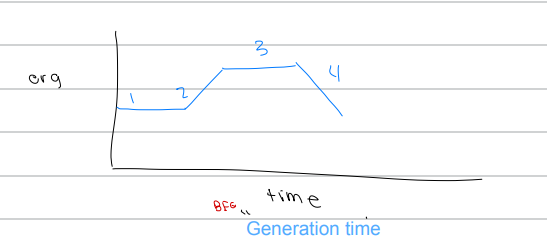
d. Log phase/Exponential phase
[Fundamental Concepts - Microbial Growth]
Stage of microbial growth where organisms are capable of reproduction
a. Lag phase
b. Stationary phase
c. Decline phase
d. Log phase/Exponential phase
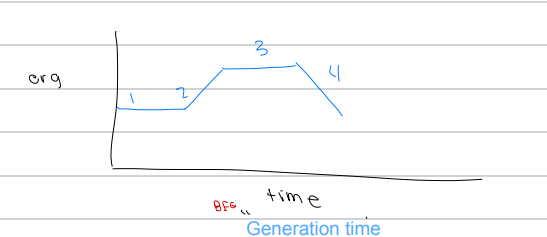
c. Log phase/Exponential phase
[Fundamental Concepts - Microbial Growth]
Target of bactericidal agents
a. Lag phase
b. Stationary phase
c. Log phase/Exponential phase
d. Decline phase
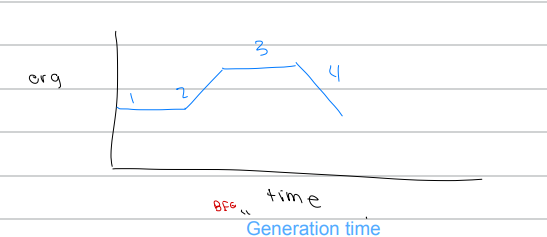
c. Stationary phase
[Fundamental Concepts - Microbial Growth]
BEQ: Stage of balance growth
a. Lag phase
b. Log phase
c. Stationary phase
d. Decline phase
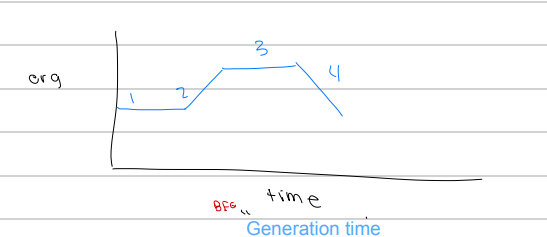
d. Decline phase
[Fundamental Concepts - Microbial Growth]
Stage characterized by decrease/death of organism
a. Lag phase
b. Log phase
c. Stationary phase
d. Decline phase
Temperature
Osmotic Pressure
Ph
[Fundamental Concepts - Microbial Growth]
Physical Requirement for Microbial Growth [3]
Oxygen
[Fundamental Concepts - Microbial Growth]
Chemical Requirement for Microbial Growth [1]
c. Psychrophile/Cryophile
[Fundamental Concepts - Microbial Growth]
Cold loving microorganism
a. Mesophile
b. Thermophile
c. Psychrophile/Cryophile
d. Halophile
d. Mesophile
[Fundamental Concepts - Microbial Growth]
Moderate temperature loving microorganism
Example: humans
a. Psychrophile
b. Thermophile
c. Halophile
d. Mesophile
c. Thermophile
[Fundamental Concepts - Microbial Growth]
Heat-loving microorganism
a. Psychrophile
b. Mesophile
c. Thermophile
d. Halophile
c. 6.5 to 7.5
[Fundamental Concepts - Microbial Growth]
pH range for microbial growth
a. 5.5 to 6.5
b. 6.0 to 7.0
c. 6.5 to 7.5
d. 7.0 to 8.0
d. >37.8°C
[Fundamental Concepts - Microbial Growth]
Temperature indicating fever
a. >36.5°C
b. >37.0°C
c. >38.5°C
d. >37.8°C
c. 5.5 to 6.5
[Fundamental Concepts - Microbial Growth]
pH range for fungi
a. 6.5 to 7.5
b. 7.0 to 8.0
c. 5.5 to 6.5
d. 4.5 to 5.5
c. Lithotroph
[Fundamental Concepts - Microbial Growth]
Uses inorganic compounds as energy source
a. Organotroph
b. Heterotroph
c. Lithotroph
d. Autotroph
d. Organotroph
[Fundamental Concepts - Microbial Growth]
Uses organic compounds as energy source
a. Lithotroph
b. Autotroph
c. Phototroph
d. Organotroph
Carbohydrates
Protein
Fats
[Fundamental Concepts - Microbial Growth]
Three essential nutrients for microbial growth
a. Vitamins, minerals, and water
b. Carbohydrates, protein, and fats
c. Nucleic acids, lipids, and glucose
d. Amino acids, fatty acids, and glucose
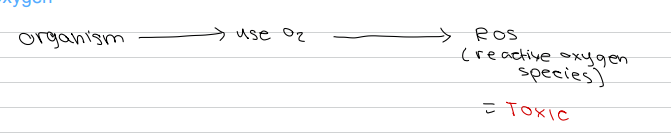
c. Reactive oxygen species (ROS)
[Fundamental Concepts - Microbial Growth]
When organisms use O₂, they produce this toxic byproduct
a. CO₂
b. H₂O
c. Reactive oxygen species (ROS)
d. H₂O₂
Superoxide dismutase
Peroxidase
Catalase
📌Mnemonic: “SPC”
[Fundamental Concepts - Microbial Growth]
Enzymes used to combat reactive oxygen species (ROS) [3]
d. Obligate aerobe
[Fundamental Concepts - Microbial Growth]
Type of organism that has superoxide dismutase, peroxidase, and catalase (S, P, C all present)
a. Obligate anaerobe
b. Facultative anaerobe
c. Microaerophile
d. Obligate aerobe
Pseudomonas
Mycobacterium
Nocardia
Leptospira
📌Mnemonic: “PMNL”
[Fundamental Concepts - Microbial Growth]
Examples of obligate aerobes [4]
c. Obligate anaerobe
[Fundamental Concepts - Microbial Growth]
Type of organism with no superoxide dismutase, peroxidase, or catalase (all absent)
a. Obligate aerobe
b. Facultative anaerobe
c. Obligate anaerobe
d. Aerotolerant anaerobe
Actinomyces
Bacteroides
Clostridium
📌Mnemonic: “ABC”
[Fundamental Concepts - Microbial Growth]
Examples of obligate anaerobes [3]
d. Facultative anaerobe
[Fundamental Concepts - Microbial Growth]
Type of organism with superoxide dismutase and catalase but no peroxidase
a. Obligate aerobe
b. Aerotolerant anaerobe
c. Microaerophile
d. Facultative anaerobe
c. E. coli
[Fundamental Concepts - Microbial Growth]
Example of a facultative anaerobe [1]
d. Aerotolerant anaerobe
[Fundamental Concepts - Microbial Growth]
Type of organism with superoxide dismutase and peroxidase but no catalase
a. Obligate aerobe
b. Facultative anaerobe
c. Microaerophile
d. Aerotolerant anaerobe