Properties of Stereoisomers
 Studied by 0 people
 Call Kai
 Learn
Learn Practice Test
 Spaced Repetition
 Match
Match Flashcards
 Knowt Play
1/8

There's no tags or description
Looks like no tags are added yet.
Name | Mastery | Learn | Test | Matching | Spaced |
|---|
No study sessions yet.
9 Terms
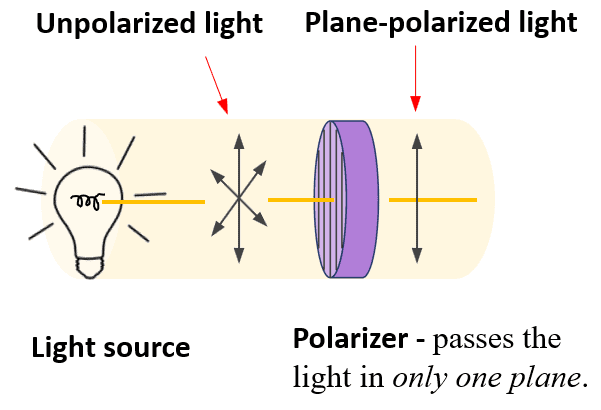
ordinary light
light vibrating in all planes (perpendicular to direction of propagation)
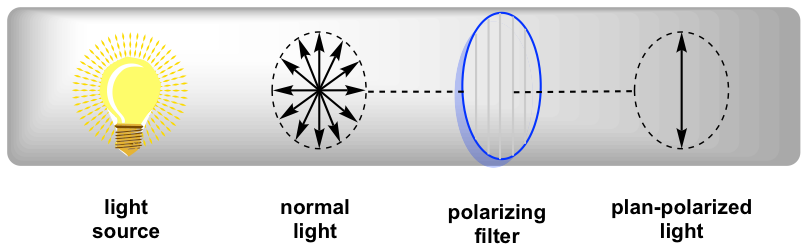
plane-polarized light
light vibrating only in parallel planes
if passes through a polarizer, forced to vibrate only in 1 plane
optically active
a compound that rotates plane-polarized light
can rotate clockwise or counterclockwise
if/when molecules are chiral ~ they can’t be superimposed on their mirror images
THINK: of your left and right hands
observed rotation
#of degrees through which a compound rotates the plane of polarized light
actual amount of light rotated during the experiment
dependent on how much of sample is used, how concentrated and length of tube
dextrorotatory (+)
rotates right/clockwise
levorotatory (-)
rotates left/counterclockwise
optical purity
sometimes called enantiomeric excess (ee), measures how much one enantiomer is present in excess over the other mixture
way to tell if 100% of one enantiomer or mixture of both
100% = only one enantiomer
0% = racemic mixture, 50:50
racemic mixture
a perfect 50:50 mix of right and left-twisting molecules
no optical activity—no net rotation
enantiomeric excess (ee)
directly tells % more of one enantiomer over the other
ee is numerically equal to optical purity
optical purity is instead experimentally determined