Week2
 Call Kai
 Learn
Learn Practice Test
 Spaced Repetition
 Match
Match Flashcards
 Knowt Play
1/104

There's no tags or description
Looks like no tags are added yet.
Name | Mastery | Learn | Test | Matching | Spaced | Call with Kai |
|---|
No analytics yet
Send a link to your students to track their progress
105 Terms
What are the 5 steps of gene cloning?
Obtain gene of interest, insert into vector, transform host cell, recover cloned DNA for QA, express cloned DNA
What does DNA Ligase do?
creates binds on the 5’ phosphate and the 3’ hydroxy group to bind DNA strands together

What is another name for a restriction enzyme
endonuclease
Why do we need to perform a Q.A after DNA recovery?
to generate a stock
to determine if the DNA sequence is correct
What is the purpose of a “miniprep”
To isolate and purify DNA
What is ampR?
A ampicillin resistance gene casette
What is ori?
the origin of replication
What is TcR?
Tetracycline resistance gene cassette?
What is a gene casette?
A gene + the compatible DNA ends
What is another name for sticky ends?
cohesive ends
What does an MCS stand for?
Multiple cloning site
What is the purpose of inserting an MCS into a vector?
Act as an easy sequence for inserting new genes
What is the key functional feature of an MCS
They contain several restriction sites of known sequences
What is the LacZ gene?
A gene inserted which, when expressed with beta-galactosidase, will turn transformed bacteria blue
What method of vector purification is in minipreps typically
Alkaline lysis
How does alkaline lysis help to purify and extract plasmids?
It exposes the DNA into a solution
What are the steps of an alkaline lysis miniprep?
centrifusion, lysoyme, NaOH, KOAc
What chemical is KOAc
Potassium acetate
What enzyme is in minipreps?
lysozymes
What must be done as a secondary Q.A once DNA is extracted?
A260/A280 purity determination
How do restriction enzymes recognize where to cut
palindromic recognition sites
What enzyme will prevent EcoR1 from cutting at its restriction site?
EcoR1 methylase
What will travel further in electrophoresis, nicked DNA or linear DNA?
nicked DNA
What is nicked DNA
DNA with one bond broken in it
What is BioLabs
Where enzymes are purchased
How do we determine the chance of a recognition site occurring in a genome?
genome total bp x (1/4^n) where n = bp length of palandrome
What DNA ligase is typically used and what energy molecule does it utilize?
T4 DNA Ligase uses ATP
Where does a T4 DNA Ligase come from?
T4 Bacteriophage
What are the two molecules which can be used for energy by DNA Ligases depending on the specific ligase?
ATP or NAD+
What is the molar mass of a histone octamer?
108kD
What is the average molar mass of a nucleotide
330g/mol
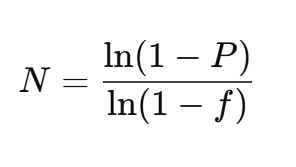
What is this formula and what do N, P and f stand for?
% confidence formula
N= number of fragments required
P = percentage confidence
f = the fraction of the genome in each fragment
How many bp are wrapped around each histone?
200
How many base pairs are wrapped around a histone after trimming?
165bp
What is the size of thin chromatin fibers?
10nm
What is the size of thick chromatin fibers?
30nm
What enzyme trims histones?
MNase
What ions are required for PCR?
Mg
What is the purpose of Mg ions in PCR?
How would you describe Taq and Pfu DNA Polymerases?
Thermostable
Where do the primers bind?
To both the 5’ and the 3’ end of the melted strands
What is a dNTP
deoxynucleotide triphosphate (free nucleotide)
Which thermostable DNA Polymerase is proofreading?
Pfu
Which thermostable DNA Polymerase isn’t proofreading?
Taq
How many cycles are peformed in PCR
30
What are the three cycles of PCR?
denaturation, annealing and extension
What temperature does denaturation occur?
over 90
What temperature does annealing occur
50
What temperature does extension occur?
72
How long is a primer typically and what GC content does it have?
17-30bp, at least 40% GC content
Why is being 17-30bp and over 40% GC content important for a primer?
prevents primers from binding to themselves (primer dimers) and the formation of hairpin loops (too short for self binding)
creates solid annealing
How is a primer Tm calculated?
What end of the DNA strand do the primers bind to?
3’ end
What does it mean for a primer in PCR to be either forward or reverse?
Why is PCR not perfectly exponential growth?
renaturation of DNA can occur preventing replication
Why must the Tm of the two primers be within 2 degrees of each other
What happens if the primer Tm is exceeded
What happens if the PCR temperature is too far under the primer Tm
What is the pGEM-T System
A commersaily avalible open vector which is complementayr to the addittional nucleotide added by Taq
in the FASTA format, which strand is the coding sequence?
The top strand
What is a 5’ 3’ exonuclease activity?
proofreading
What secondary activity does Taq Polymerase have
a terminal transferase added on the 3’ end
(additional nucleotide requiring no template)
What is the prefered addittional nucleotide to be added by Taq and why?
A, prevent self bindign
What is the name of the additional nucleotide added by Taq
terminal transferase
What are common problems with PCR
digestion efficiency, ligation efficiency, avoiding recirculation of open vector
How do you avoid recirclisation of a cut vector?
Use two restriction enzymes with non-compatible ends
What does a phosphatase do?
How does a phosphatase prevent a vector from recirculating
What do you need to ensure is removed before electroporation
What is electroporation?
What is chemical transformation
How is chemical transformation acheived
What does the calculation for transformation efficency measure?
CFU/micro gram of DNA
What is the coefficient for pico
What does bacterial competency refer to?
Ability to transform
What is a transformant?
What does it mean to study something “in vitro”
study it outside of the organisation
Why do we use restriction enzymes on the entire genome when creating a vector?
To create fragments small enough to be able to be inserted into a plasmid
What is the concept of a gene library?
When a genome is spread across multiple vectors, a gene library is created
What is commonly done with a gene libirary once it has been created?
The entire library is transformed into a capable bacterium and it contains the entire genome
Why do all plasmids require an ORI
So that the plasmid containing the target sequence can be self-replicating within the bacteria it is inserted within
What does it mean for a bacterium to be naïve?
no previous exposure to [ whatever in context ]
If using genomic DNA for insertion into vector, how is the target sequence isolated?
amplification of only the target gene by designing exclusive PCR primers
If you needed to generate DNA from a sequence where only RNA is available, how would you achieve it?
Reverse transcriptase enzyme and PCR amplification
How do we know if the bacteria has transformed with the intended DNA?
lyse the bacteria, extract the DNA and perform a sequence analysis
Why must we do a QA when producing proteins from a vector?
To ensure the expression system of the organism is creating the intended protein
Once we are sure that the sequence transformed into the bacteria is correct through sequence analysis, what is performed?
expression of the gene in the form required to be studied
What part of a phage can be used as a vector?
a phage chromosome
Do plasmids have 5’ and 3’ ends?
Not unless they are cut
How is a coding sequence represented on a plasmid diagram?
an arrow
What is a phagemid
a hybrid of a phage and a plasmid
What is refered to by ori specificity
an ori recognised by the machinery of the specific organisim it is inserted within
What is crucial when selecting a restriction enzyme?
The restriction site doesn’t appear in the target sequence
Why would you use a phagemid
To utilize phage cell machinery for the expression of the target gene
What are the two chemicals which alkaline lysis relies?
NaOH (sodium hydroxide)
KOAc (potassium acetate)
What are the 4 ingredients for alkaline lysis?
Bacterial pellet
NaOH (sodium hydroxide)
KOAc (potassium acetate)
Lysozyme
What are the two options of chemical “washes” used after alkaline lysis?
Phenol chloroform
Cesium chloride + ethidium bromide
What are the benefits and risks of using cesium chloride + ethidium bromide over phenol chloroform?
It is expensive and toxic
But can help differentiate between types of DNA
Where do you extract the DNA from in the tube?
The very bottom as that is where the plasmids are located
Protein or phenol contamination is indicated by what A230/A260 ratio
over 0.5