Critical Care HL Exam 3
 Call Kai
 Learn
Learn Practice Test
 Spaced Repetition
 Match
Match Flashcards
 Knowt Play
1/104

There's no tags or description
Looks like no tags are added yet.
Name | Mastery | Learn | Test | Matching | Spaced | Call with Kai | Chat |
|---|
No analytics yet
Send a link to your students to track their progress
105 Terms
Which opioids are used for treatment of pain in the ICU?
fentanyl, morphine, hydromorphone
Which of the following is used most often in the ICU?
A. Fentanyl
B. Morphine
C. Hydromorphone
A. Fentanyl
What are common ADRs of opioids?
Oversedation
Respiratory depression delirium
Hypotension
Decreased GI motility
What are concurrent medication options for treatment of pain in the ICU?
Acetaminophen
NSAIDs
Lidocaine
Ketamine
What are concurrent medication options for treatment of NEUROPATHIC pain in the ICU?
gabapentin and pregabalin
What are non-pharm options for pain?
music
pet
massage
temp control
relaxation techniques
What meds are used for anxiety and agitation?
benzos, propofol, dexmedetomidine
these are only used if not relieved by analgosedation for mechanically ventilated patients
What do the PADIS guidelines recommend for anti anxiety or anti agitation?
propofol or dexmedetomidine
nonbenzos to maintain a light goal of sedation and to minimize delirium
What is the onset of lorazepam via IV?
10 min
What is the onset of lorazepam via IM?
20-30 min
What is the onset of lorazepam via PO?
20-30 min
What are ADRs of lorazepam?
Anterograde amnesia
CNS effects
Neurodevelopmental (kids)
Paradoxical rxns
Propylene glycol toxicity
Withdrawal syndromes
Pain at injection site
What are clinical pearls of lorazepam?
Intermittent dosing >>> continuous infusion
Long term sedation
C/I in patients with alcohol withdrawal or risk of seizures
What is the onset of propofol bolus?
9-51 sec (averages 30 sec)
What is the duration of lorazepam?
6-8 hours
What is the duration of propofol?
3-10 min
What are ADRs of propofol?
Pain at injection site
Hypertriglyceridemia
Pancreatitis
Propofol-related infusion syndrome (PRIS)
Hypotension
Hypersensitivity (soy, egg, peanut allergies)
CV (MI, afib, etc)
What are clinical pearls of propofol?
Patient needs to be awakened rapidly for neurological evaluation
Good option for head injury with elevated intracranial pressures
Causes light sedation
What is the onset of dexmedetomidine (precedex) via IV loading dose?
5-10 min
What is the onset of dexmedetomidine (precedex) via instranasal?
10-20 min
What is the duration of dexmedetomidine (precedex)?
1-2 hours (60-240 min)
What are ADRs of precedex?
CV (hypotension, bradycardia, HTN)
Tolerance
Tachyphlaxis
Withdrawal
Constipation
NA
Agitation
Drowsiness
What are clinical pearls of precedex?
Only drug approved for sedation of non-intubated ICU patients you can extubate and continue giving this medication it does not cause respiratory depression
May require an adjunct benzo
Used for light sedation (
What are FDA approved treatments for delirium?
none, but there are ppx options
What are management strategies for delirium ppx?
Reducing benzodiazepine utilization
Patient reorientation
Improving sleep hygiene
Early mobilization
Lighter sedation strategies
What are 2 things that can be done to improve sleep for patients in the ICU?
minimize noise and light disturbances
What is the blood glucose target for patients in the ICU?
IF 2+ consecutive BG readings above 180mg/dL
→ initiate insulin continuous infusion
→ check glucose Q1-2H to reach goal < 180mg/dL
What patients are at risk for clinically upper gastrointestinal bleeding (UGIB)?
Critically ill adults with... *Coagulapathy, Shock, Chronic liver disease (CLD)
and neurocritical care adults
What are independent RF for stress-related mucosal changes?
coagulopathy and respiratory failure
What does coagulopathy mean?
platelet counts < 50,000/mm3 (INR > 1.5 or PTT >2x NL)
What does respiratory failure mean?
requiring mechanical ventilation for 48+ hours
What are relative RF of stress-related mucosal changes?
spinal cord injury, multiple trauma, hepatic failure
thermal injury (35% or more BSA), partial hepatectomy, head injury (glasgow coma score < 11), hx of ulcer/bleeds within 1 year, sepsis or septic shock, ICU stay for 1+ week, bleeding for 1+ week, and steroids
What are agents for stress-related UGIB?
PPIs > H2 receptor antagonists
Who qualifies for pharm therapy with stress-related UGIB?
patients with independent RF or 2 other RF within the ICU
When should stress ulcer ppx (SUP) be discontinued?
when RF are no longer present
What are RF of VTE?
non-modifiable: factor V leiden or hematological disorders, age 40+, family hx of thrombosis, oncological disorders, males
modifiable: immobility, meds, obesity, transfusion related, surgery or trauma
What is the dose of UFH for ppx?
5000 units 2-3x QD
What is the route of UFH, lovenox, and fondaparinux for ppx?
SQ
What is the CrCl adjustment for UFH ppx?
none
What are monitoring parameters of UFH for ppx?
Hemoglobin,
hematocrit,
platelet count,
PT,
aPTT,
S/S of bleeding,
RF for bleeding,
fecal occult blood test (if clinically indicated);
potassium.
What route is preferred for UGIB agents?
IV or enternal
What is the dose of lovenox for ppx?
40mg QD
What is the CrCl adjustment of enoxaparin (lovenox) for ppx?
decrease to 30mg QD
What are monitoring parameters for enoxaparin?
At baseline and during therapy:
Platelet count,
hemoglobin,
hematocrit,
fecal occult blood,
S/S of bleeding,
anti-factor Xa levels (as appropriate),
and serum creatinine
Monitoring of PT and/or aPTT is not necessary. Routine monitoring of anti-factor Xa activity is not required but has been utilized in patients with obesity and/or kidney insufficiency.
What is the dose of fondaparinux (arixtra) for ppx?
2.5mg QD
What are the CrCl adjustments for fondaparinux for ppx?
30-50mL/min use with caution
C/I if < 30mL/min
What are monitoring parameters of fondaparinux for ppx?
Periodically monitor CBC, platelet count, serum creatinine, occult blood testing of stools, S/S of bleeding.
Anti-Xa activity can be measured if the assay is specifically calibrated.
In patients undergoing neuraxial procedures, monitor for S/S of neurologic impairment.
What agents are used to treat constipation in the ICU?
laxatives: PEG, bisacodyl, senna
prokinetic agents: metoclopramide SOMETIMES
What agents are used to treat opioid induced constipation in the ICU?
bulk forming or osmotic laxatives: psyllium or PEG + docusate (stool softener)
What is the last line agent for opioid induced constipation (OID) in the ICU?
senna (stimulants)
What is preload?
volume in the left ventricle at the end of diastole
What is contractility?
force of the heart
What is afterload?
overall resistance to blood flow leaving the heart
What is mean arterial pressure (MAP)?
important monitoring parameters in shock with a goal of MAP > 65
How do you calculate MAP?
(SBP + 2xDBP) / 3
What are the types of shock?
hypovolemic, cardiogenic, distributive
What are causes of hypovolemic shock?
Bleeding, diarrhea, vomiting, diuretic use, diabetic ketoacidosis, diabetes insipidus, damaged skin
What main change happens in blood flow or circulation when someone has hypovolemic shock?
decreased preload
What main change happens in blood flow or circulation when someone has cardiogenic shock?
decreased myocardial contractility
What main change happens in blood flow or circulation when someone has distributive shock?
decreased afterload (and increased contractility)
What are causes of cardiogenic shock?
MI, CHF, arrhythmias, septal wall rupture
What are causes of distributive shock?
Sepsis, anaphylaxis, neurogenic
What is sepsis?
Life-threatening organ dysfunction caused by a dysregulated host response to infection (which manifests as systemic inflammation, coagulation, and tissue hypo-perfusion, potentially leading to organ dysfunction)
What is septic shock?
subset of sepsis with circulatory and cellular/metabolic dysfunction associated with a higher risk of mortality
What is the primary desired outcome of sepsis?
prevent morbidity/mortality via rapid recognition and interventions
What are examples of early implementation of sepsis therapies?
fluid resuscitation and antibiotics
What are treatment goals of sepsis?
Reduce or eliminate organ dysfunction
Eliminate source of infection
Avoid ADRs of treatment
Cost-effective therapy
Focus on infection, inflammation, hypoperfusion, and widespread tissue injury
Septic patients may require multiple simultaneous treatment regimens to achieve desired outcomes of decreased morbidity and mortality
What is the general approach to treatment of sepsis?
1. prompt recognition
2. fluids
3. broad spectrum antibiotics
4. vasopressor therapy (NE)
5. IV hydrocortisone
6. glycemic control
7. adjunctive therapies
What is the purpose of NE in sepsis?
maintain hemodynamic stability in patients with shock refractory to fluid resuscitation
What is the purpose of IV hydrocortisone in sepsis?
patients who remain hemodynamically unstable despite adequate fluid resuscitation and vasopressor support
What is the goal of glycemic control during sepsis?
140-180mg/dL
What are adjunctive therapy options for sepsis?
Blood product administration
Analgesia
Sedation
Neuromuscular blockade
Renal replacement therapy
Na bicarbonate therapy
VTE ppx
Stress ulcer ppx
Nutrition
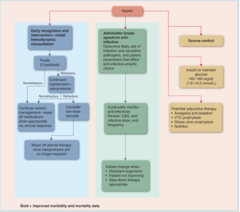
What are examples of fluids?
crystalloid vs colloid
What are examples of crystalloids?
lactated ringers (LR) and 0.9% NaCl (NS)
What are advantages of crystalloids?
preferred for initial fluid resuscitations and $
What are disadvantages of crystalloids?
Require more fluid volume, may lead to edema
Large volume of isotonic saline may increase incidence of AKI and renal replacement therapy
Precautions: risk of fluid overload, HF, renal failure, ARDS)
C/I: if large amounts are needed or hypervolumia may be harmful to patient, then avoid crystalloids
What qty is given of crystalloids?
1-2 L in the first hour and then 2-4+ L total
What are examples of colloids?
albumin 5% and 25%
What are advantages of colloids?
Can be used in which large amounts are needed and hypervolemia may be harmful to patient
Use when crystalloids are C/I
What are disadvantages of colloids?
$
C/I: Hydroxyethyl starch (HES) increase morbidity and mortality
What qty is given of colloids?
500-1000mL
What is the function of alpha receptors?
vasoconstriction in the periphery
What is the function of beta 1 receptors?
chronotropic (cardiac rate) and inotropic (myocardial contractility)
What is the function of dopaminergic receptors?
increase renal blood flow
What receptors are involved in NE (levophed)?
alpha adrenergic agent with less pronounced beta adrenergic activity
What is the effect of NE (levophed)?
increases BP through vasoconstriction with small changes in HR or cardiac index
Dose: 0.01-0.3mcg/kg/min
What is the first line vasopressor in sepsis?
NE (levophed)
What are ADRs of NE?
extravasation (tissue necrosis)
bradycardia
arrhythmia (but less than DA)
Which is more potent, NE or DA?
NE
What are the receptors and effect of DA?
1-5 mcg/kg/min: improve renal blood flow (not appropriate)
5-10 mcg/kg/min: Beta1 & mild Beta2 & Dopaminergic
10-20 mcg/kg/min: Alpha effects
*Note: receptors and effect are dose-dependent
What are ADRs of DA?
Tachycardia → leading to Arrhythmias (more than NE)
NOT used routinely in the management of septic shock.
NOT used for renal protection as part of the treatment of septic shock.
Low doses should NOT be used for renal protection as part of sepsis treatment
Can cause tissue necrosis w/ extravasation
What receptors are involved with epinephrine?
Nonspecific α- & β- adrenergic agonist
What is the effect of epinephrine?
can increase cardiac index and produce significant peripheral vasoconstriction
What are ADRs of epinephrine?
Angina, arrhythmias, cardiomyopathy, CVA, anxiety, dizziness/drowsiness
What can epinephrine be added to?
NE in patients with persistent hypotension
What receptors are involved with phenylephrine?
Fast-acting, short-acting pure α1- agonist
What are the ADRs of phenylephrine?
Least likely to cause tachycardia but may decrease stroke volume
Should be reserved for use in patients with high cardiac output in whom tachycardia or ischemia limits the use of other vasopressors
What is the effect of vasopressin?
Direct vasoconstrictor without inotropic or chronotropic effects and may result in decreased cardiac output and hepatosplanchnic flow
What are the ADRs of vasopressin?
decreased cardiac output and hepatosplanchnic flow
When do we consider vasopressin?
refractory shock